
 FRENCH
 EN
EN FRENCH
 繁体中文
繁体中文




Rotating Residential vs Static ISP vs Datacenter Proxies
Learn how to choose between rotating residential, static ISP, and datacenter proxies based on scale, session length, geographic coverage, and target difficulty.

Choosing the right proxy should start with the task rather than the price. Rotating residential proxies are built for IP diversity and geographic coverage, static ISP proxies provide a consistent identity for longer sessions, and datacenter proxies prioritize speed and affordability. Understanding these differences can help businesses avoid paying for features they do not need.
This proxy IP selection guide compares the three options and explains where each performs best. It focuses on common use cases such as web scraping, market research, ad verification, price monitoring, and browser-based automation. The goal is to help you select a proxy based on scale, session length, location requirements, and target difficulty.
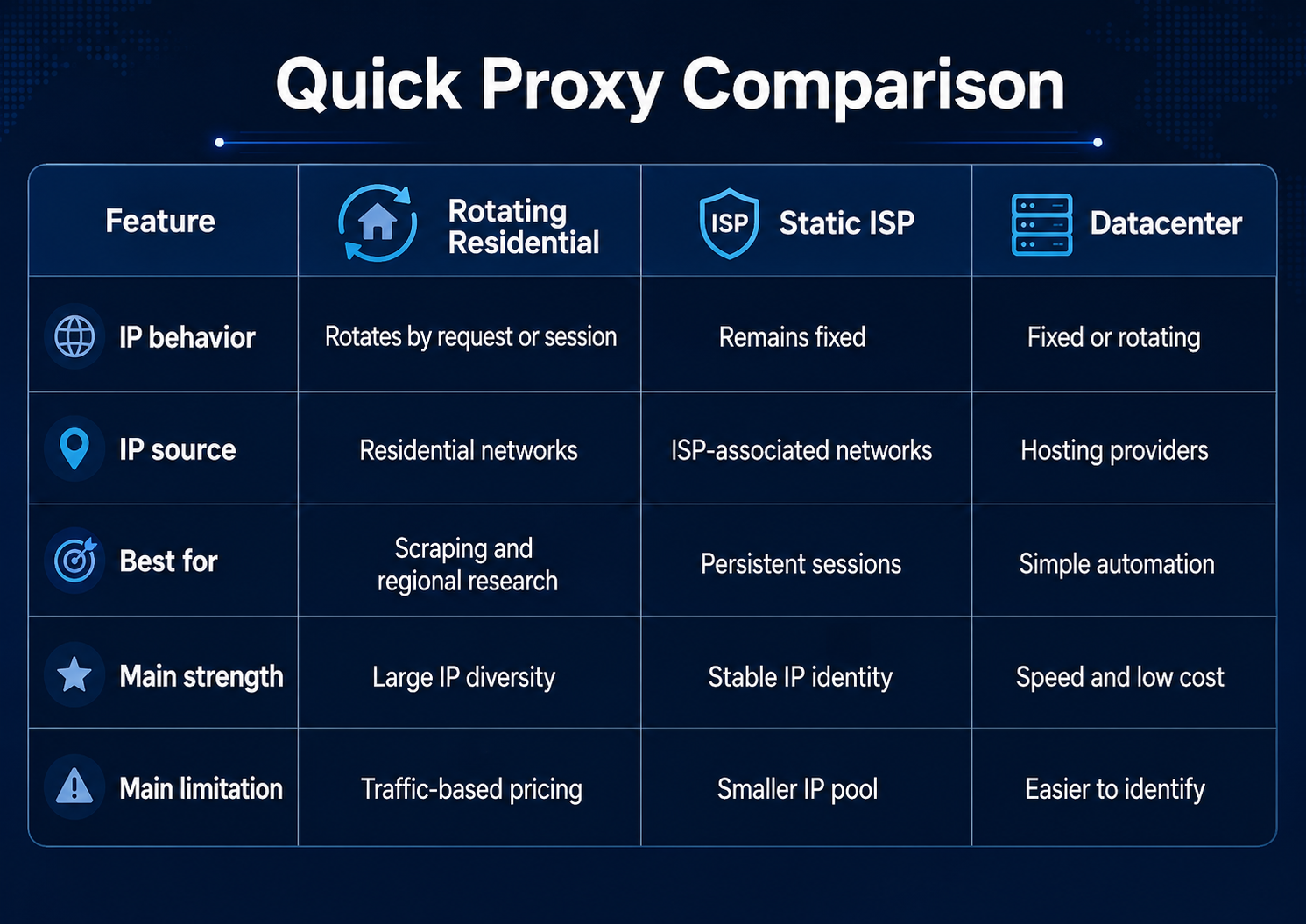
Quick Proxy Comparison
Rotating Residential Proxies
Rotating residential proxies route requests through IP addresses associated with residential internet connections. The exit IP can change after every request or remain active for a limited sticky session. This flexibility makes them suitable for projects that need many IPs without manually managing individual proxy addresses.
Their main advantage is scale. Requests can be distributed across different IPs and locations, which is useful for web scraping, price monitoring, search tracking, and localized market research. Sticky sessions can also maintain the same IP when several related pages must be accessed within one workflow.
Swiftproxy Residential Proxies support both automatic rotation and sticky sessions. This gives users the flexibility to collect public web data at scale while maintaining session continuity when required. Since residential proxy plans are usually priced by traffic, blocking unnecessary images, videos, fonts, and scripts can reduce bandwidth consumption.
Static ISP Proxies
Static ISP proxies, often called static residential proxies, provide fixed IP addresses associated with Internet Service Providers. Unlike rotating residential proxies, the same address remains available across repeated visits and longer sessions. This creates a more consistent connection identity.
They are commonly used for browser profiles, account workflows, regional testing, e-commerce operations, and continuous monitoring. A stable IP is particularly useful when a platform expects the same connection throughout a login or multi-step process. It can also support projects that require repeated access from one consistent location.
Swiftproxy Static Residential Proxies provide dedicated IPs for workflows that depend on reliable session continuity. They are better suited to persistent tasks than projects requiring thousands of rotating addresses. Their main limitation is that the available IP pool is restricted to the number of proxies purchased.
Datacenter Proxies
Datacenter proxies use IP addresses from cloud platforms, hosting companies, and server facilities. They are generally faster and more affordable than residential or ISP proxies. Their stable infrastructure also makes them useful for high-speed tasks with predictable traffic requirements.
These proxies work well for development, internal automation, basic monitoring, and websites with limited access restrictions. They may offer the best cost-to-speed ratio when geographic authenticity is not important. They are also useful for testing a scraping workflow before moving more difficult targets to residential proxies.
The main disadvantage is that hosting network addresses are easier to classify. Websites with stronger traffic controls may treat datacenter connections differently from normal residential users. This can make them less reliable for location-sensitive content, competitive data collection, and advanced ad verification.
Best Proxy for Web Scraping
Rotating residential proxies are usually the strongest choice for large-scale web scraping. Their IP diversity helps distribute requests when collecting product listings, prices, reviews, search results, or other public web data. Geographic targeting also allows businesses to compare content across multiple markets.
Static ISP proxies are better when the scraper must preserve cookies, login status, or a consistent regional identity. Datacenter proxies can remain effective for simpler websites with fewer access restrictions. Many teams use datacenter proxies for testing and move difficult targets to residential web scraping proxies.
Best Proxy for Market Research
Market research often involves comparing prices, promotions, product availability, rankings, and customer feedback across different regions. Rotating residential proxies provide the location coverage needed to view localized websites from multiple markets. They are especially useful when the research involves many countries, cities, or competitor websites.
Static ISP proxies are a better option when a company needs to monitor the same location consistently over time. A fixed IP can support repeated competitor checks without changing the connection identity between sessions. The Swiftproxy Market Research Proxy Solution supports both localized data collection and long-term regional monitoring.
Best Proxy for Ad Verification
Ad verification helps businesses confirm that campaigns appear in the correct location, language, format, and placement. Rotating residential proxies are effective when advertisements must be checked across several countries or cities. Their broad geographic coverage makes it easier to compare how campaigns appear to different local audiences.
Static ISP proxies are better for continuous monitoring from one fixed location. Datacenter proxies may provide less representative results because advertising platforms can identify hosting traffic. The Swiftproxy Ad Verification Solution supports both multi-location campaign checks and stable regional monitoring.
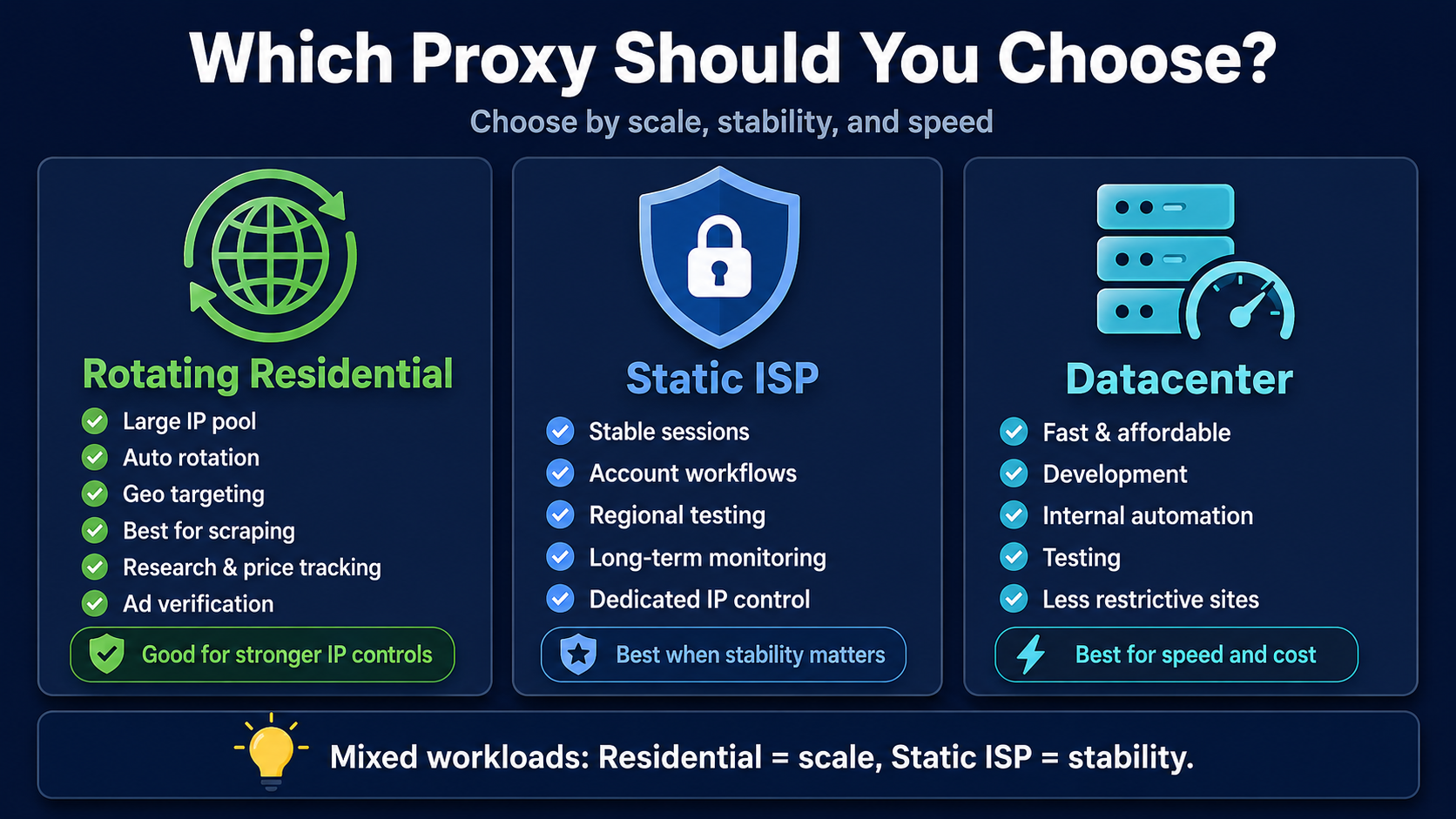
Which Proxy Should You Choose?
Choose rotating residential proxies when the project requires a large IP pool, automatic proxy rotation, geographic targeting, and scalable public web data collection. They are the most flexible option for web scraping, market research, search tracking, price monitoring, and multi-location ad verification. They are also the best starting point when the target website applies stronger IP reputation controls.
Choose static ISP proxies when session stability matters more than IP diversity. They are better for persistent browser sessions, account-based workflows, repeated regional testing, and long-term monitoring from one location. Their dedicated IP structure also provides greater control over how each proxy is assigned.
Choose datacenter proxies when speed and affordability are the main priorities. They are suitable for development, testing, internal automation, and less restrictive websites. For mixed workloads, using rotating residential proxies for scale and static ISP proxies for stability is often the most practical strategy.
Note sur l'auteur
 Solutions proxy résidentielles de haut niveau
 {{item.title}}
Articles liés

 492
492


- Veuillez fournir votre numéro de compte ou votre adresse courriel.
- Fournissez des vidéos ou des captures d'écran et décrivez simplement les problèmes auxquels vous êtes confronté.
- Notre personnel répondra à votre message dans les 24 heures.