
 FRENCH
 EN
 FRENCH
 繁体中文






Residential Proxies for SaaS Automation – Setup, Use Cases and Best Practices
Learn how residential proxies support SaaS automation, web scraping, price monitoring, and market research. Explore setup steps, proxy rotation strategies, and best practices.

SaaS platforms often rely on public web data for pricing intelligence, competitor tracking, market research, SEO monitoring, and ad verification. When these tasks span multiple countries, using a single IP address can limit geographic visibility and make automated workflows less reliable.
Residential proxies give SaaS applications access to IP addresses associated with real internet service providers. With the right proxy rotation and session strategy, they can support scalable data collection while improving regional coverage and connection flexibility.
Why SaaS Teams Use Residential Proxies
Online content is often location-dependent. Product prices, search results, ads, promotions, and even available inventory may differ between regions.
Residential proxies allow SaaS platforms to access this localized content through IP addresses from different countries or cities. They also make it easier to distribute requests instead of sending every connection through the same IP.
Common SaaS applications include
- Web scraping for product data, prices, search results, and competitor intelligence.
- Market research for regional pricing, promotions, and product availability.
- Ad verification for checking campaign placement and geographic targeting.
- SEO monitoring for analyzing search results from different locations.
For businesses building these workflows, Swiftproxy Residential Proxies provide residential IP access for automated data collection and location-based tasks.
Rotating vs Static Residential Proxies
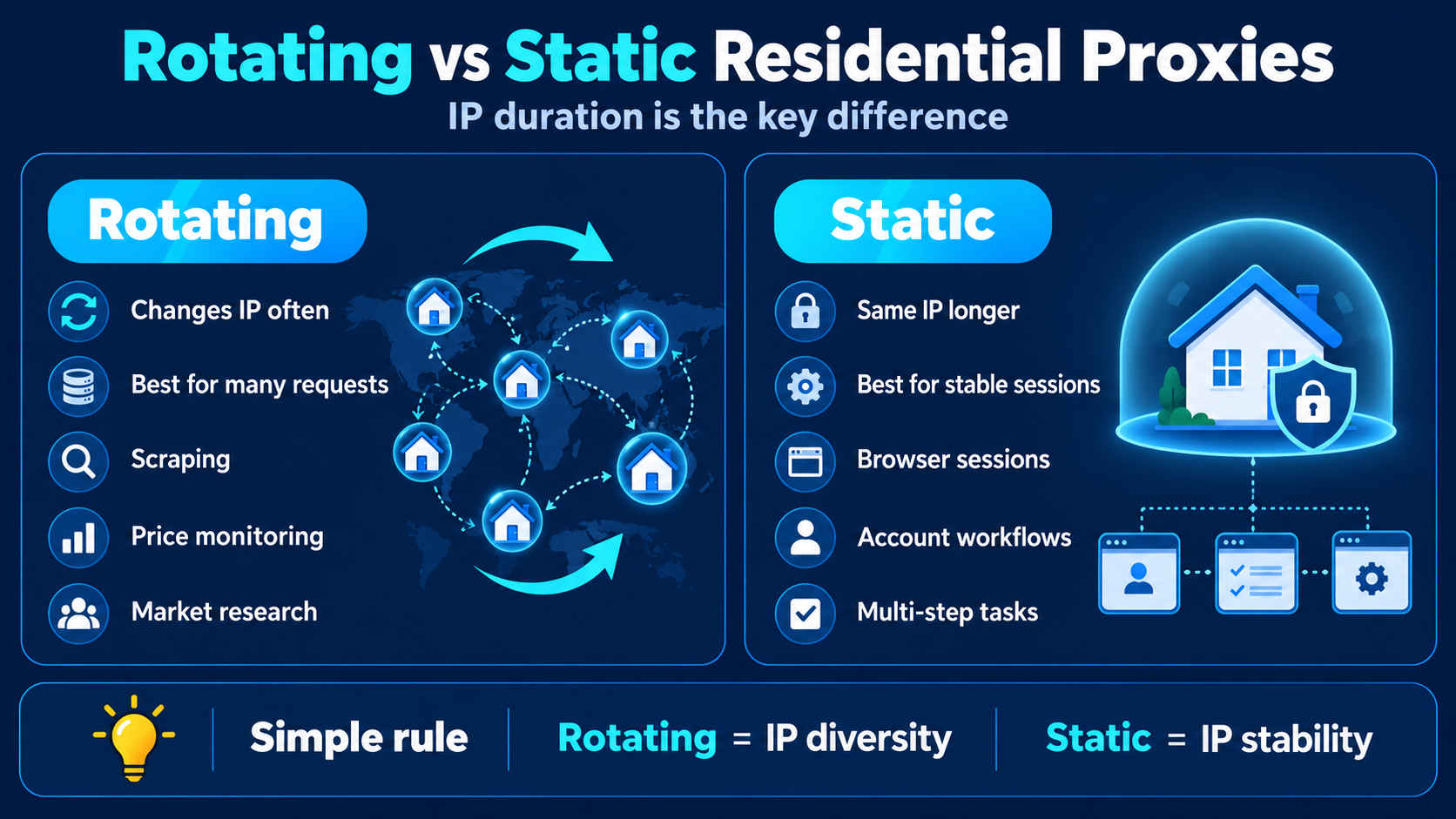
The main difference between rotating and static residential proxies is how long the application keeps the same IP address.
Rotating Residential Proxies
Rotating residential proxies automatically switch between IP addresses based on a defined rotation policy. They are best suited to workloads involving many independent requests.
A price intelligence platform, for example, may need to collect publicly available product data from thousands of pages across several markets. Rotating IPs help distribute those requests and provide broader geographic coverage.
Typical use cases include
- Large-scale web scraping
- Price monitoring
- Search data collection
- Competitive research
- Multi-region market analysis
Static Residential Proxies
Static residential proxies maintain the same IP address for longer periods. They are better suited to workflows where session continuity is more important than frequent IP changes.
Common examples include persistent browser sessions, testing environments, authorized account management, and automation tasks that involve multiple connected steps.
For these scenarios, Swiftproxy Static Residential Proxies provide stable residential IPs for applications that require consistent sessions.
The choice is straightforward. Use rotating residential proxies when IP diversity matters most and static residential proxies when maintaining the same IP is the priority.
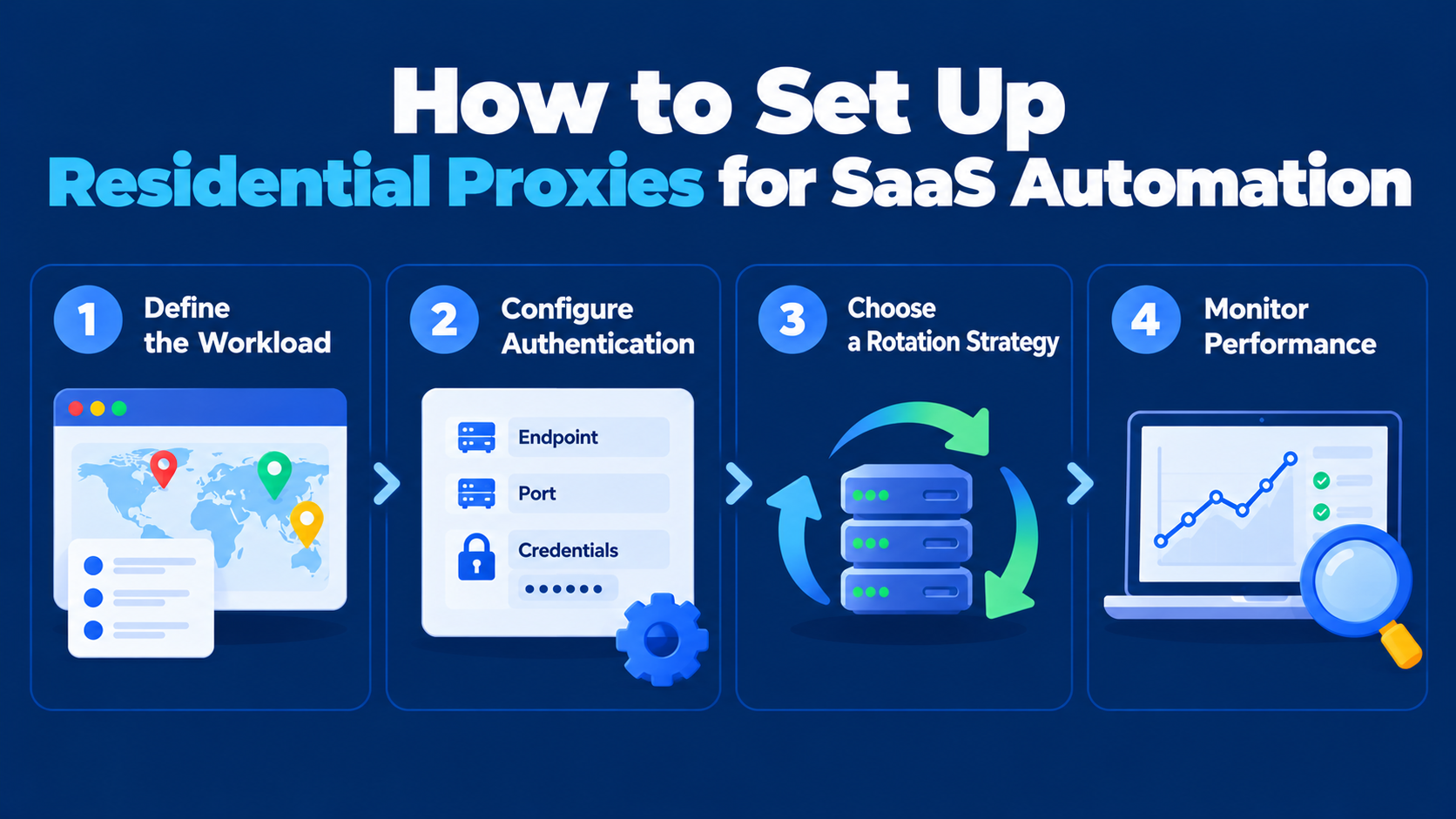
How to Set Up Residential Proxies for SaaS Automation
A reliable proxy setup should match the requirements of the application rather than applying the same configuration to every task.
Step 1 – Define the Workload
Start by identifying the target locations, expected traffic volume, request frequency, and required session length.
A market research platform collecting data from multiple countries will usually benefit from rotating IPs. A browser automation workflow that needs a stable identity for several steps may work better with static or sticky sessions.
Step 2 – Configure Authentication
Once a proxy service is selected, configure the endpoint, port, and authentication credentials inside the application.
Most HTTP clients, scraping frameworks, and browser automation tools support proxy connections directly. In production environments, credentials should be stored in environment variables or a secrets management system instead of being hard-coded.
Step 3 – Choose a Rotation Strategy
More rotation is not always better.
Independent requests can benefit from frequent IP changes, while multi-step workflows may require the same IP for a defined period. Rotation frequency should match the structure of the task rather than changing IP addresses unnecessarily.
A well-designed strategy reduces connection disruptions and makes data collection more predictable.
Step 4 – Monitor Performance
Before scaling a workflow, track request success rates, latency, bandwidth usage, and connection errors.
If performance declines, review request frequency, concurrency, retry logic, and session duration. This helps determine whether the issue comes from the proxy configuration or the application itself.
SaaS Use Cases for Residential Proxies
Web Scraping and Price Intelligence
Retail analytics platforms often need to monitor prices, promotions, and product availability across multiple markets.
Residential proxies allow these systems to access localized public pages while rotating IPs across large numbers of independent requests. This can make cross-market price monitoring more scalable and consistent.
Market Research
Market research platforms can compare how websites, products, and offers appear across different locations.
This is useful when analyzing regional pricing strategies, product launches, promotions, or competitor positioning. Geographic targeting gives analysts a clearer view of how online experiences differ between markets.
Ad Verification
Advertising campaigns can vary depending on location, audience rules, and campaign settings.
Residential proxies help ad verification systems check how ads appear in different regions. Marketing teams can use this information to monitor placement, validate geographic targeting, and identify inconsistencies between expected and actual delivery.
Best Practices for Reliable Proxy Automation
A good proxy strategy combines the right IP type with responsible request management.
SaaS teams should
- Use rotating proxies for independent, high-volume requests.
- Use static or sticky sessions when continuity is required.
- Keep request frequency appropriate for the target site.
- Set retry limits instead of repeatedly sending failed requests.
- Cache data when repeated downloads are unnecessary.
- Monitor latency, bandwidth, and request success rates.
- Protect proxy authentication credentials.
- Follow applicable laws, privacy requirements, and website access policies.
Residential proxies improve network flexibility, but reliable automation still depends on well-designed applications and sensible request behavior.
Conclusion
Residential proxies can help SaaS teams build more flexible systems for web scraping, market research, price monitoring, SEO analysis, and ad verification.
Rotating residential proxies are generally better for large-scale data collection where IP diversity matters. Static residential proxies are more suitable when an application needs a consistent IP and stable session.
By matching the proxy type to the workload and monitoring performance carefully, SaaS businesses can create more reliable and scalable automation workflows.
Frequently Asked Questions
Are Residential Proxies Suitable for SaaS Automation?
Yes. Residential proxies are commonly used for SaaS workflows involving web scraping, market research, SEO monitoring, price intelligence, and ad verification.
Their main advantages are geographic flexibility, IP diversity, and support for different session strategies.
Should I Use Rotating or Static Residential Proxies?
Use rotating residential proxies when your workload contains many independent requests and benefits from IP diversity.
Use static residential proxies when the same IP needs to remain active throughout a longer session or multi-step workflow.
Does Proxy Rotation Improve Web Scraping?
Proxy rotation can improve request distribution and regional coverage. However, reliable web scraping also depends on request frequency, retry logic, session management, data validation, and compliance with website access rules.
Note sur l'auteur
 Solutions proxy résidentielles de haut niveau
 {{item.title}}
Articles liés

 478



- Veuillez fournir votre numéro de compte ou votre adresse courriel.
- Fournissez des vidéos ou des captures d'écran et décrivez simplement les problèmes auxquels vous êtes confronté.
- Notre personnel répondra à votre message dans les 24 heures.



