
 FRENCH
 EN
 FRENCH
 繁体中文






What Is a Proxy Server? How It Works, Types & Uses
Learn what a proxy server is, how it works, and the different proxy types. Explore common uses, including web scraping, market research, SEO monitoring, and price tracking.

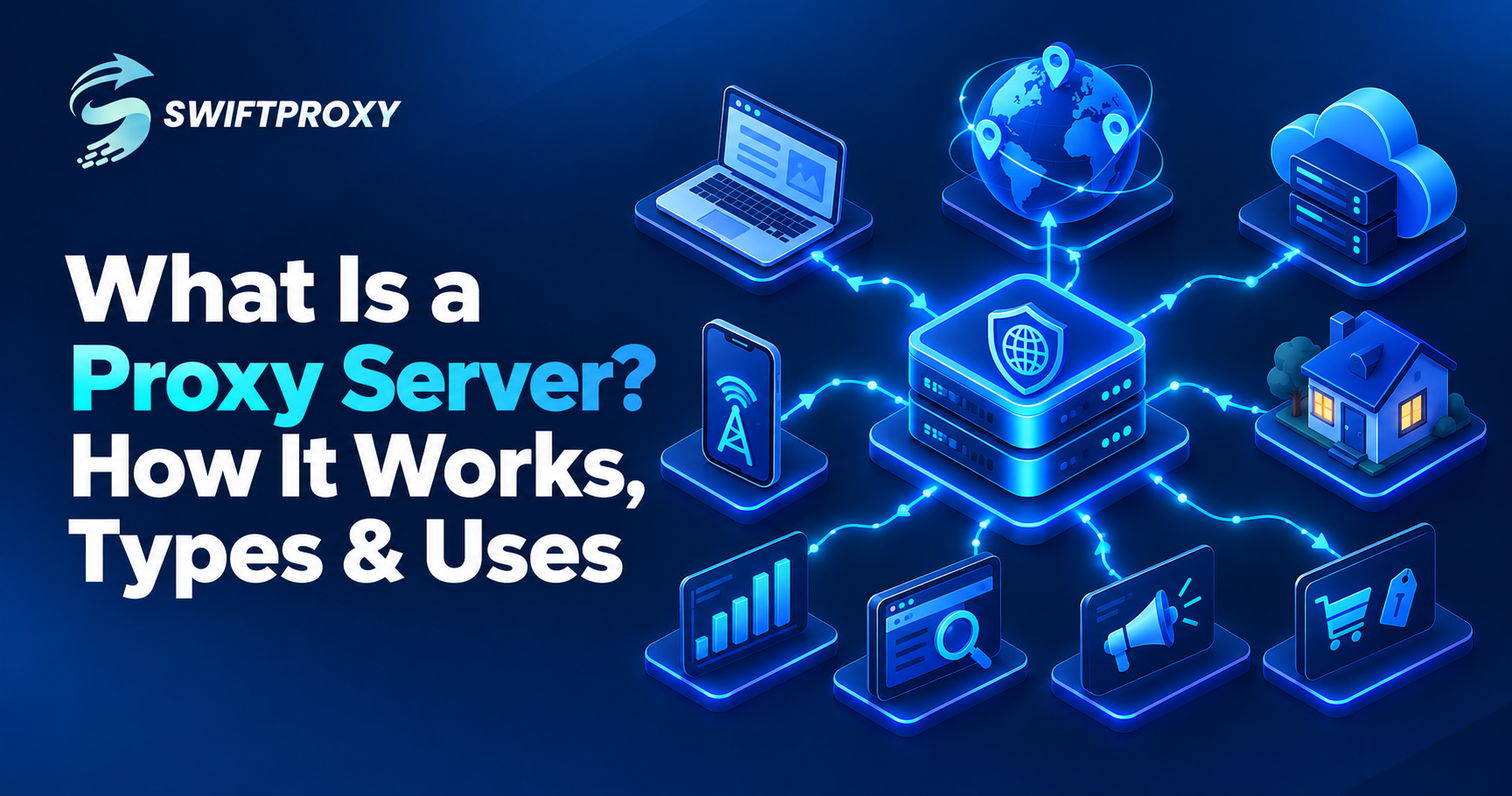
A proxy server acts as an intermediary between your device and the internet. Instead of connecting directly to a website, your request goes through the proxy first, which forwards it using a different IP address.
For businesses, this makes proxies valuable for web scraping, market research, ad verification, SEO monitoring, price tracking, and accessing location-specific public content.
How Does a Proxy Server Work
When you use a proxy, internet traffic follows a simple route
Your device → Proxy server → Website → Proxy server → Your device
The proxy receives your request and forwards it to the destination website. The website responds to the proxy, which then sends the requested content back to you.
Because the destination typically sees the proxy's IP address instead of your original public IP, requests can be routed through different IP addresses or geographic locations.
This ability is especially useful for businesses that need to collect or compare public web data across multiple markets.
Main Types of Proxy Servers
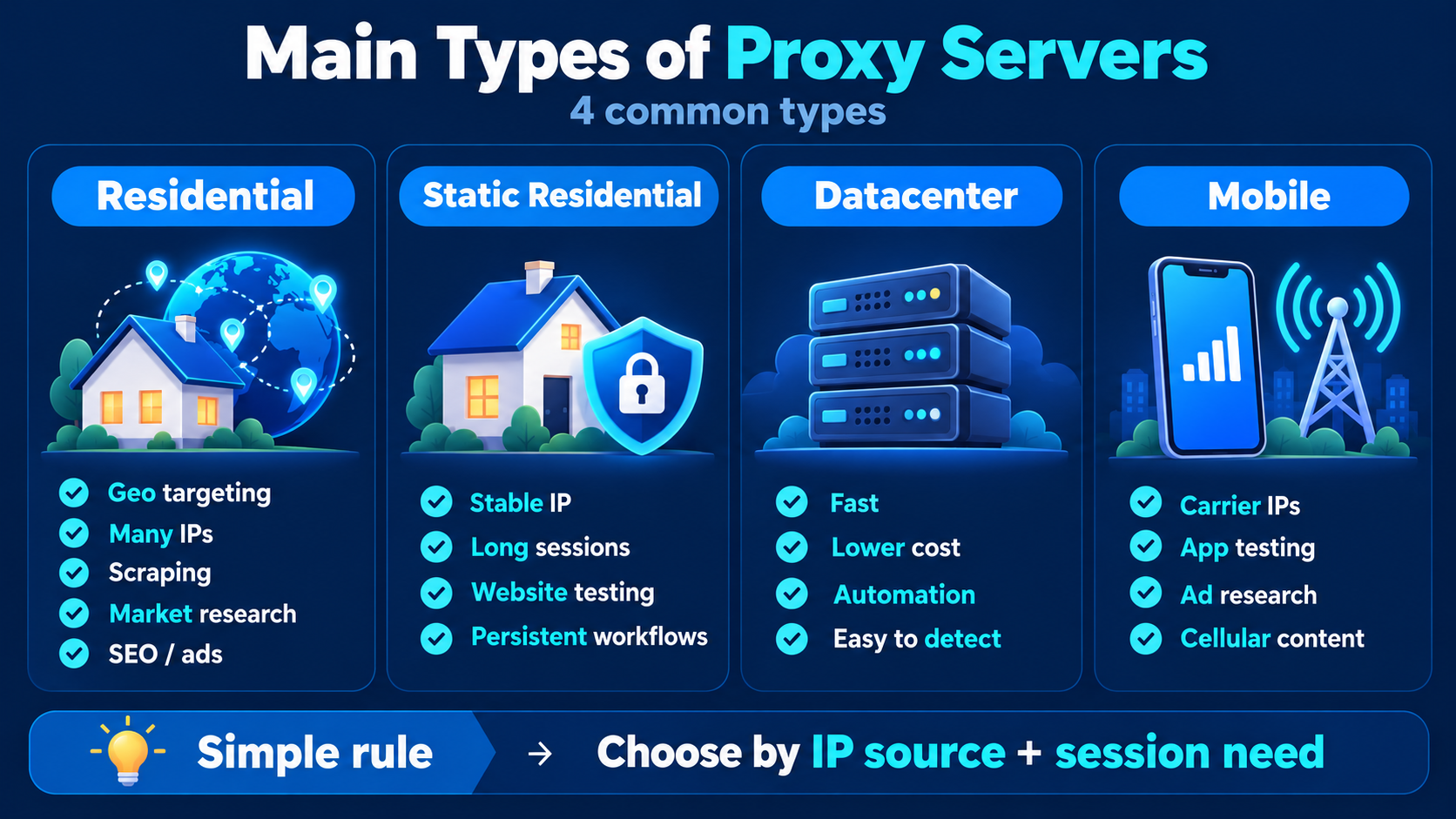
Proxy servers differ mainly in where their IP addresses come from and how long those addresses remain active.
Residential Proxies
Residential proxies use IP addresses associated with consumer internet service providers. They are commonly used when projects require geographic targeting, multiple IP addresses, or access through residential networks.
Typical applications include web scraping, market research, price monitoring, SEO tracking, and ad verification.
For projects that need flexible IP sessions, explore Swiftproxy Residential Proxies.
Static Residential Proxies
Static residential proxies, often called ISP proxies, combine residential IP characteristics with a stable IP address.
Unlike rotating residential proxies, the address remains consistent for longer periods. This makes static residential proxies a strong choice for persistent sessions, repeated website testing, and workflows where frequent IP changes are undesirable.
Learn more about Swiftproxy Static Residential Proxies.
Datacenter Proxies
Datacenter proxies use IP addresses hosted on server infrastructure rather than residential networks.
They are generally fast and cost-effective, making them suitable for automation and performance-focused tasks. However, their IP ranges may be easier for some websites to identify than residential addresses.
Mobile Proxies
Mobile proxies route requests through IP addresses associated with mobile carrier networks.
They are mainly used for mobile application testing, mobile advertising research, and checking content delivered through cellular networks.
What Is Proxy Rotation
Proxy rotation is the process of automatically changing the IP address used for internet requests.
Instead of sending all traffic through one address, rotating proxies distribute requests across a pool of IPs. This is particularly useful for large-scale data collection where relying on a single IP can limit flexibility.
Two session types are commonly used.
Rotating sessions switch IP addresses between requests or at defined intervals. They are best suited to tasks where IP diversity matters.
Sticky sessions keep the same IP for a set period, making them more appropriate when several related requests need to maintain the same session.
The choice is simple — use rotation when you need more IP diversity and sticky sessions when you need greater continuity.
What Are Proxy Servers Used For
The business value of a proxy server comes from its ability to route requests through different IPs and locations. This supports several common data-driven workflows.
Web Scraping
Web scraping enables businesses to collect publicly available information such as product listings, prices, search results, and market data.
Residential proxies help distribute scraping requests across different IP addresses and geographic locations. Proxy rotation can also reduce dependence on a single IP when collecting larger datasets.
Businesses building data collection workflows can also explore Swiftproxy Web Scraping Proxies.
Market Research
Websites may display different products, prices, promotions, or content depending on the visitor's location.
Using geo-targeted proxies allows research teams to view public websites from different markets and compare regional information more accurately. This can support competitor research, expansion planning, and pricing analysis.
Ad Verification
Digital ads can vary depending on country, region, or audience.
Proxies allow advertisers to check how campaigns and landing pages appear from different locations. This helps teams verify regional ad placement and identify inconsistencies in localized campaigns.
SEO Monitoring
Search engine results are often location-dependent.
SEO teams can use proxies to review localized SERPs, monitor keyword positions, and compare competitor visibility across different geographic markets.
Price Monitoring
Retailers and e-commerce businesses often track publicly displayed prices across competitors and regions.
Proxies make it easier to collect location-specific pricing data, which can then support pricing decisions, competitor analysis, and promotional planning.
Residential vs Static Residential Proxies
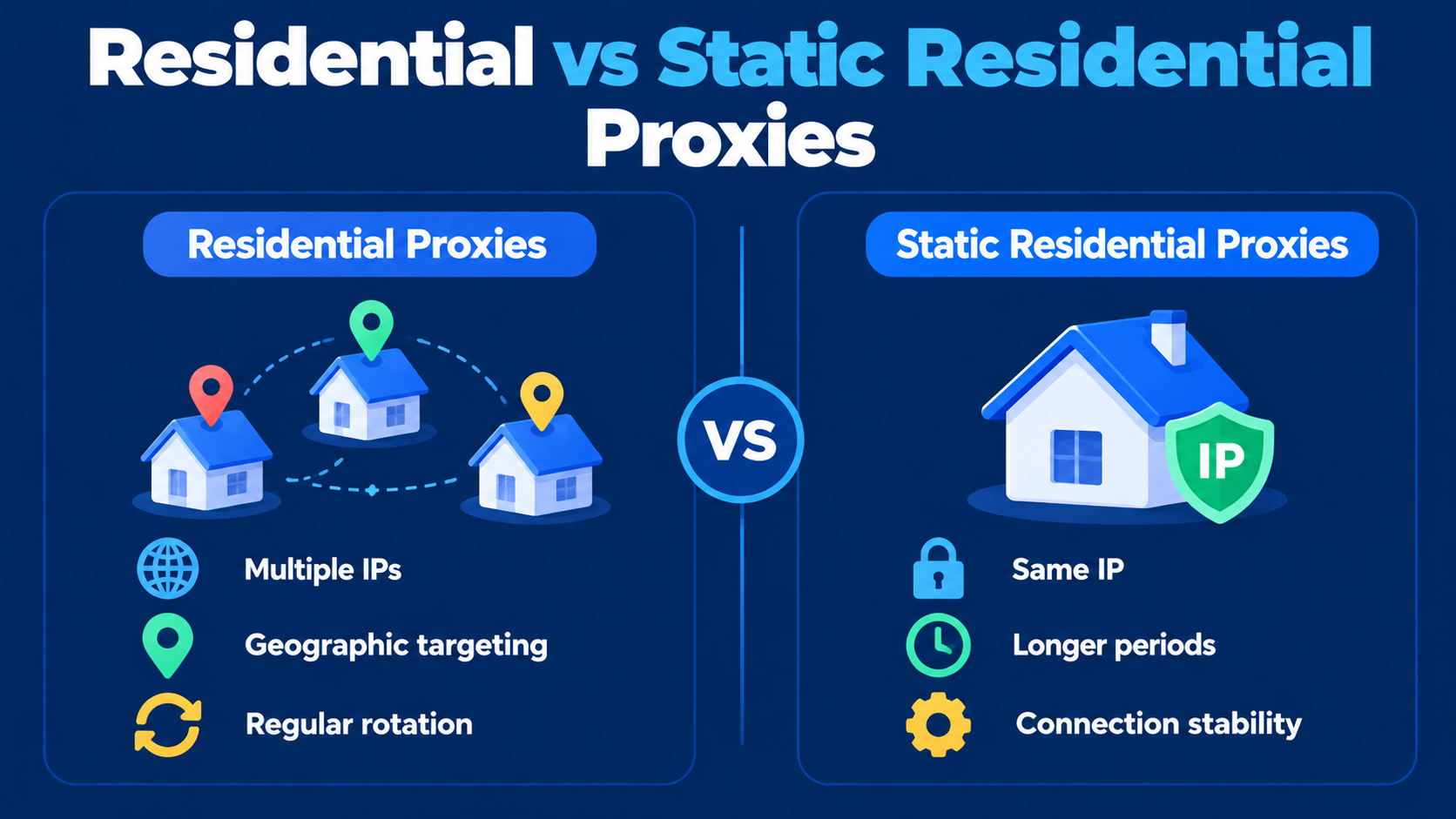
The biggest difference between residential and static residential proxies is how the IP address is managed.
Residential proxies are generally better when a project needs multiple IP addresses, geographic targeting, or regular rotation. This makes them a practical choice for web scraping, market research, SEO monitoring, and price tracking.
Static residential proxies keep the same IP for longer periods. They work better for persistent sessions and tasks where connection stability is more important than IP diversity.
In short
Residential proxies = IP diversity
Static residential proxies = IP stability
How to Choose the Right Proxy
Start with the requirements of your project.
If you need to collect public data across multiple locations or distribute requests across many IPs, rotating residential proxies are usually the better fit.
If your workflow depends on maintaining the same IP for a longer session, static residential proxies may be more appropriate.
You should also consider geographic coverage, connection reliability, rotation controls, supported protocols, authentication options, and pricing.
Most importantly, test the proxy with the websites and applications you actually plan to use. Real-world performance can vary depending on the target, location, and workload.
Why Proxy Type Matters for Business Tasks
There is no single proxy type that works best for every project.
A market research platform collecting data from several countries may prioritize residential IP diversity and geographic targeting. A long-running testing workflow may value a stable static residential IP instead.
Matching the proxy type to the task can improve connection consistency, simplify session management, and make data collection workflows easier to scale.
The goal is not simply to use more proxies. It is to use the right proxy setup for the job.
Frequently Asked Questions
What is a proxy server?
A proxy server is an intermediary that forwards internet requests between your device and a destination website using another IP address.
What is a residential proxy?
A residential proxy uses an IP address associated with a consumer internet service provider. It is often used for web scraping, market research, SEO monitoring, price tracking, and ad verification.
What is proxy rotation?
Proxy rotation automatically changes the IP address used for requests. It allows traffic to be distributed across multiple IPs instead of relying on one fixed address.
What is the difference between rotating and static proxies?
Rotating proxies regularly change IP addresses and are useful when IP diversity matters. Static proxies maintain the same IP for longer periods and are better for workflows that require stable sessions.
Can proxies be used for web scraping?
Yes. Proxies can help distribute requests and access geographically relevant public web content during scraping projects. Businesses should still comply with applicable laws, website policies, and data protection requirements.
Conclusion
A proxy server gives businesses greater control over how internet requests are routed and which IP address is presented to a destination website.
Residential proxies are well suited to web scraping, market research, ad verification, SEO monitoring, and price tracking, while static residential proxies are better for workflows that require stable IP sessions.
Choosing between them ultimately comes down to the needs of the project — use rotating residential proxies when you need IP diversity and static residential proxies when you need IP stability.
Note sur l'auteur
 Solutions proxy résidentielles de haut niveau
 {{item.title}}
Articles liés

 495



- Veuillez fournir votre numéro de compte ou votre adresse courriel.
- Fournissez des vidéos ou des captures d'écran et décrivez simplement les problèmes auxquels vous êtes confronté.
- Notre personnel répondra à votre message dans les 24 heures.



