
 FRENCH
 EN
 FRENCH
 繁体中文






Residential Proxies Explained: How They Work, What They Cost, and How to Pick One
This guide explains how residential proxies work, how providers source their IPs, and the key differences between rotating and static residential proxies. It compares pricing models, highlights common billing pitfalls, and shares practical tips for evaluating IP pool quality, success rates, speed, targeting options, and customer support to help you choose a reliable provider and avoid unnecessary costs.

Last year I burned through three proxy providers in two months. One had a pool so small I kept hitting the same IPs on my target sites. Another billed me for 40 GB I never used. The third one worked fine, and that's the one I still pay for.
That trial-and-error cost me around $400. This article exists so you don't repeat it.
What a Residential Proxy Actually Is
A proxy server sits between your machine and the website you're visiting. Your request goes to the proxy first, the proxy forwards it, the site sees the proxy's IP instead of yours. Cloudflare's learning center has a solid breakdown of how proxy servers route traffic if you want the networking fundamentals.
Residential proxies take this one step further. The IP you're borrowing doesn't come from a datacenter. It belongs to a real household. An ISP like Comcast or Deutsche Telekom assigned it to someone's router, and that IP has years of normal browsing history attached to it.
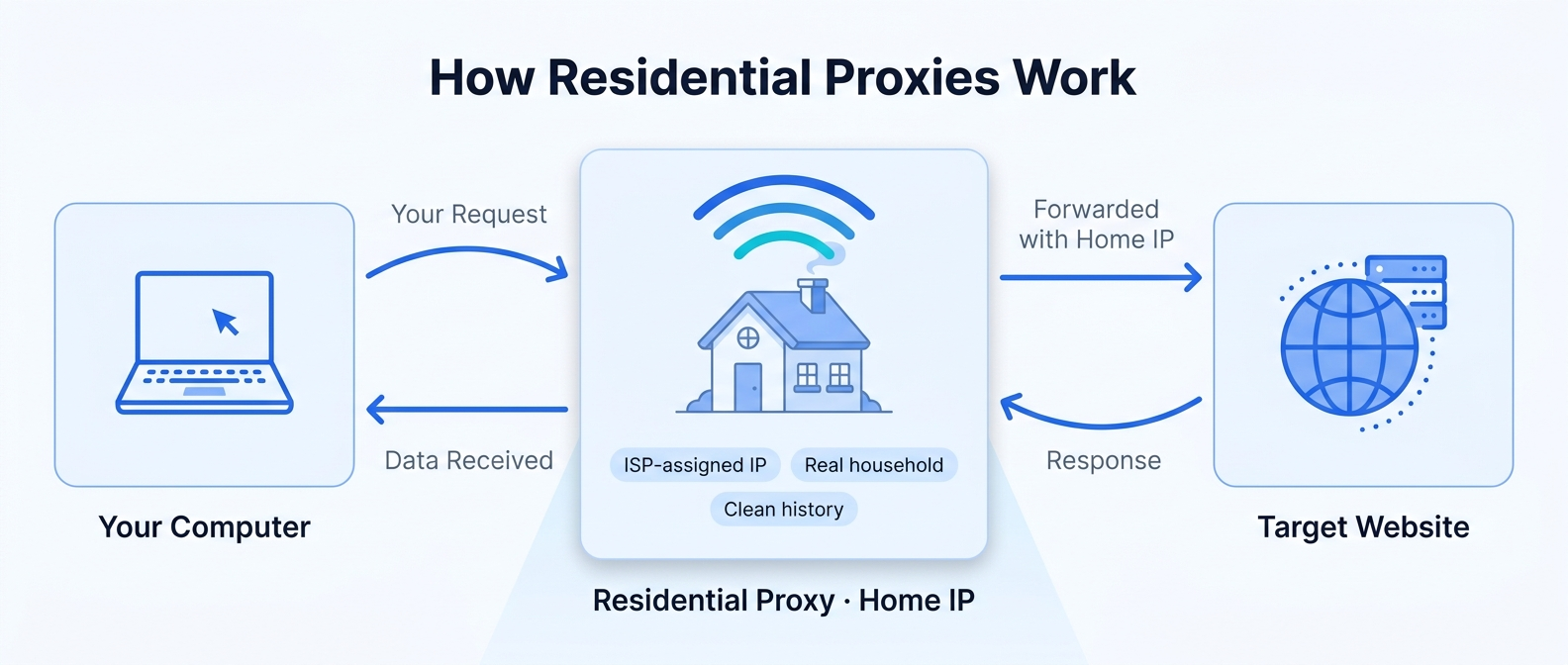
Why does that matter? Because websites treat IPs differently. A datacenter IP screams "I'm a script." A residential IP whispers "I'm a guy on a couch watching Netflix." Anti-bot systems check IP type before they check anything else, and datacenter ranges get flagged in milliseconds.
And websites are paranoid for a reason. According to Imperva's 2025 Bad Bot Report, bad bots now make up 37% of all internet traffic, and automated traffic overall has passed human activity. Over half the web is machines talking to machines. So yes, your innocent price-monitoring script gets treated like a criminal until it proves otherwise.
Where the IPs Come From
This part makes people uncomfortable, so let's just say it plainly.
Providers build their pools through apps. Someone installs a free VPN or a weather app, buries consent in the terms, and their bandwidth joins the pool while the phone sits idle. Reputable providers pay app developers per user, require explicit opt-in, and let people leave anytime. Sketchy ones don't.
I've tested pools where IPs stayed online for weeks, meaning a real stable household connection. And I've tested pools where IPs dropped mid-request every few minutes, meaning people were closing the app or losing Wi-Fi. The difference in success rate was brutal: 97% versus 74% on the same target.
Ethics aside, this affects you practically. Ask a provider how they source IPs. If they dodge the question, walk away. Some companies have been sued over this stuff, and you don't want your scraping operation tangled in that.
The Market Is a Mess, So Compare Before You Pay
Here's the annoying truth. There are 30+ serious residential proxy providers right now, and their pricing pages are designed to confuse you. Different GB definitions, different rotation options, "starting at" prices that double once you pick a real plan.
Before you commit to anything, look at an independent comparison of residential proxy services that ranks providers on pool size, speed, and actual cost per GB. It'll save you a week of reading marketing pages that all say the same thing.
I wish someone had handed me a ranking like that before my $400 experiment. Instead I learned that "99% success rate" on a landing page means "99% on Google.com, 61% on the site you actually need."
Rotating vs. Static: Pick Your Poison
Two flavors. Rotating proxies give you a new IP every request, or every few minutes if you set sticky sessions. Static residential (sometimes called ISP proxies) keep one IP for as long as you want.
Rotating is what you want for scraping at scale. Ten thousand product pages, ten thousand different IPs, nobody notices a pattern. Sticky sessions matter when the target needs continuity, like a checkout flow or a logged-in dashboard. I usually set 10-minute sessions. Long enough to finish a task, short enough to stay cheap.
Static residential costs more per IP but behaves like a real home connection that never changes. Good for managing accounts. Bad for bulk scraping, because one IP making 5,000 requests an hour gets noticed no matter how residential it looks.
What This Stuff Actually Costs
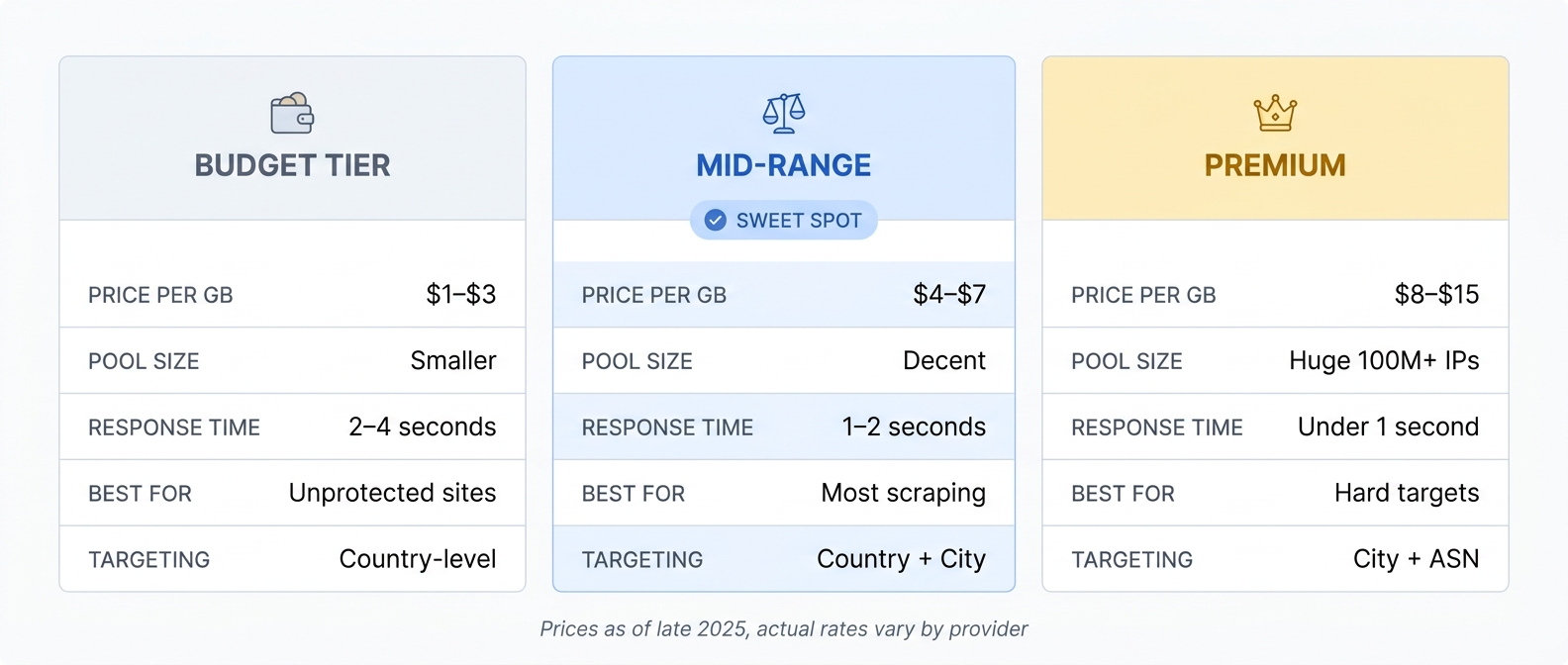
The standard model is pay-per-GB. Rough market picture as of late 2025:
- Budget providers: $1 to $3 per GB. Fine for unprotected targets. Expect smaller pools and slower response times.
- Mid-range: $4 to $7 per GB. The sweet spot for most scraping work. Decent pools, decent support.
- Premium tier: $8 to $15 per GB. Huge pools, city-level targeting, account managers. Worth it only if your targets fight back hard.
Watch the traps. Some providers sell "unlimited bandwidth" plans that throttle you after a hidden threshold. Others expire your unused traffic after 30 days, which is how I lost that 40 GB I mentioned earlier. Pay-as-you-go with no expiration exists. Find it.
One more thing about cost. Success rate changes the real price. A $2/GB provider with 70% success costs you more per successful request than a $5/GB provider at 98%. Do the math with your own targets, not their marketing numbers.
How I'd Pick a Provider Today
After two years of running scrapers for e-commerce and SEO projects, my checklist looks like this.
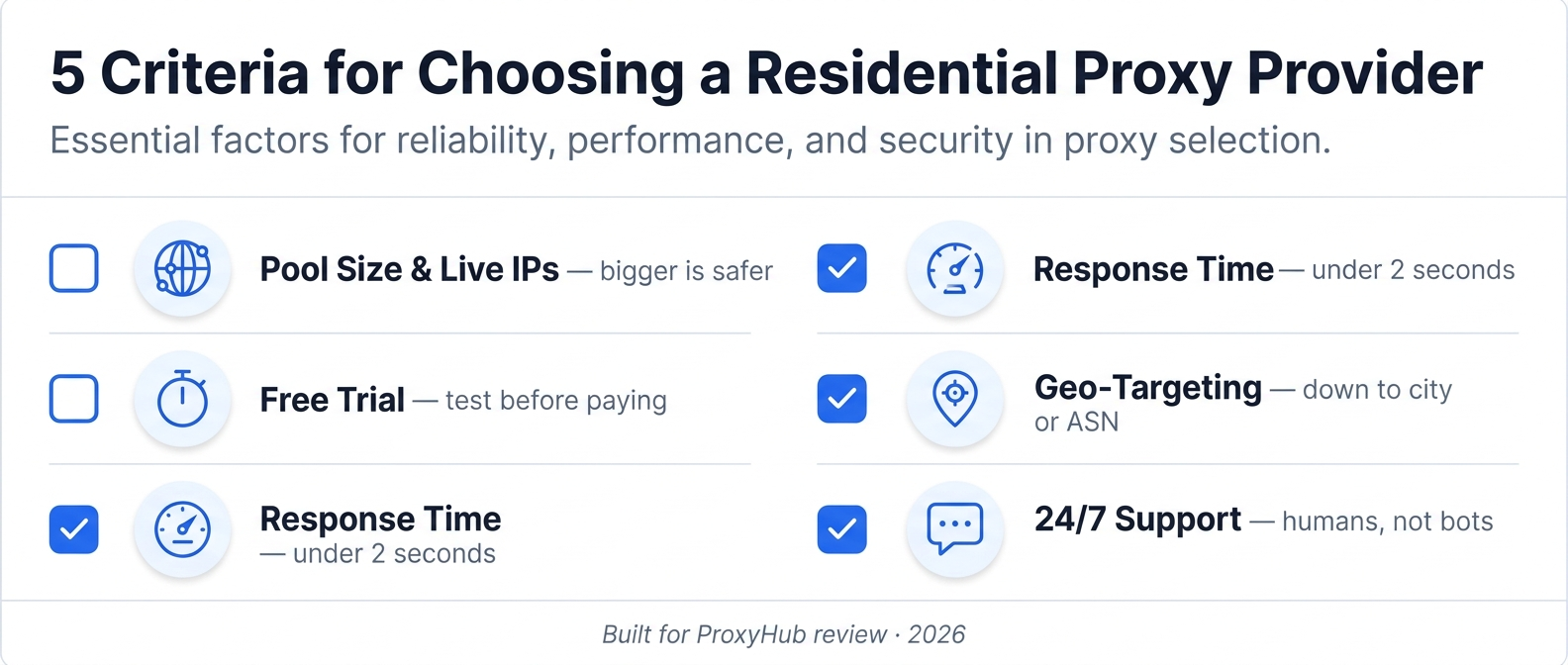
- Pool size and honesty about it. Everyone claims "millions of IPs." Ask how many are online concurrently in your target country. A 100-million pool with 8,000 live US IPs is an 8,000-IP pool for your purposes.
- A real free trial. Not a demo call. Actual traffic you can point at your actual target. I run 500 test requests and measure success rate, average response time, and how many IPs repeat. Any provider refusing a trial is hiding something.
- Response time under 2 seconds. Residential proxies are slower than datacenter ones by nature. That's the tax you pay for looking human. But 5-second responses mean overloaded exit nodes, and your scraper will crawl.
- Targeting granularity. Country-level is standard. City-level matters for local SEO and classifieds. ASN targeting is niche but gold when you need it, like when a site blocks one specific carrier.
- Support that answers at 2 AM. Scrapers break on weekends. I've had providers fix a dead gateway in 20 minutes via live chat, and I've had tickets sit unanswered for four days. Guess which provider I still use.
Mistakes I See People Make
Buying datacenter proxies for protected targets because they're cheaper. They're cheaper because they don't work there. You'll spend the difference on CAPTCHA solvers and still fail.
Rotating on every request when the site needs sessions. Your cart empties, your login drops, and you blame the proxies when it's your own configuration.
And the classic: judging a provider by its homepage benchmark. Test on your target. Always. A pool that's amazing for sneaker sites can be useless for real estate listings, because different sites run different anti-bot stacks.
Wrapping Up
Residential proxies are a solved problem in 2025, but the market makes it feel unsolved. The tech works. The pricing pages don't.
Figure out your use case first. Rotating for volume, static for accounts. Then test two or three providers against your real targets with a stopwatch and a spreadsheet. A week of testing beats a month of regret, and it definitely beats my $400 education.
Note sur l'auteur
 Solutions proxy résidentielles de haut niveau
 {{item.title}}
Articles liés

 24



- Veuillez fournir votre numéro de compte ou votre adresse courriel.
- Fournissez des vidéos ou des captures d'écran et décrivez simplement les problèmes auxquels vous êtes confronté.
- Notre personnel répondra à votre message dans les 24 heures.



