
 English
 EN
EN FRENCH
 繁体中文
繁体中文




What Is a Residential Proxy? How It Works, Benefits and Use Cases
Learn what residential proxies are, how they work, their key benefits, common use cases, and how to choose the right proxy solution for your business.

Residential proxies route internet traffic through IP addresses associated with real internet service providers. Because these IPs resemble regular consumer connections, they are widely used for web scraping, price monitoring, SEO research, ad verification, and other location-sensitive tasks.
For businesses that need reliable access to public web data, residential proxies provide greater IP diversity and geographic flexibility than relying on a single connection.
What Is a Residential Proxy
A residential proxy is an intermediary server that replaces your original IP address with a residential IP.
When you visit a website through the proxy, the destination sees the proxy IP instead of your own. Since residential IPs are associated with real ISP networks, they generally appear more like ordinary internet traffic than datacenter IPs.
Swiftproxy's Residential Proxies provide access to a global residential IP network with rotating and sticky session options, making them suitable for both large-scale data collection and workflows that require session consistency.
How Do Residential Proxies Work
The process involves three simple steps.
Your device sends a request to the residential proxy server. The proxy forwards that request using a residential IP address, and the target website returns its response through the proxy.
This means the website interacts with the proxy IP rather than your original address.
Depending on the configuration, the IP can rotate automatically between requests or remain unchanged for a specific session. This flexibility allows businesses to adapt proxy behavior to different projects.
Rotating vs Static Residential Proxies
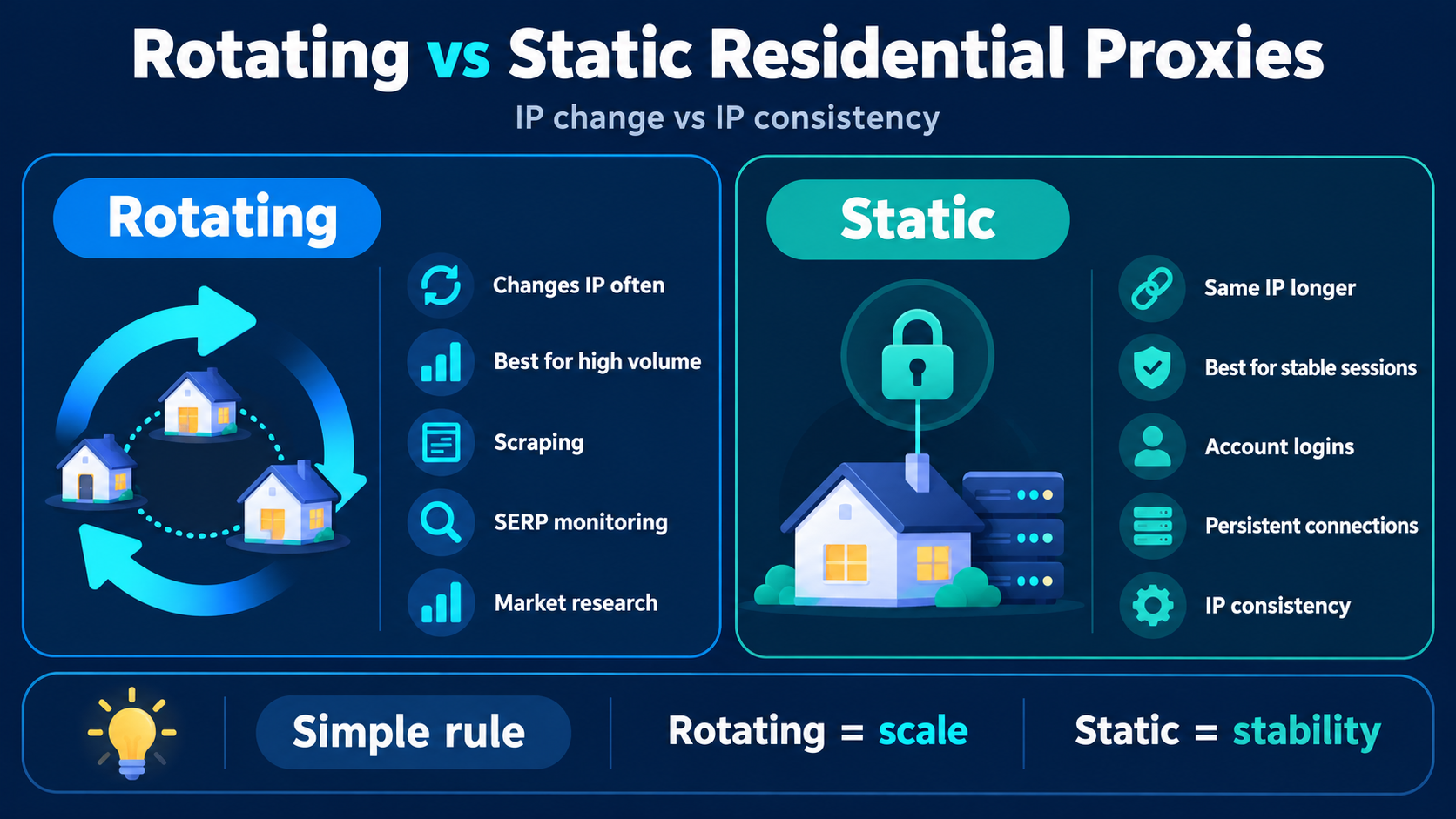
Residential proxies generally fall into two categories.
Rotating residential proxies regularly switch IP addresses. They are ideal for tasks involving a high volume of requests, including web scraping, SERP monitoring, and large-scale market research.
Static residential proxies keep the same IP for a longer period. They are better suited to account sessions, persistent connections, and workflows where IP consistency matters.
Swiftproxy also offers Static Residential Proxies for projects that require stable residential IPs and longer-lasting sessions.
Key Benefits of Residential Proxies
Residential proxies are popular because they combine genuine ISP-based IP addresses with flexible network controls.
Key benefits include:
- Better IP authenticity — Residential addresses resemble normal consumer connections.
- Geo-targeting — Access region-specific search results, prices, ads, and public content.
- IP rotation — Spread requests across multiple addresses instead of relying on one IP.
- Session flexibility — Choose between rotating IPs and persistent sessions.
- Scalability — Handle anything from small research tasks to high-volume data collection.
These features make residential proxies useful when websites apply rate limits, regional restrictions, or automated traffic filtering.
Common Residential Proxy Use Cases
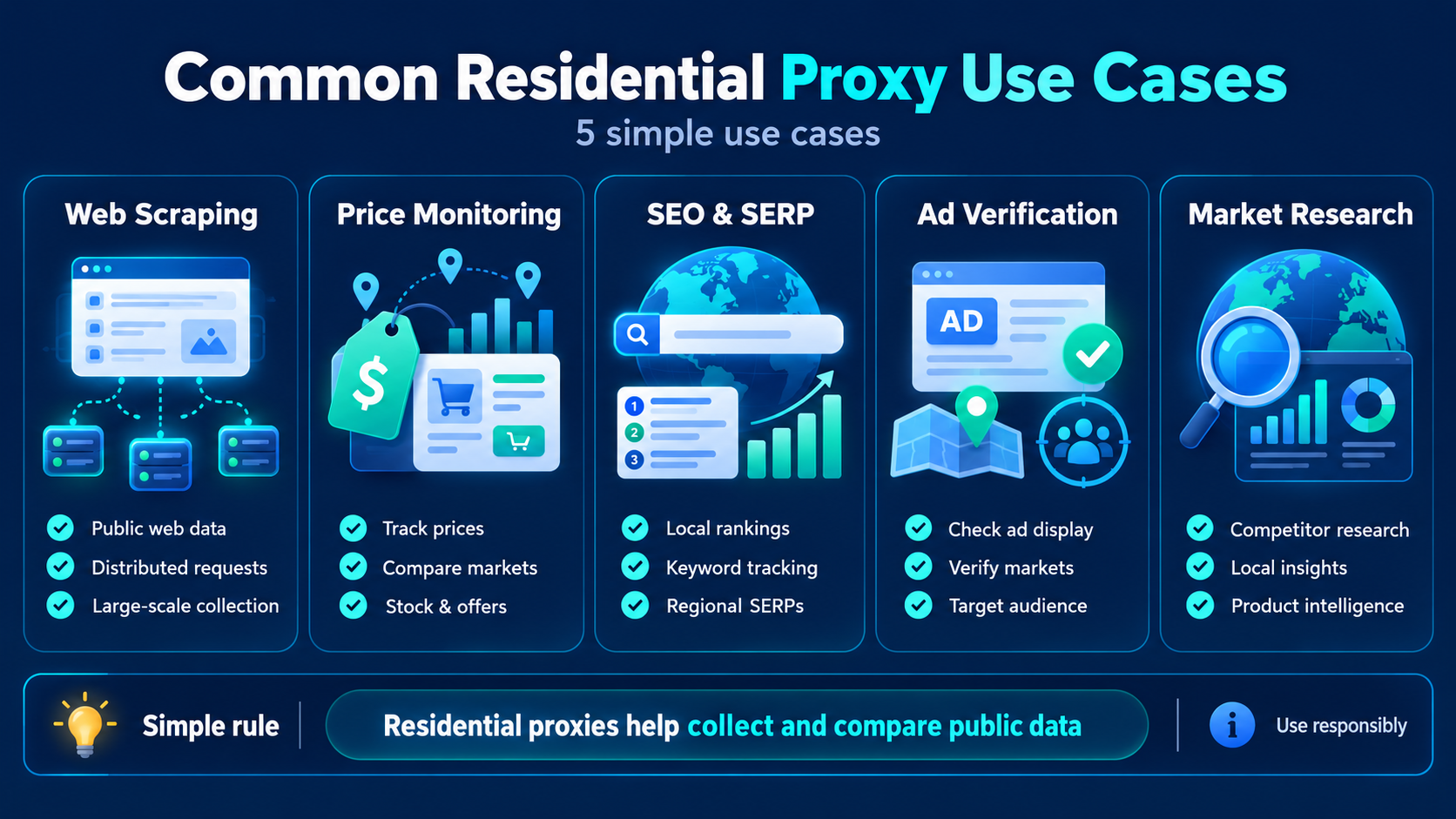
Web Scraping
Residential proxies help businesses collect publicly available web data while distributing requests across multiple IP addresses.
This is particularly useful for large-scale projects where sending every request from the same IP may lead to rate limits or access restrictions. Swiftproxy's Web Scraping Proxies are designed for scalable public data collection.
Price Monitoring
Ecommerce teams can track product prices, promotions, stock levels, and competitor listings across multiple locations.
Using geographically targeted residential IPs also helps businesses understand how prices and offers differ between markets.
SEO and SERP Monitoring
Residential proxies allow SEO teams to view search results from different countries or regions.
This makes it easier to monitor local rankings, competitor visibility, keyword performance, and regional SERP changes.
Ad Verification
Advertisers can use residential IPs to check how ads appear in different markets and verify whether campaigns are being displayed to the intended audience.
Market Research
Businesses can gather localized public information to support competitor research, market analysis, product intelligence, and strategic decision-making.
Residential Proxies vs Datacenter Proxies
The biggest difference is the source of the IP address.
Residential proxies use IPs associated with consumer internet service providers, while datacenter proxies originate from hosting providers, servers, or cloud infrastructure.
Datacenter proxies are often fast and economical. Residential proxies, however, are generally better suited to tasks where IP reputation, regional targeting, and traffic authenticity are important.
Neither option is universally better. The right choice depends on the requirements of the project.
How to Choose a Residential Proxy Provider
A good residential proxy provider should offer more than a large IP pool.
Look for reliable global coverage, country or city targeting, rotating and sticky sessions, protocol support, stable connections, flexible concurrency, and pricing that matches your usage model.
Swiftproxy currently provides residential coverage across more than 195 locations and supports HTTP(S) and SOCKS5 protocols, together with rotating and sticky session options.
For high-volume scraping, rotating IPs are usually the better choice. For workflows that require a consistent identity or longer connection, static residential proxies may be more appropriate.
Are Residential Proxies Legal
Residential proxies are legitimate networking tools, but their legality depends on how they are used.
Users should follow applicable laws, privacy regulations, website terms, and data protection requirements. Businesses should also ensure that data collection activities are lawful and focused on legitimate purposes such as public data research, SEO analysis, pricing intelligence, and ad verification.
Final Thoughts
Residential proxies offer a practical way to access the web through ISP-associated IP addresses while gaining greater control over location, IP rotation, and session behavior.
They are particularly useful for web scraping, price monitoring, SEO research, advertising, and market intelligence. Choosing between rotating and static residential proxies ultimately depends on whether your project prioritizes IP diversity or connection consistency.
With the right proxy setup, businesses can build more stable, scalable, and location-aware web data workflows.
About the author
 Top-tier residential proxy solutions
 {{item.title}}
Related articles

 443
443


- Please provide your account number, or email address.
- Provide videos or screenshots, and simply describe the problems you are facing.
- Our staff will reply to your message within 24 hours.