
 English
 EN
EN FRENCH
 繁体中文
繁体中文




How to Crawl Large Lists Without Getting Blocked Using Residential Proxies
Learn how to crawl large-scale product lists and search results without getting blocked, leveraging residential proxies, rate control, and smart rotation strategies.

Crawling a few pages is simple. Crawling thousands of product listings, search results, prices, or business records is much harder.
As request volume increases, crawlers may encounter 403 errors, 429 rate limits, CAPTCHA challenges, and unstable connections. Reliable large-scale web scraping therefore requires controlled request behavior and the right proxy strategy.
Residential proxies can distribute traffic across different IP addresses, while proxy rotation reduces the pressure placed on a single IP. Static residential proxies are better suited to workflows that need a consistent IP for longer sessions.
Why Large-Scale Crawling Gets Blocked
Websites can evaluate request volume, IP reputation, session behavior, and traffic patterns. Sending hundreds or thousands of requests from one IP in a short period can quickly trigger rate limits or temporary restrictions.
Common warning signs include:
- HTTP 403 Forbidden
- HTTP 429 Too Many Requests
- CAPTCHA challenges
- Connection failures
- Incomplete responses
A proxy can reduce IP concentration, but it should be combined with reasonable request rates, retry logic, and session management.
How Residential Proxies Help Web Scraping
A residential proxy routes requests through IP addresses associated with residential networks. This gives crawlers access to a larger IP pool and allows requests to originate from different geographic locations.
Swiftproxy Residential Proxies support both rotating and sticky connections. Rotating sessions are useful for large numbers of independent requests, while sticky sessions help maintain continuity across multiple requests.
Residential proxies are commonly used for:
- Web scraping
- Price monitoring
- SEO research
- Market research
- Ad verification
They are especially useful when websites display different prices, search results, products, or advertisements depending on location.
Rotating vs Static Residential Proxies
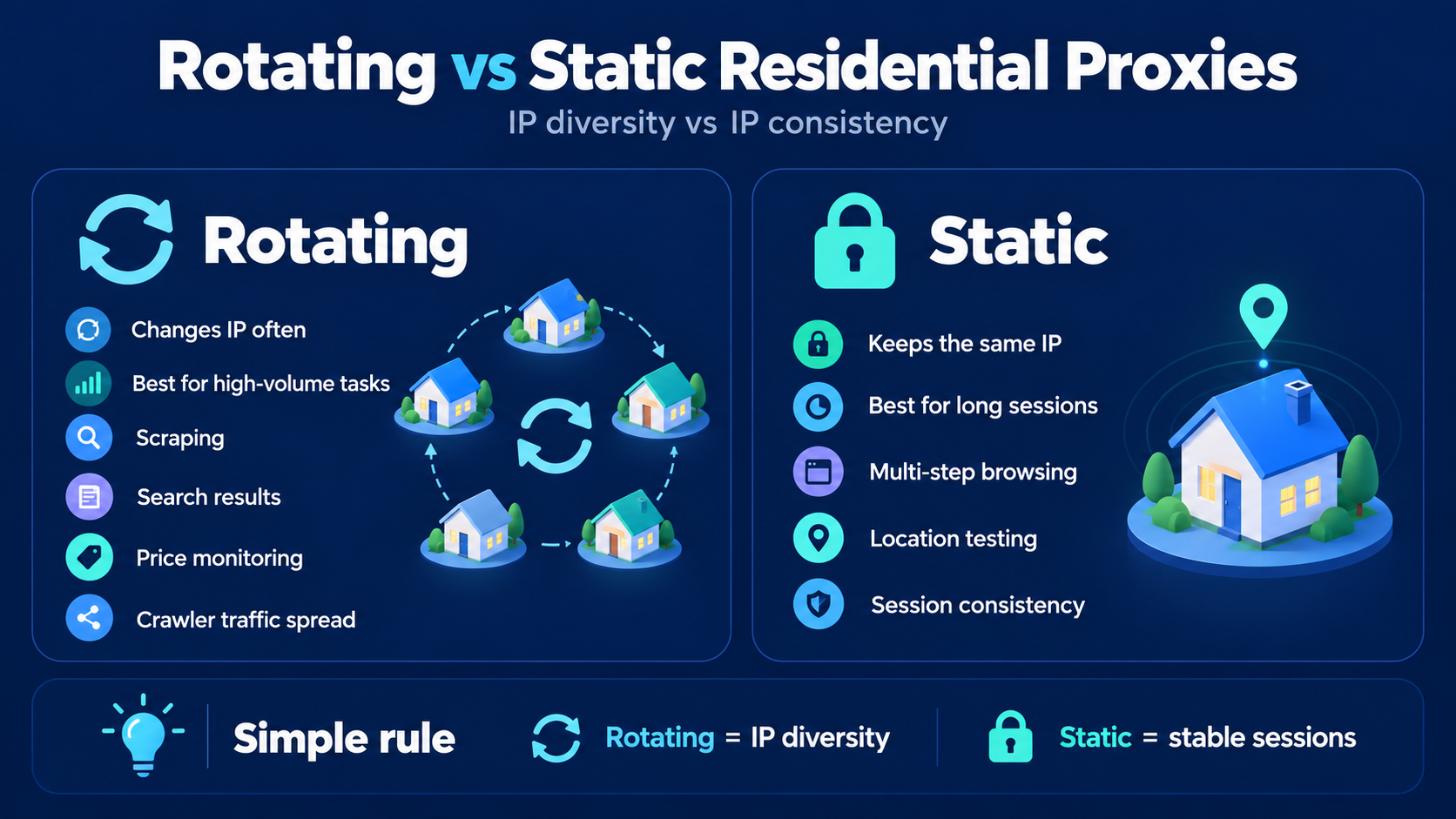
The main difference between rotating and static residential proxies is simple: one focuses on IP diversity, while the other focuses on IP consistency.
Rotating Residential Proxies
Rotating residential proxies change the exit IP between requests or sessions. They are suitable for high-volume tasks such as:
- Product scraping
- Search result collection
- Price monitoring
- Directory crawling
- Competitor research
By spreading requests across multiple residential IPs, crawlers can reduce traffic concentration on a single address.
Static Residential Proxies
Some workflows require the same IP for longer periods. Multi-step browsing, long-running sessions, and location-specific testing may work better with a stable IP.
Swiftproxy Static Residential Proxies are designed for these use cases.
A simple rule is:
- Use rotating proxies for IP diversity
- Use static or sticky proxies for session consistency
How to Crawl Paginated Lists Reliably
Pagination is common on product catalogs, marketplaces, directories, and search pages.
A crawler may request:
/products?page=1
/products?page=2
/products?page=3
At scale, sending all requests from one IP can lead to rate limits.
A more reliable approach is to:
- Keep concurrency moderate
- Monitor 403 and 429 responses
- Rotate IPs for independent requests
- Use retry backoff
- Remove duplicate URLs
- Cache previously collected pages
The goal is not to send the maximum number of requests per second. It is to maximize successful requests while keeping failures low.
Crawling Infinite Scroll Pages
Many websites use infinite scrolling instead of numbered pagination. New content may load through JavaScript, AJAX, REST APIs, or GraphQL requests.
Tools such as Playwright, Puppeteer, and Selenium can handle these pages when browser rendering is required.
Rotating residential proxies are useful for independent browser jobs, while sticky or static residential proxies are better when a session must remain consistent.
Whenever possible, developers should also inspect how additional data is loaded. Accessing a public data endpoint directly can be more efficient than rendering a full browser session for every page.
How to Reduce 403 and 429 Errors
Proxy rotation alone will not fix an aggressive crawler.
A better approach combines:
- Lower concurrency
- Reasonable request delays
- Exponential retry backoff
- HTTP status monitoring
- Duplicate request prevention
- Stable sessions when required
- Residential IP rotation for independent requests
If error rates increase, slow the crawler down before increasing proxy rotation.
Residential Proxies for Market Research and Ad Verification
Residential proxies are especially useful when businesses need to compare localized online content.
For market research, teams can monitor:
- Product prices
- Marketplace inventory
- Search visibility
- Regional availability
- Competitor positioning
For ad verification, teams can check whether ads, landing pages, and regional campaigns appear correctly in different locations.
Because content often varies by geography, residential proxies provide a more realistic view than relying on a single server location.
Choosing the Right Proxy Strategy
The best proxy setup depends on whether the workflow needs diversity or continuity.
Use rotating residential proxies when crawling large numbers of independent URLs. Use sticky or static residential proxies when the same IP needs to remain active throughout a session.
Many large scraping systems use both approaches. For example, rotating proxies may collect thousands of product pages, while static IPs handle browser sessions that require a persistent identity.
Scale Web Crawling With Swiftproxy
Large-list crawling becomes harder as request volume, geographic coverage, and session complexity increase. Residential proxies help distribute traffic, while static residential proxies provide stability for longer sessions.
For high-volume web scraping and localized data collection, explore Swiftproxy Residential Proxies.
For workflows that require a persistent IP, explore Swiftproxy Static Residential Proxies.
Final Thoughts
Reliable large-scale crawling is not about sending requests as fast as possible. It is about balancing concurrency, retries, session management, and proxy rotation.
Rotating residential proxies are ideal when crawlers need IP diversity across many URLs. Static residential proxies are better when workflows require a stable network identity.
With the right combination, businesses can scale web scraping for market research, price monitoring, competitive intelligence, and ad verification more reliably.
About the author
 Top-tier residential proxy solutions
 {{item.title}}
Related articles

 371
371


- Please provide your account number, or email address.
- Provide videos or screenshots, and simply describe the problems you are facing.
- Our staff will reply to your message within 24 hours.