
 English
 EN
 FRENCH
 繁体中文






How to Manage Multiple Social Media Accounts: Proxies and Phone Numbers That Keep Them Apart
Learn how to manage multiple social media accounts with dedicated residential proxies, phone numbers, and browser profiles to improve account separation and maintain consistent connections.

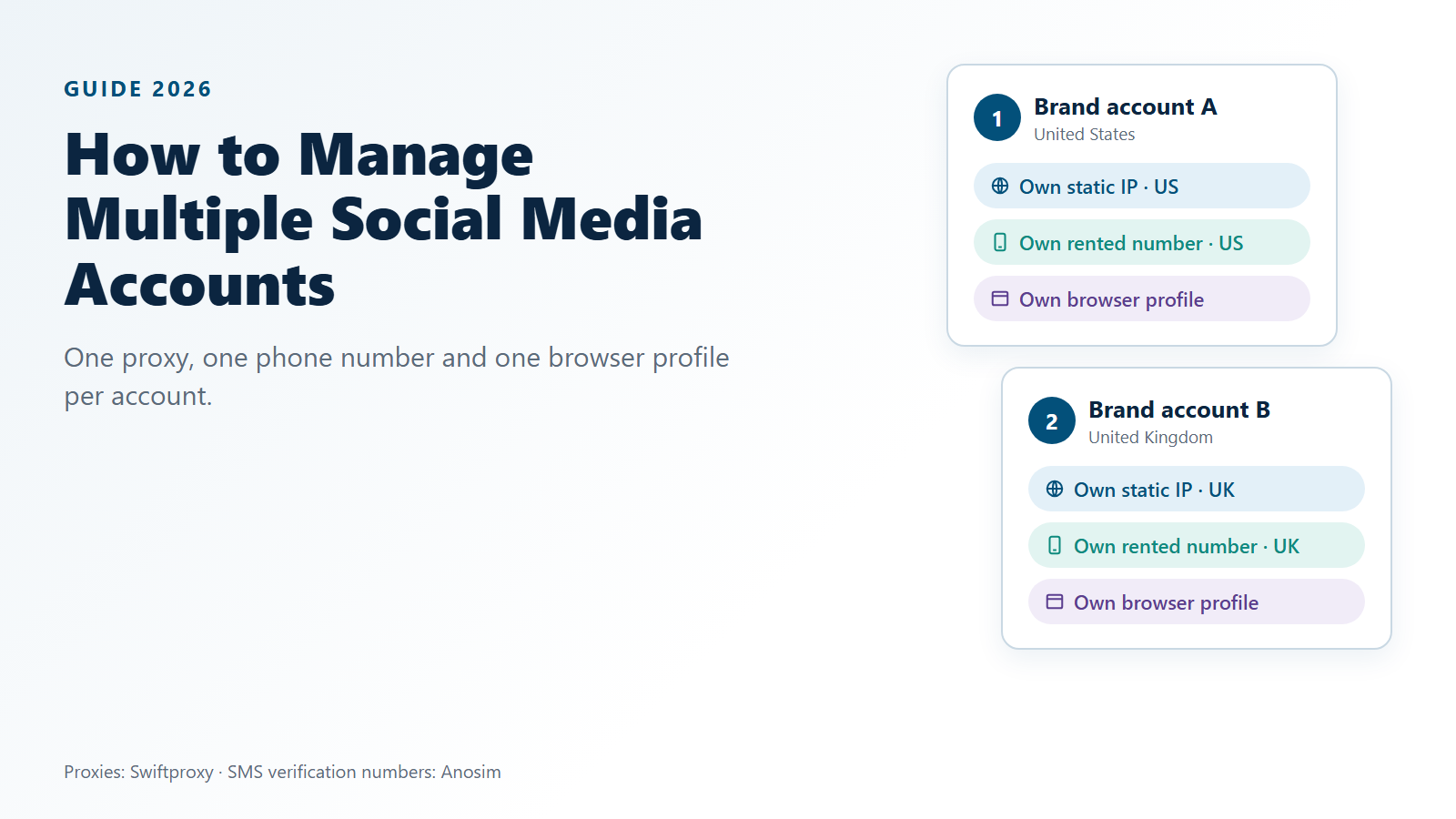
If you run social media for several brands, clients or regional markets, you know the problem. Platforms link accounts that share signals, and one flagged account can drag the others down with it. Two signals matter more than any other: the IP address an account logs in from and the phone number it was verified with. This guide shows how to manage multiple social media accounts with a clean setup: one stable proxy and one real phone number per account.
Key takeaways
- Platforms connect accounts mainly through shared IP addresses, shared phone numbers and shared browser fingerprints.
- Give every account its own static residential proxy and keep that IP stable.
- Give every account its own phone number that you control long-term.
- A one-time code is fine for a test account; an account you keep needs a rented number for recovery and 2FA.
- Proxy country, number country, time zone and language should match.
Proxies and phone numbers: two halves of one setup
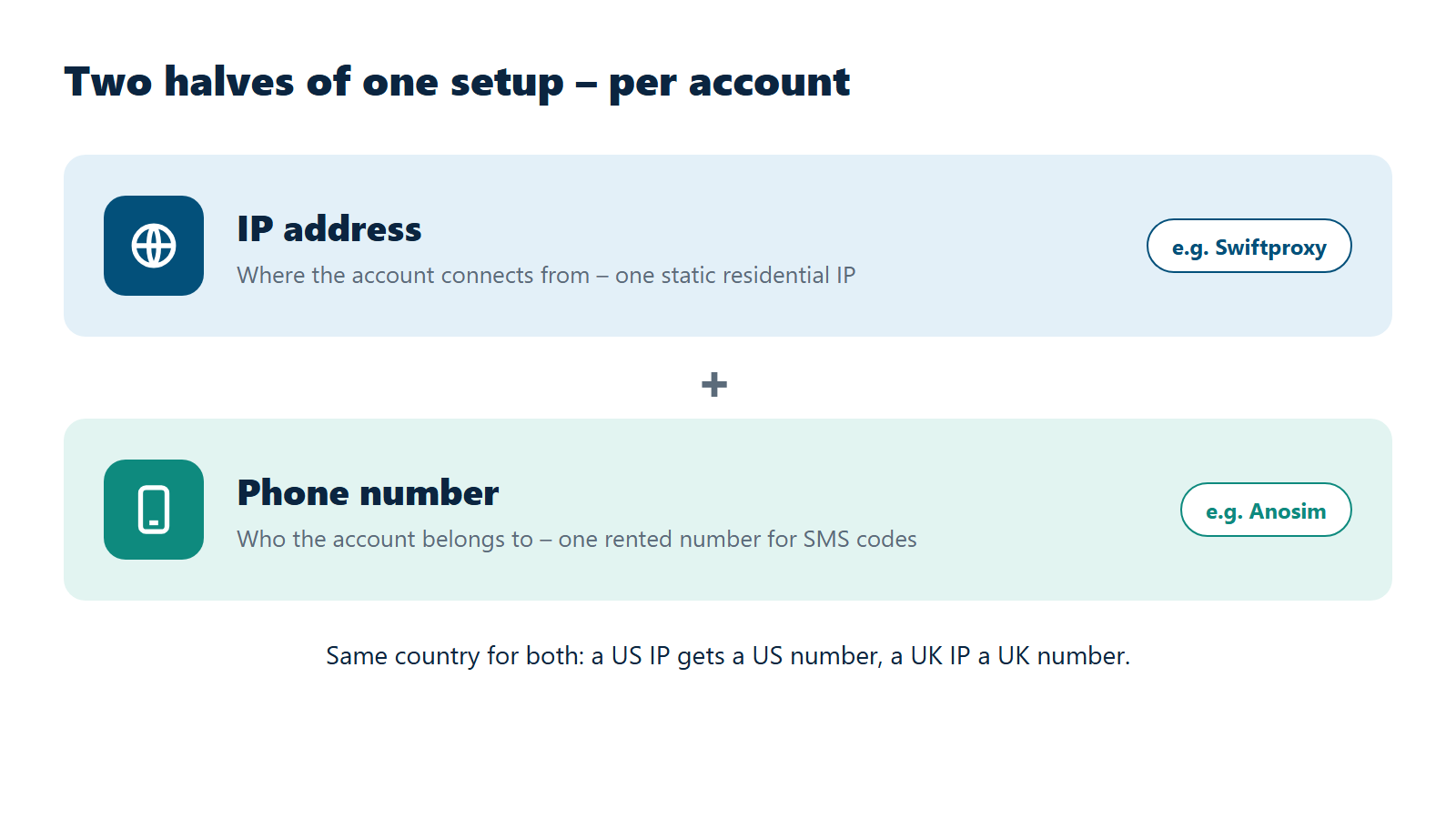
Most guides about multiple accounts stop at proxies. A proxy decides where an account appears to connect from. But every platform also asks for a phone number: at signup, after a suspicious login and when you switch on two-factor authentication. If ten accounts sit on ten clean IPs but share one phone number, the platform still sees one person.
So a working setup has two halves:
|
Layer |
What it separates |
Where it comes from |
|
IP address |
Where each account connects from |
A residential or static ISP proxy, e.g. from Swiftproxy |
|
Phone number |
Who each account belongs to |
A rented number per account, e.g. from Anosim |
What is Anosim?
Anosim is a marketplace for phone numbers used for SMS verification. Numbers come from several providers, and you pick the country, the service and the provider yourself. Anosim offers both numbers from real SIM cards on mobile carrier networks and virtual numbers; the provider selection shows which kind a number is. You can take a number for a single code, rent it for one platform or rent the whole number. Payment is by cryptocurrency or bank transfer, no KYC is needed to use the service, and support answers 24/7 via Telegram, live chat and email.
Why platforms connect your accounts
Instagram, TikTok, Facebook and LinkedIn all run risk systems that look for accounts operated by the same person. That alone is not a problem: agencies and brands manage many accounts legitimately, and the platforms' business tools allow it. The trouble starts when accounts share a signal and one flag spreads to all of them.
|
Signal |
What the platform sees |
How to separate it |
|
IP address |
Many accounts logging in from one IP or one datacenter range |
A dedicated residential or static ISP proxy per account |
|
Phone number |
One number verifying several accounts, or a number that has verified thousands |
One rented number per account |
|
Browser fingerprint |
Identical device, fonts, time zone and cookies |
One antidetect browser profile per account |
|
Behaviour |
Identical posting times and actions |
Different schedules and workflows |
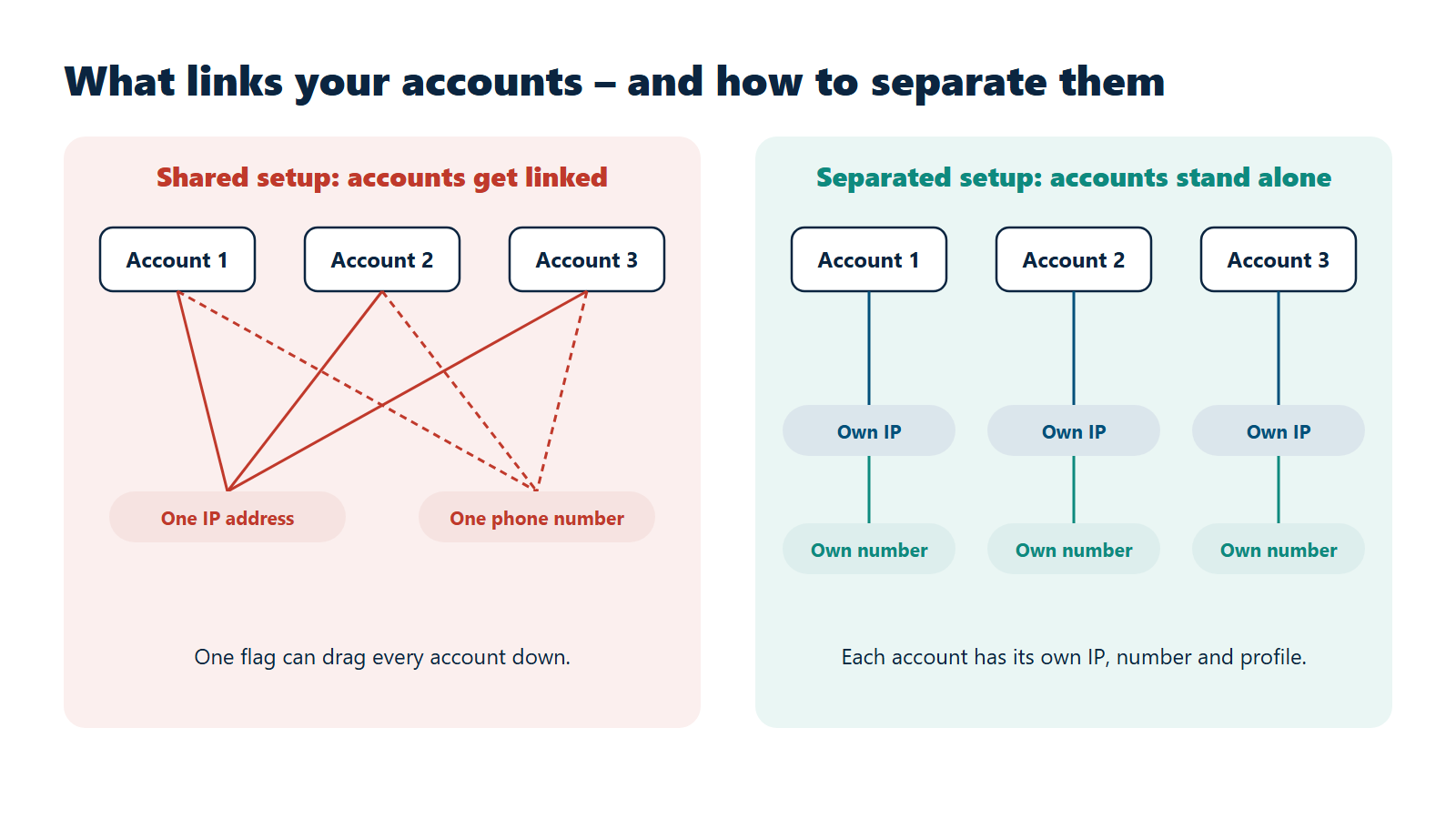
Shared signals link accounts; separated ones keep a flag contained.
Layer 1: the IP address
A social account that logs in from a datacenter IP looks like a bot, and one that jumps between countries every hour looks hijacked. You want an IP that looks like an ordinary home connection and stays the same.
That is what residential proxies are for. Swiftproxy's residential proxies cover more than 80 million IPs in 195+ countries, so each account can sit in its audience's region. For accounts you log into every day, static residential proxies are usually the better fit: a dedicated ISP IP that does not change between sessions.
- One account, one IP. Never let two accounts share a proxy.
- Match the proxy country to the account's country and to its phone number.
- Use static or sticky IPs for logged-in sessions; rotation is for data collection, not for accounts.
- HTTP(S) and SOCKS5 both work with the common antidetect browsers.
Layer 2: the phone number
The proxy hides where you connect from. The phone number decides whether you can keep the account. Teams that verify ten accounts with one personal phone, or with random free numbers, run into three problems.
One number, many accounts. Platforms limit how many accounts one number can verify, and a shared number links every account it touched.
Public numbers. Free numbers are public: anyone can open the same inbox. They are handy to receive SMS online for a quick test, but wrong for an account you keep, because the next person can request a password reset to the same number.
Rejected numbers. Many low-quality virtual numbers come from ranges that platforms have already marked. The code never arrives, or the platform refuses the number outright. Numbers from real SIM cards on carrier networks are accepted more reliably, which is why the provider selection matters.
Choose the number by how long you need it:
|
You need |
Anosim product |
What you get |
|
One code for a test account |
One-time SMS verification |
A number for one code within 20 minutes; refunded to your balance automatically if no SMS arrives |
|
An account you keep on one platform |
Rent a number for one service |
Unlimited SMS for that service during the rental; the service on that number stays reserved for you |
|
One number for several services |
Rent a virtual phone number |
The whole number, all services, unlimited SMS during the rental |
|
A number that also takes calls |
Mobile VoIP number |
A rented number with incoming calls, currently in Germany |
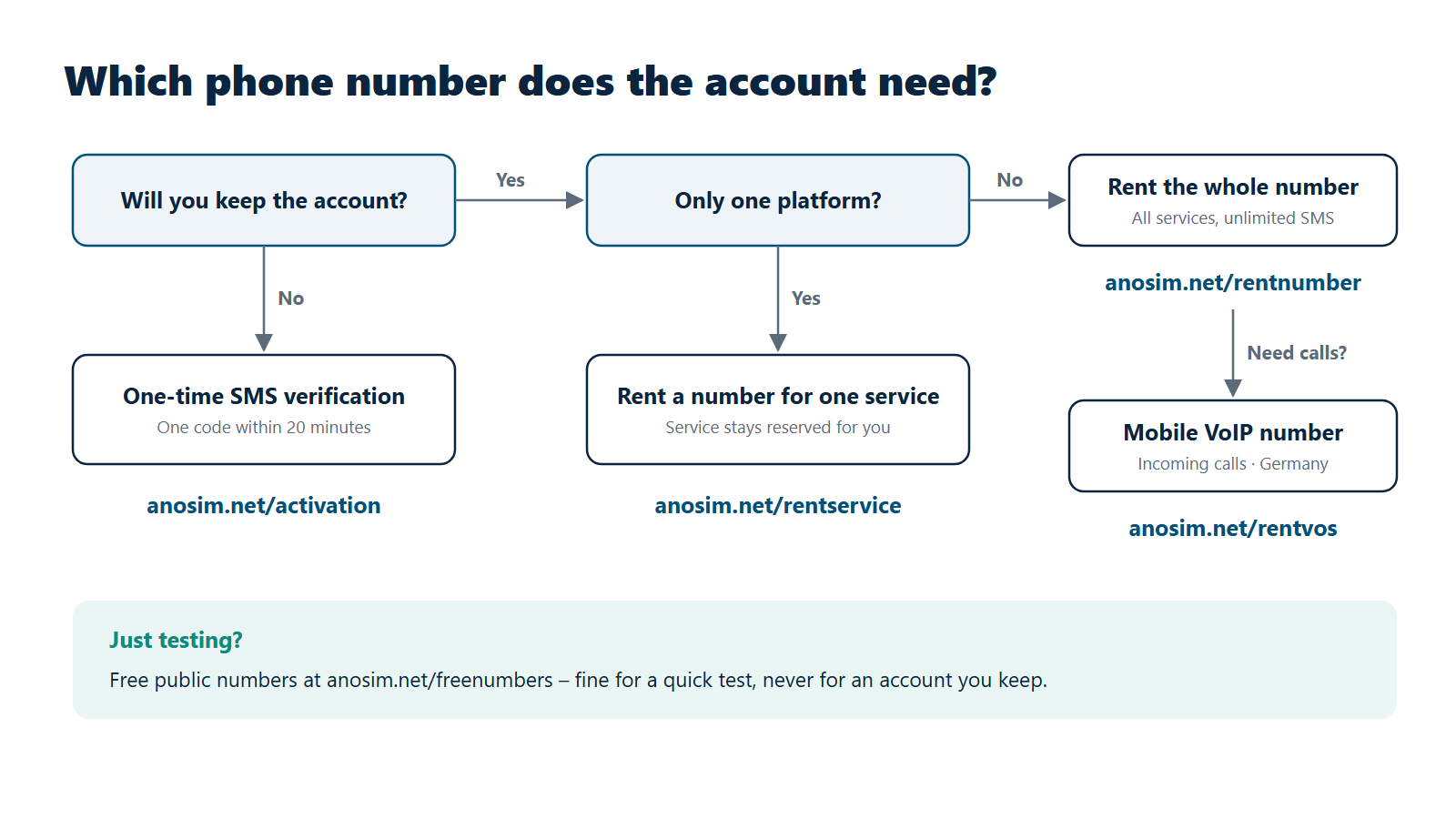
Pick the number by how long you keep the account.
For social accounts the second row is usually right. Rent the number for the platform you need, for example for Instagram verification. Once you have used a service on a number, nobody else will ever use that service on it, so the number stays yours for recovery codes. Rentals run up to 30 days and can be extended in the account or with auto-renewal; longer periods are available on request.
Match the number to the proxy: an account on a US residential IP gets a US phone number, one on a UK IP a UK number. A US IP with a number from another continent is exactly the mismatch risk systems look for.
Travelling while you manage accounts? Your regular SIM can stay in the phone while you buy an eSIM with a data plan for your destination. The eSIM carries data only, so SMS codes still go to the rented numbers.
Layer 3: the browser profile
A separate IP and number do not help if all accounts share one browser. Antidetect browsers give each account its own profile with its own cookies, fingerprint and time zone, and you attach the account's proxy to that profile. Swiftproxy works with AdsPower, Dolphin{Anty}, GoLogin, Incogniton, Hidemium and others. Set the profile's time zone and language to the proxy country.
A setup that scales to 10, 50 or 200 accounts
- Create an account sheet. One row per account: platform, country, proxy, phone number, browser profile, rental end date.
- Pick the proxy. One static residential IP per account, in the account's country.
- Rent the number. One number per account, same country, rented for that platform.
- Create the browser profile. Attach the proxy and set time zone and language.
- Verify and switch on 2FA. Use an authenticator app where the platform allows it, and keep the rented number as the recovery method.
- Keep the rental active. Turn on auto-renewal so a recovery number never expires.
- Automate at volume. The Anosim SMS verification API places orders, rents numbers and retrieves inbound SMS by polling; an SMS-Activate-compatible API is available for existing tools.
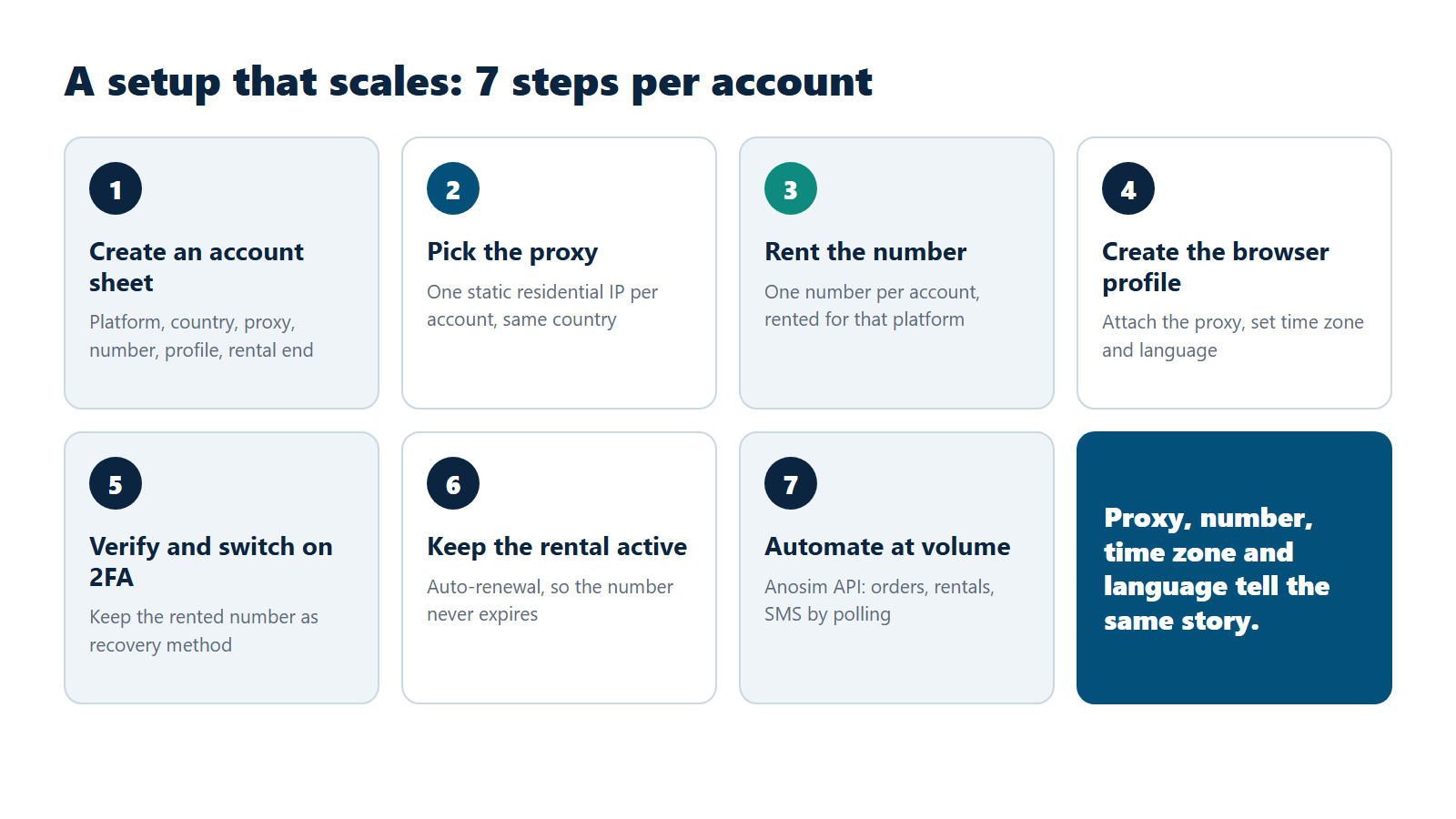
The setup per account, from sheet to automation.
Common mistakes
- Rotating proxies on logged-in accounts. A new IP on every request looks like an account takeover.
- Verifying a kept account with a public number. Anyone can read the code and reset the password.
- Letting the number lapse. If the platform asks for a code months later and the number is gone, so is the account. A rental costs less than a lost account.
- Mismatched countries. Proxy, number, time zone and language should tell the same story.
- No documentation. Without the account sheet, the first lost recovery code becomes a lost account.
SMS codes are one-time passwords: they only protect you if the number receiving them is under your control. More platform-specific setups are on Swiftproxy's social media management page.
FAQ
How many social media accounts can I manage from one device?
There is no fixed number. What counts is that each account has its own IP, its own phone number and its own browser profile. With an antidetect browser, a static residential proxy and a rented number per account, one computer can run many accounts without them sharing signals.
Can I use one phone number for several accounts?
On the same platform, no: a shared number links the accounts, and platforms limit how many accounts one number can verify. Use one number per account.
What is a non-VoIP number, and do I need one?
Platforms often reject numbers from low-quality virtual ranges. A number from a real SIM card on a mobile carrier network is accepted more reliably. On Anosim the provider selection shows whether a number is a SIM-card number or a virtual one.
Why am I not receiving verification codes?
The most common reasons are a number the platform has blocked, a country mismatch between number and IP, and too many code requests in a short time. With a one-time SMS verification on Anosim, the activation is refunded to your balance automatically if no SMS arrives within 20 minutes.
Should I use rotating or static proxies for social media accounts?
Static or sticky IPs for anything you log into. Rotating residential proxies suit research and data collection, where no account is involved.
Are free numbers safe for social media accounts?
For a quick test, yes. For an account you keep, no: free numbers are public, so anyone can read the codes sent to them. Test with a free number, then rent a number for the account itself.
About the author
 Top-tier residential proxy solutions
 {{item.title}}
Related articles

 468



- Please provide your account number, or email address.
- Provide videos or screenshots, and simply describe the problems you are facing.
- Our staff will reply to your message within 24 hours.



