
 English
 EN
 FRENCH
 繁体中文






How Virtual Numbers and Proxies Work Together in SMS Verification
Virtual numbers and residential proxies serve different purposes but can complement each other in online workflows. This article explains their key differences, how they work together, and how businesses can use them for SMS verification, regional testing, browser automation, and location-specific research.

SMS verification is now part of many online workflows: account registration, login confirmation, two-factor authentication, and testing user flows. A virtual number helps receive the verification code, while a proxy can shape the network environment from which the request is made.
These tools solve different problems. A virtual number handles SMS reception; a proxy handles the IP address and network location. Used together, they can support legitimate testing, regional research, and organized account workflows, but neither tool guarantees that a platform will approve a registration.
What a virtual number does
A virtual number is a phone number that receives SMS messages without requiring you to use your personal SIM card. Services such as https://hero-sms.com/ru?utm_source=blog&utm_medium=swiftproxy&utm_campaign=18112026 provide numbers for SMS verification from more than 180 countries and support hundreds of services, including messaging apps, social platforms, marketplaces, and gaming services.
HeroSMS offers both one-time numbers and rented numbers. A one-time number is suitable when you need a single code, while a rented number stays assigned to your account for a longer period and can be useful for repeat sign-ins, ongoing access, and SMS testing.
A virtual number can help you:
- Receive OTP codes without exposing your personal phone number.
- Register or test accounts using a number from a selected country.
- Separate personal contacts from work, testing, or project-related accounts.
- Receive codes directly in a personal dashboard or mobile app.
- Use a stable number for repeat verification when a rented number is appropriate.
The key limitation is important: a virtual number does not change your IP address, browser fingerprint, device characteristics, or payment details. It only provides a phone number for receiving SMS.
What a proxy does
A proxy routes your internet traffic through another IP address. Instead of connecting to a website directly from your own network, your request appears to come from the proxy’s IP location.
Residential proxies use IP addresses associated with residential networks. They are commonly used for regional website testing, market research, SEO monitoring, browser automation, and other tasks where the network location matters. Swiftproxy, for example, offers dynamic and static residential proxies across 220+ locations, with country, city, and ISP targeting options.
A proxy can help with:
- Viewing how a website behaves in a specific country or city.
- Testing localized pages, pricing, availability, and registration flows.
- Running browser automation from selected network locations.
- Organizing legitimate multi-account workflows with separate network environments.
- Collecting public market data for research purposes.
|
Feature |
Virtual number |
Residential proxy |
|
Main function |
Receives SMS and OTP codes |
Routes internet traffic through another IP |
|
What it represents |
A phone number |
An IP address and network location |
|
Typical use |
Registration, login verification, SMS testing |
Regional testing, research, automation |
|
Geographic control |
Country of the phone number |
Country, city, or ISP of the IP |
|
Changes browser fingerprint? |
No |
No |
|
Guarantees account approval? |
No |
No |
|
Replaces the other? |
No |
No |
A proxy does not receive SMS codes. It cannot replace a phone number, and it does not guarantee that a service will accept your registration attempt.
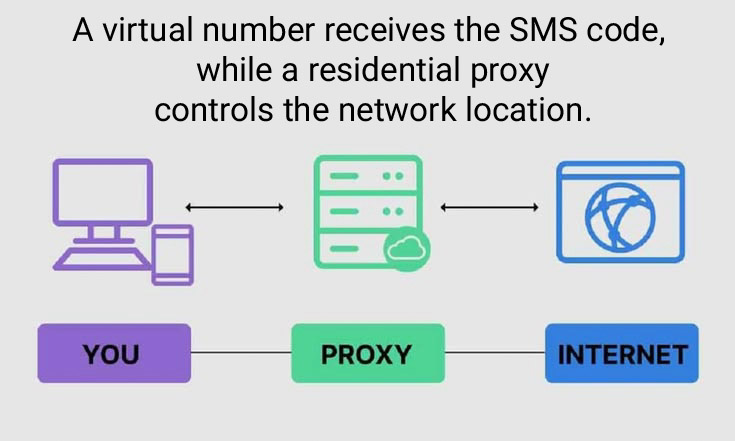
The two services are complementary. A virtual number receives the code; a proxy determines the network path used to reach the service. If a platform checks both the phone number country and the IP location, using only one of them may not be enough for the intended workflow.
When the combination makes sense
Regional registration testing
A QA team may need to check how a sign-up form behaves for users in different regions. A virtual number from the relevant country can receive the verification code, while a residential proxy provides a network connection from the same or another selected location.
This setup is useful for testing localized pages, form behavior, error messages, and regional restrictions. It does not bypass platform rules or guarantee successful registration.
Multi-region account management
Businesses that manage legitimate accounts in several markets may need to organize their network environments. A virtual number keeps the phone verification separate from a personal number, while a proxy can provide a network location appropriate to the account’s region.
This approach can make workflows more organized, but it does not remove the need to follow each platform’s terms of service and account policies.
Browser automation and QA
Development and QA teams often automate repetitive tasks such as filling registration forms, checking page behavior, and validating user flows. A virtual number can receive the OTP, while a proxy can support tests that require different network locations.
For teams that run repeated tests, API access can reduce manual work. HeroSMS provides API support, allowing developers to integrate number requests and SMS retrieval into their existing testing workflows.
Market and SEO research
Some websites show different prices, product availability, content, or search results depending on the visitor’s location. A residential proxy can help researchers examine localized pages, while a virtual number can support verification when a platform requires it.
The goal should be research and testing, not misleading platforms or violating their policies.
How a typical workflow looks
A practical workflow may include these steps:
- Define the task: registration testing, regional QA, market research, or account management.
- Choose a virtual number that supports the target service and country.
- If location matters, configure a residential proxy with the appropriate IP location.
- Open the target website or application in the intended browser or testing environment.
- Enter the virtual number and request the verification code.
- Receive the SMS code through the virtual number provider.
- Record the test result, including country, IP location, browser environment, and outcome.
The proxy and the virtual number operate independently. The proxy handles traffic; the virtual number handles SMS. Neither one controls the other, and neither one guarantees that the target platform will accept the attempt.
What neither tool can do
It is important to keep expectations realistic.
A virtual number does not:
- Hide your IP address.
- Change your browser fingerprint.
- Conceal your device characteristics.
- Guarantee that a service will send a code.
- Guarantee successful registration.
A proxy does not: receive SMS or OTP codes, replace a phone number, bypass platform security checks, guarantee that a registration will be accepted.
Platforms may evaluate many signals, including IP location, browser information, device characteristics, account history, and phone number details. Changing one signal does not automatically change the others.
Using both tools responsibly
Virtual numbers and proxies should be used for legitimate purposes: testing, privacy-conscious registration, regional research, and organized account management. They should not be used for fraud, ban evasion, mass abuse, or violation of platform rules.
HeroSMS rules prohibit illegal use of numbers and use in the banking sphere. Similarly, proxy providers expect users to follow the laws and platform policies relevant to their activities.
The best approach is to use each tool for what it is designed to do:
- Use a virtual number to receive SMS codes.
- Use a proxy to control the network location.
- Use both only when the task genuinely requires them.
- Always respect the target platform’s terms and local regulations.
Choosing the right setup
For a simple one-time registration, a virtual number may be enough. For repeated sign-ins, a rented number can be more practical. For regional testing or research, a proxy may also be needed to control the network location.
HeroSMS supports numbers from 180+ countries, rented numbers, and API access for automation. Swiftproxy provides residential proxies with broad location coverage, flexible sessions, and support for HTTP(S) and SOCKS5 protocols.
The right combination depends on the task, the target platform’s requirements, and the level of control you need over both the phone number and the network environment.
Final thought
Virtual numbers and residential proxies are not competitors. They solve different parts of the same workflow.
A virtual number handles the SMS side. A proxy handles the network side. Used together, they can support more organized testing, research, and account workflows, but they do not guarantee success and should always be used within platform rules.
If you work with regional testing, browser automation, or multi-region accounts, understanding the difference between these tools can help you build a cleaner and more predictable workflow. For teams that need reliable SMS reception as part of that workflow, HeroSMS provides virtual numbers from 180+ countries with both one-time and rental options.
About the author
 Top-tier residential proxy solutions
 {{item.title}}
Related articles

 24



- Please provide your account number, or email address.
- Provide videos or screenshots, and simply describe the problems you are facing.
- Our staff will reply to your message within 24 hours.



