
 English
 EN
EN FRENCH
 繁体中文
繁体中文




How to Choose the Best Facebook Proxy in 2026
Learn how to choose between static ISP proxies and rotating residential proxies for stable Facebook account management, compliant ad verification, and market research.

Facebook may request additional verification when an account suddenly changes its IP address, location, or network provider. Shared or unstable proxies can also interrupt sessions and create inconsistent access. The best Facebook proxy should therefore provide a clean IP, accurate targeting, and a reliable connection.
A proxy cannot guarantee that an account will never be restricted. Account history, browser settings, authentication, advertising compliance, and user behavior also matter. However, the right proxy can create a more consistent environment for authorized account management, research, and ad verification.
Static ISP Proxies vs. Rotating Residential Proxies
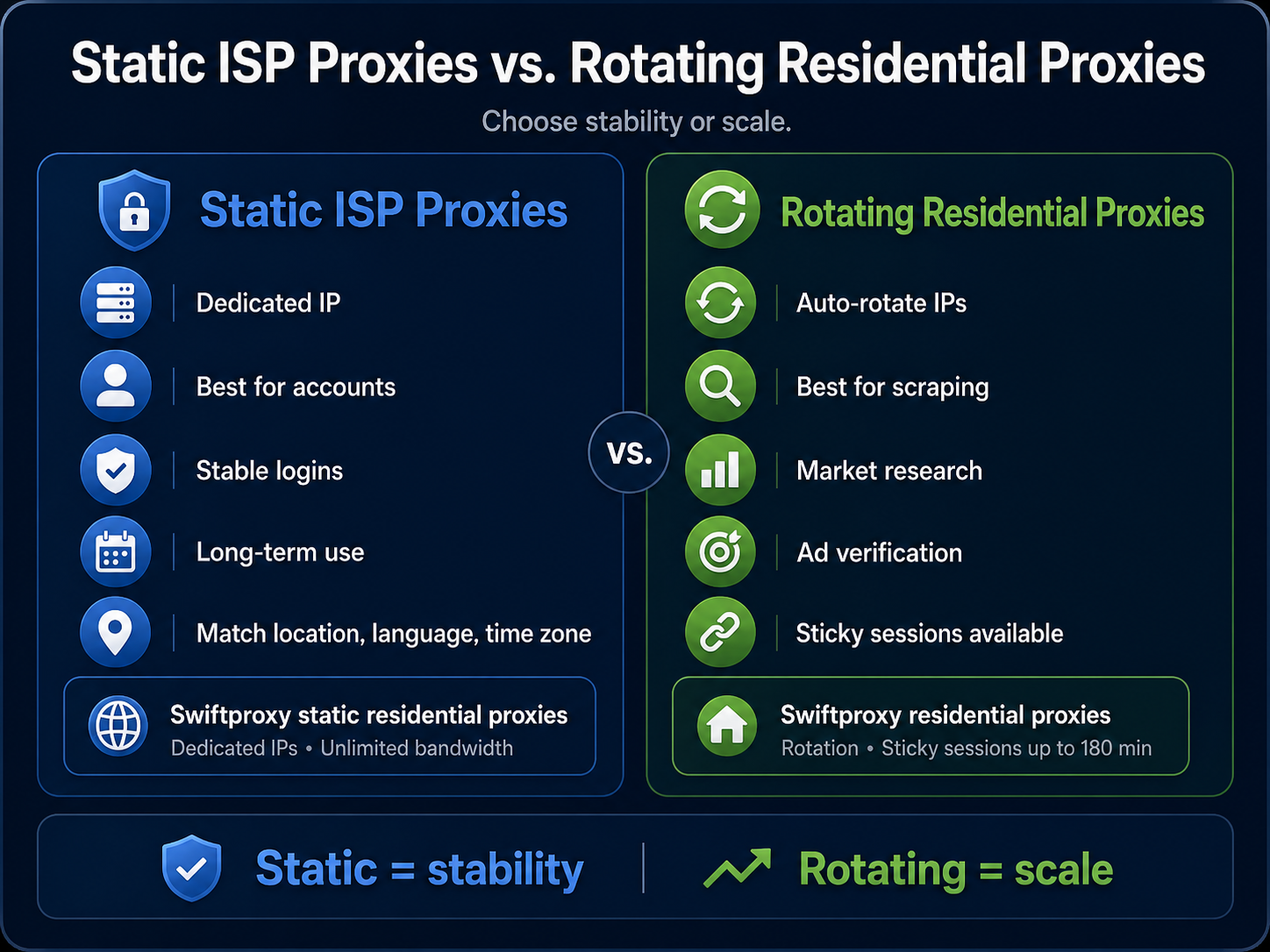
Static ISP proxies provide dedicated IP addresses that remain unchanged during the subscription period. They are suitable for Facebook account management, business page administration, customer support, and advertising operations. A stable IP can reduce unnecessary login challenges caused by frequent location changes.
For best results, keep the proxy location, browser language, and time zone consistent with the account’s normal environment. Swiftproxy offers static residential proxies with dedicated IPs and unlimited bandwidth during the active subscription period. This option is best for workflows that require long-term stability.
Rotating residential proxies change the exit IP automatically. They are better suited to public web scraping, market research, competitor monitoring, and ad verification. Proxy rotation distributes requests across multiple residential IPs instead of relying on one address.
Some workflows require several consecutive page loads from the same location. In these cases, sticky sessions are more practical than rotating the IP with every request. Swiftproxy residential proxies support automatic rotation and sticky sessions lasting up to 180 minutes.
Why Datacenter Proxies Are Less Suitable
Datacenter proxies come from hosting providers rather than consumer internet networks. They are often fast and affordable, but their IP ranges are easier for major platforms to classify. Shared datacenter IPs may also have poor reputations because many unrelated users operate through the same network.
Not every datacenter proxy will be blocked. However, residential and dedicated ISP proxies usually provide better location authenticity and more consistent IP control. They are generally the safer choice for important Facebook workflows.
What to Check Before Choosing a Proxy
IP quality should be the first priority. Avoid free proxies, heavily shared networks, and providers that promise complete invisibility. Check the IP location, ISP, ASN, and reputation before using it.
Connection stability is equally important. Unexpected disconnections or IP changes can interrupt posting, reporting, account management, and ad verification. Static ISP proxies work best for long-term access, while sticky residential sessions are suitable for temporary but stable connections.
Geographic targeting should match the project. Country-level targeting is often enough for general research, while city-level targeting is more useful for localized advertising tests. Pricing should also be compared based on traffic, location coverage, session duration, and expiration rules.
Best Proxy for Each Facebook Use Case
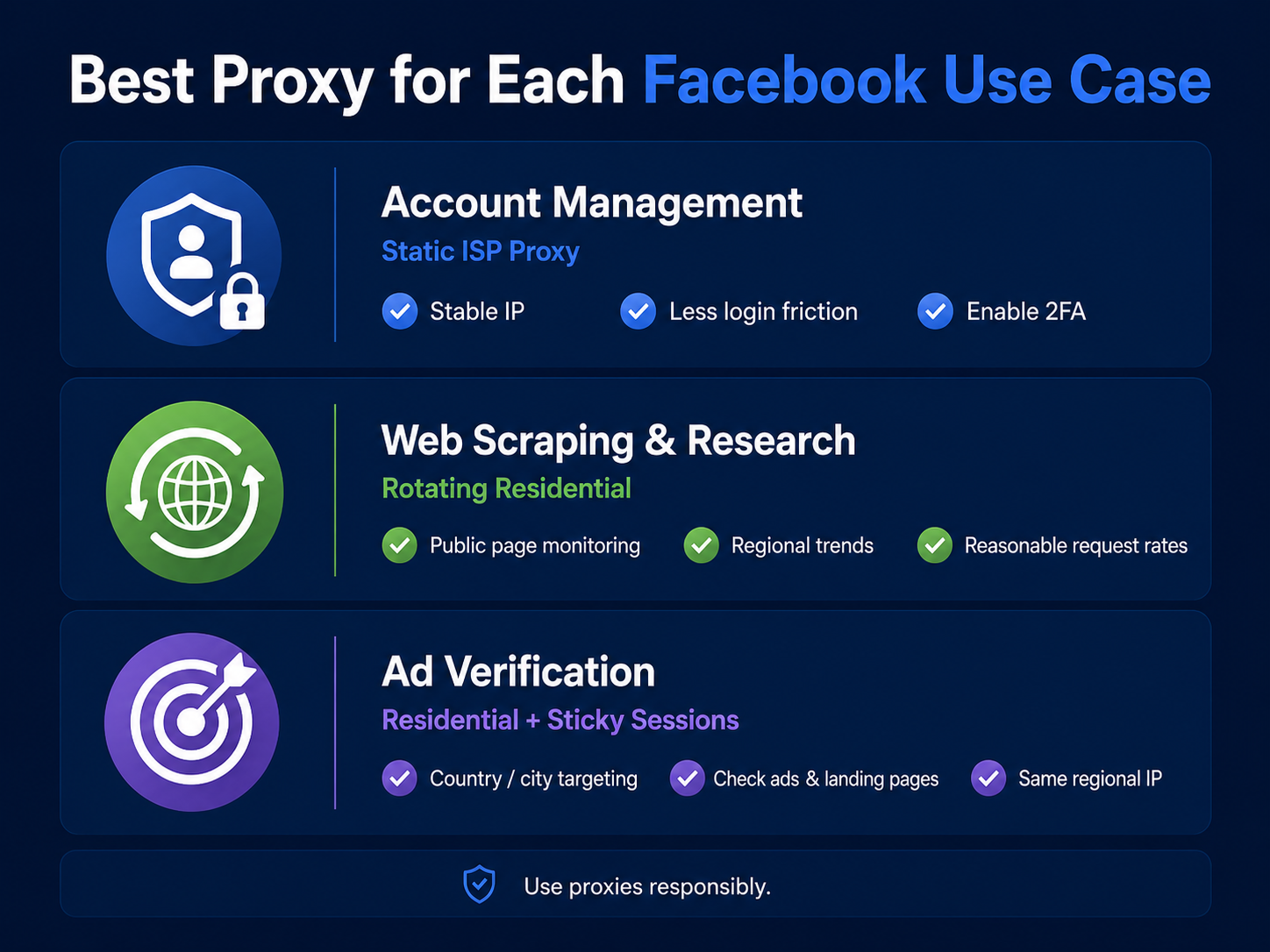
For authorized account management, use a dedicated static ISP proxy. It provides a stable network identity and reduces frequent location changes. Two-factor authentication and updated recovery information should also be enabled.
For public web scraping and market research, use rotating residential proxies for web scraping. Proxy rotation can support public page monitoring, competitor research, and regional trend analysis. Request rates should remain reasonable, and only legally accessible public data should be collected.
For ad verification, use residential proxies with country-level or city-level targeting. Sticky sessions help users check advertisements, redirects, pricing, landing pages, and localized content through the same regional IP. Swiftproxy also provides a dedicated ad verification proxy solution for these workflows.
Facebook Proxy Best Practices
Assign a stable proxy to each important account environment and avoid sharing the same IP across unrelated accounts. Keep browser profiles, cookies, and login sessions separated between different clients or projects. Before logging in, confirm that the IP location, browser language, and time zone are consistent.
Swiftproxy supports HTTP, HTTPS, and SOCKS5 protocols. It can also be integrated with AdsPower, BitBrowser, and HubStudio. These tools should only be used for authorized business operations and legitimate environment management.
Why Choose Swiftproxy
Swiftproxy provides rotating residential proxies and static ISP proxies for different Facebook workflows. Its residential network includes more than 80 million IPs across over 195 locations, with city-level targeting and sticky sessions lasting up to 180 minutes. Residential traffic does not expire, while static ISP proxies include dedicated IPs and unlimited bandwidth during the active subscription period.
These features make Swiftproxy suitable for account management, web scraping, market research, competitor monitoring, and ad verification. Users can choose automatic proxy rotation for large-scale research or maintain the same IP for longer sessions. This flexibility helps teams match the proxy type to the task.
Conclusion
Static ISP proxies are the better choice for stable Facebook account access. Rotating residential proxies are more suitable for web scraping, market research, competitor monitoring, and regional ad verification. Sticky sessions provide additional stability when the same residential IP is required for an extended workflow.
Choose a provider based on IP quality, connection stability, geographic accuracy, and transparent pricing. Explore Swiftproxy residential proxies and use sticky sessions lasting up to 180 minutes for more reliable Facebook research and verification.
About the author
 Top-tier residential proxy solutions
 {{item.title}}
Related articles

 58
58


- Please provide your account number, or email address.
- Provide videos or screenshots, and simply describe the problems you are facing.
- Our staff will reply to your message within 24 hours.