
 FRENCH
 EN
 FRENCH
 繁体中文






Residential vs Datacenter Proxies: Which Is Better
Learn the differences between residential and datacenter proxies, comparing speed, cost, IP reputation, geographic flexibility, and best-fit technical use cases.

Residential and datacenter proxies both route traffic through another IP address, but they are built for different priorities. Datacenter proxies usually offer faster speeds and lower costs, while residential proxies provide greater IP diversity and geographic flexibility.
For businesses involved in web scraping, market research, ad verification, or localized data collection, understanding these differences can help improve both performance and reliability.
What Are Residential and Datacenter Proxies
Residential proxies use IP addresses associated with consumer internet service providers. Because these addresses resemble regular household connections, they are widely used for accessing public web data from different regions.
Datacenter proxies use IP addresses hosted on commercial servers or cloud infrastructure. They are generally faster and more affordable, making them suitable for automation and high-volume requests where geographic identity is less important.
In simple terms, datacenter proxies prioritize speed and cost, while residential proxies prioritize IP diversity and location flexibility.
Key Differences Between Residential and Datacenter Proxies
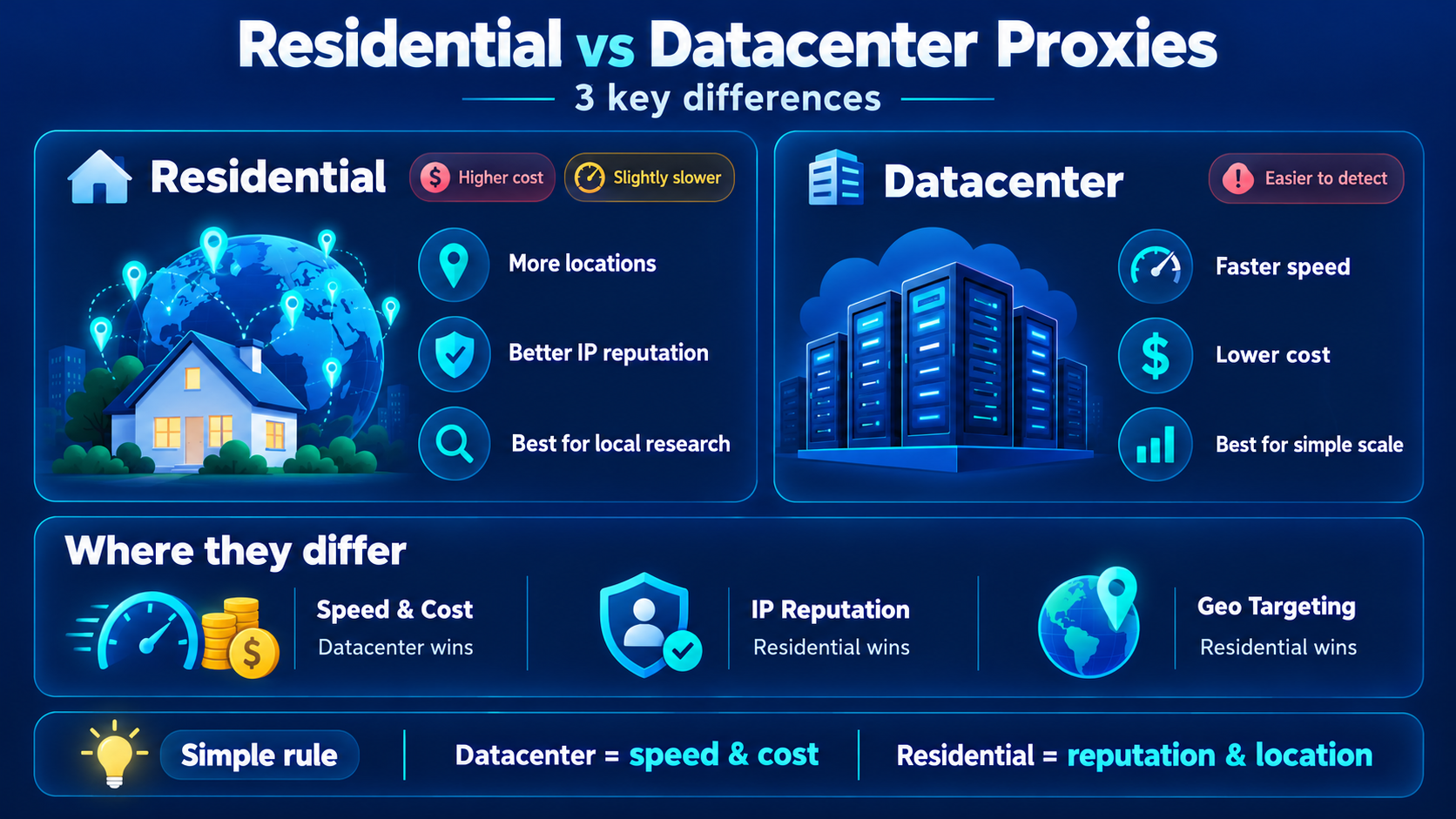
Speed and Cost
Datacenter proxies typically provide faster response times because they operate on dedicated server infrastructure. They are also more cost-effective for large volumes of straightforward requests.
Residential proxies may cost more and have slightly higher latency. However, they can provide better results when a project depends on multiple locations or a wider range of IP addresses.
IP Reputation
Datacenter IP addresses are easier for websites to identify as hosting infrastructure. On platforms that closely monitor automated traffic, this can lead to additional restrictions.
Residential proxies use ISP-associated IP addresses that appear closer to ordinary consumer connections. This makes them useful when IP reputation and network origin matter.
Geographic Targeting
Residential proxies are especially valuable for accessing public information from specific countries, regions, or cities. This makes them suitable for localized pricing research, search monitoring, market analysis, and ad verification.
Which Proxy Is Better for Web Scraping
Datacenter proxies can work well for basic scraping tasks where speed and low cost are the main priorities. They are particularly useful when target websites apply few restrictions to automated requests.
For larger or location-sensitive projects, rotating residential proxies are often more flexible. Proxy rotation distributes requests across multiple IP addresses, reducing dependence on a single connection and making regional data collection easier.
Businesses handling large-scale scraping can explore Swiftproxy Residential Proxies or its dedicated Web Scraping Proxies solution.
Reliable scraping also depends on reasonable request rates, retry handling, and compliance with applicable website policies.
When Are Static Residential Proxies Better
Not every task requires frequent IP rotation. Some workflows need the same IP address to remain active throughout a longer session.
Swiftproxy Static Residential Proxies are designed for use cases where IP consistency matters. They are useful for persistent sessions, repeated testing, and workflows that may be interrupted by frequent IP changes.
A simple rule is to use rotating residential proxies when IP diversity matters and static residential proxies when session stability matters.
Common Business Use Cases
Residential proxies are particularly useful for tasks that depend on geographic accuracy or diverse IP addresses.
- Web Scraping — Collect public product, pricing, and competitor data.
- Market Research — Compare regional trends and market conditions with Market Research Proxies.
- Ad Verification — Check how campaigns appear across locations with Ad Verification Proxies.
- SEO Monitoring — Review localized search results and competitor visibility.
Datacenter proxies remain a practical option when speed, simplicity, and lower costs are more important than geographic diversity.
Which Proxy Should You Choose
Choose datacenter proxies when you need fast and economical connections for simple automation or high-volume requests.
Choose rotating residential proxies when you need geographic targeting, large-scale web scraping, market research, or broader IP diversity.
Choose static residential proxies when your workflow requires a consistent IP address and longer sessions.
The best choice ultimately depends on your target websites, locations, request volume, session requirements, and budget.
Conclusion
Residential and datacenter proxies solve similar problems in different ways. Datacenter proxies are faster and more affordable, while residential proxies offer greater geographic flexibility and IP diversity.
For web scraping, market research, and location-sensitive data collection, residential proxies are often the more versatile option. When long-term session stability is required, static residential proxies provide a practical alternative.
Explore Swiftproxy Residential Proxies to find a proxy setup that matches your data collection needs.
Note sur l'auteur
 Solutions proxy résidentielles de haut niveau
 {{item.title}}
Articles liés

 22



- Veuillez fournir votre numéro de compte ou votre adresse courriel.
- Fournissez des vidéos ou des captures d'écran et décrivez simplement les problèmes auxquels vous êtes confronté.
- Notre personnel répondra à votre message dans les 24 heures.



