



 English
 EN
 FRENCH
 繁体中文






Web Crawling vs Web Scraping – Key Differences and Use Cases
Learn the key differences between web crawling and web scraping, how they work together, and where residential proxies support scalable data collection, market research, and monitoring.

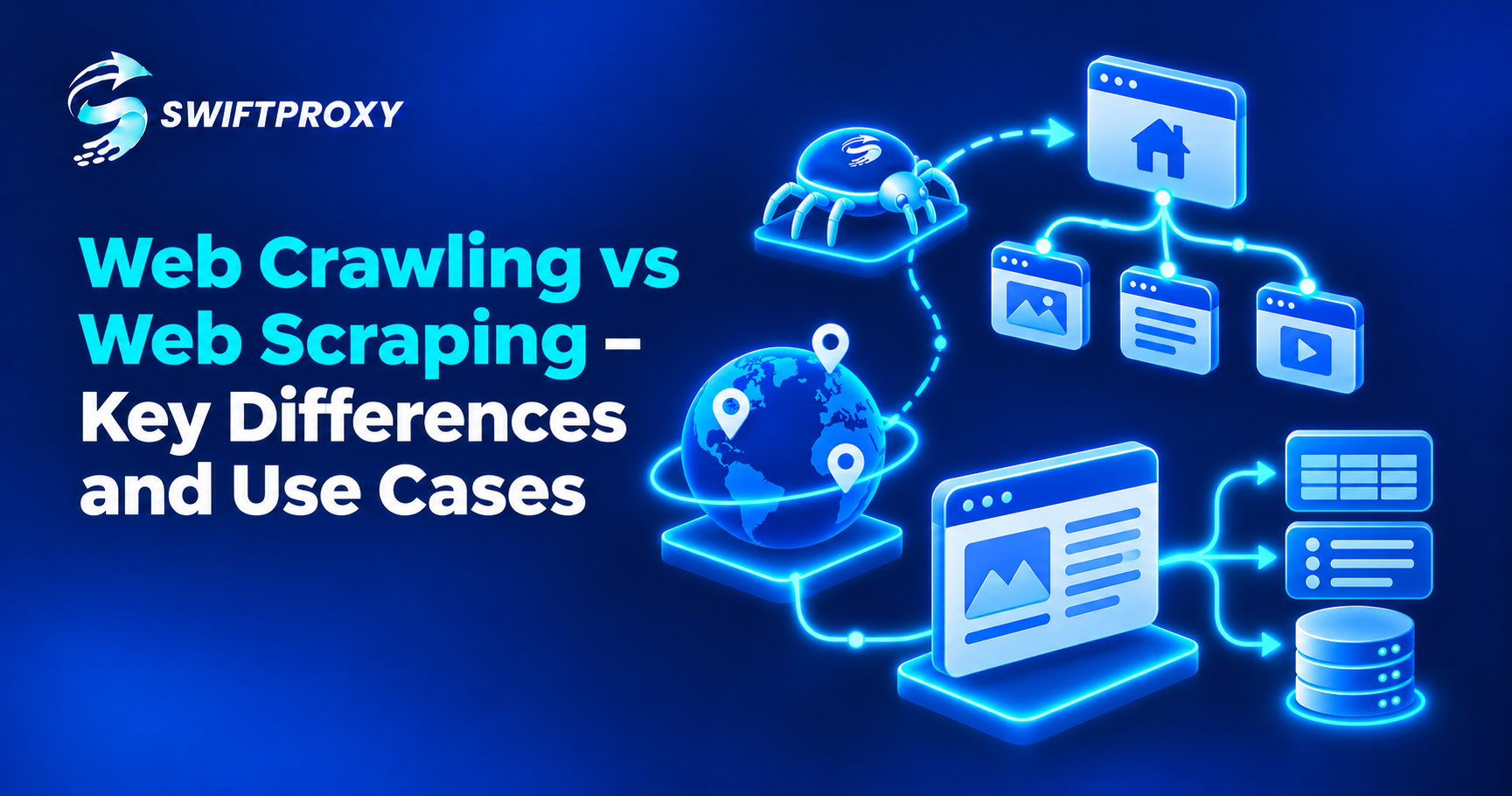
Web crawling and web scraping both collect information from the web, but they perform different tasks. Crawling discovers pages, while scraping extracts specific data from those pages.
Businesses often combine both for market research, price monitoring, competitive intelligence, and ad verification. Residential proxies can also support larger projects that require geographic targeting, IP rotation, or stable sessions.
What Is Web Crawling
Web crawling is the automated process of discovering pages by following links. A crawler starts with one or more URLs and continues exploring new pages according to predefined rules.
Search engines use crawlers to discover and index new content. Businesses can also use crawling for SEO audits, website monitoring, product discovery, and competitor research.
The main goal is discovery. A crawler identifies which pages exist and how they are connected rather than extracting every detail from each page.
What Is Web Scraping
Web scraping extracts selected information from web pages and converts it into structured data. Common fields include prices, product names, reviews, availability, search results, and advertisements.
The extracted data can be stored in databases, spreadsheets, CSV files, or analytics platforms. Businesses commonly use scraping for price monitoring, market research, SEO analysis, and ad verification.
Scraping methods range from simple HTML parsing to browser automation. The right approach depends on the website structure, data volume, and update frequency.
Web Crawling vs Web Scraping
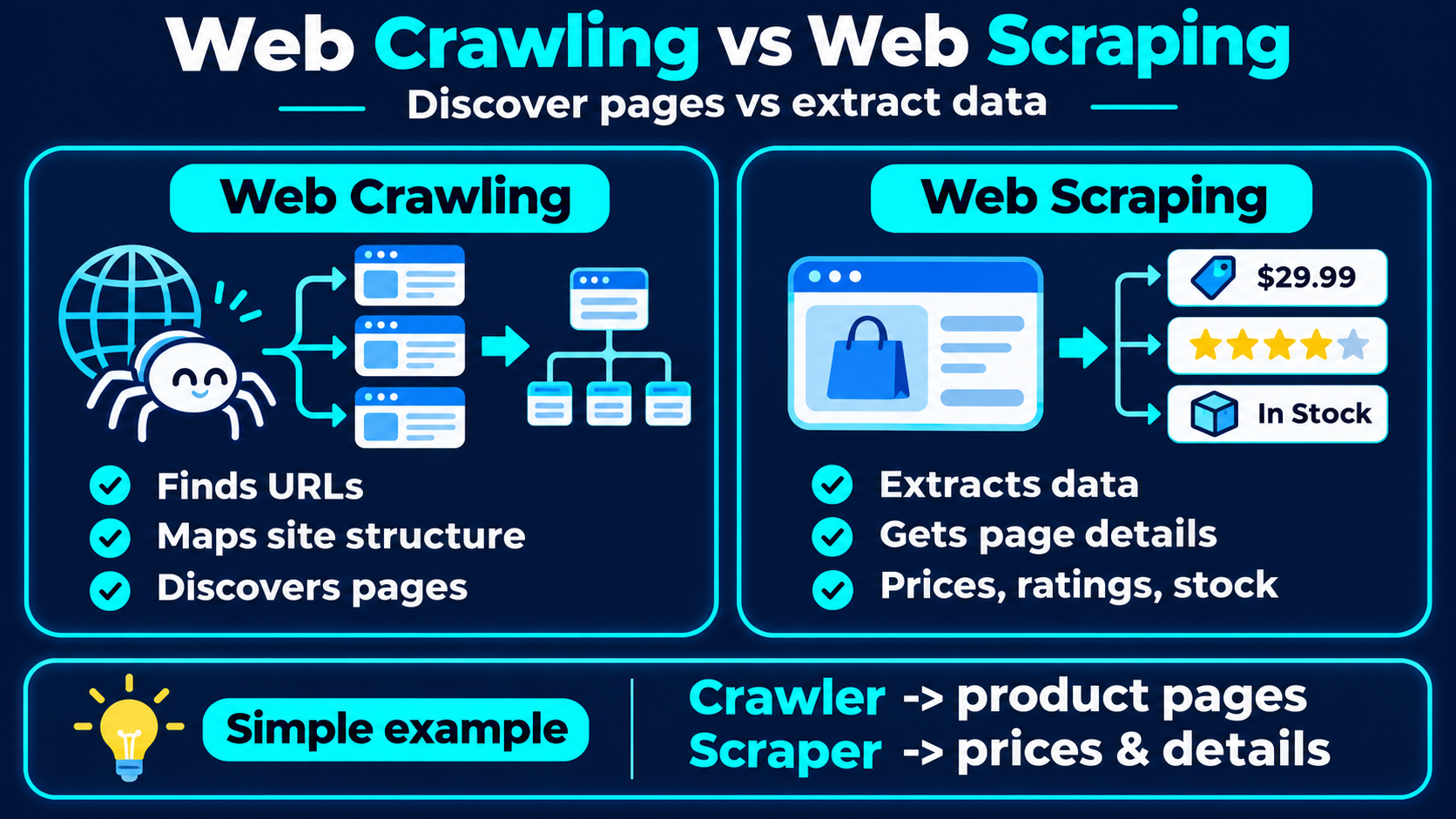
The key difference is simple. Web crawling discovers pages, while web scraping extracts data from pages.
A crawler focuses on URLs and website structure. A scraper focuses on specific information contained within those URLs.
For example, a crawler may discover thousands of product pages across an online store. A scraper can then collect prices, ratings, availability, and product details from those pages.
How Crawling and Scraping Work Together
Crawling and scraping are often used in the same data pipeline. The crawler discovers relevant pages, while the scraper converts selected content into structured data.
A market research platform, for example, can crawl product categories to identify new listings. It can then scrape prices and stock information for analysis.
This approach reduces manual URL management and makes large data projects easier to maintain.
Why Residential Proxies Matter
Large crawling and scraping projects may involve many pages, geographic markets, or repeated requests. Relying on a single IP can limit geographic coverage and network flexibility.
Swiftproxy Residential Proxies can support workflows that require residential IPs across different regions. This is useful when public prices, products, search results, or advertisements vary by location.
Proxies should still be combined with reasonable request rates, retry logic, and compliance requirements. They support the data collection process rather than replace good scraping practices.
Proxy Rotation vs Stable Sessions
Proxy rotation changes the IP used for requests or sessions. It is useful for large numbers of independent requests where maintaining the same IP is unnecessary.
Market research and large-scale product monitoring often benefit from rotating residential proxies. Requests can be distributed across multiple connections instead of relying on one IP.
Some workflows require continuity instead. When several requests share cookies, redirects, or session data, a sticky or stable session may provide more consistent results.
When to Use Static Residential Proxies
Static residential proxies keep the same IP for longer periods. They are useful when consistent network identity matters more than frequent rotation.
Common use cases include persistent sessions, repeated regional monitoring, and long-running website checks. Swiftproxy Static Residential Proxies are designed for workflows that require a stable residential IP.
In simple terms, rotating proxies prioritize IP diversity, while static residential proxies prioritize continuity.
Crawling and Scraping for Market Research
Market research often involves monitoring public prices, products, promotions, and competitor activity. Crawling helps discover relevant pages, while scraping collects the data needed for analysis.
Geographic differences can also affect results. Residential proxies can help researchers compare publicly available content across different regional network environments.
Rotating proxies work well for broad data collection. Stable sessions may be better when the same region needs to be monitored consistently.
Web Scraping for Ad Verification
Advertisements can vary by country, city, language, publisher, or campaign settings. Scraping and browser automation can help teams record how ads and landing pages appear in different markets.
Residential proxies provide regional network perspectives for these checks. Rotation is useful for independent observations, while stable sessions can help when an ad, redirect, and landing page must be checked together.
The collected data can support campaign monitoring, regional comparisons, and landing-page verification.
Best Practices for Crawling and Scraping
Crawlers should avoid repeatedly discovering the same URLs, while scrapers should validate extracted fields. Collecting only necessary data also reduces bandwidth and processing costs.
Applications should control request frequency, concurrency, timeouts, caching, and retries. Temporary failures may justify another request, while permanent errors should not trigger endless retries.
Teams should also review website terms, robots.txt directives, applicable laws, permissions, and data protection requirements. Official APIs may be preferable when they provide the required information.
Should You Use Web Crawling or Web Scraping
Use web crawling when you need to discover pages, map website structures, or monitor new content. Use web scraping when you already know the target pages and need specific information from them.
Many projects need both. A crawler can discover new products, while a scraper collects their prices and availability.
Proxy management forms a separate network layer. Rotating residential proxies provide geographic and IP diversity, while static residential proxies provide longer-term consistency.
Frequently Asked Questions
Is web crawling the same as web scraping?
No. Web crawling discovers pages and links, while web scraping extracts specific information from those pages.
Can web scraping work without crawling?
Yes. If you already have the target URLs, a scraper can process them directly without using a crawler.
Why use residential proxies for web scraping?
Residential proxies can provide different geographic network locations and IP addresses. They are useful when public website content varies by region or a project requires distributed connections.
What is proxy rotation?
Proxy rotation changes the IP address used between requests or sessions. It is commonly used when many independent requests do not need the same IP.
Should I use rotating or static residential proxies?
Use rotating proxies when IP diversity is important. Use static residential proxies when the same IP needs to remain consistent for longer sessions or repeated monitoring.
Final Thoughts
Web crawling discovers pages, while web scraping extracts useful information from them. Together, they support market research, competitive intelligence, price monitoring, and ad verification.
Proxy strategy should match the workflow. Rotating residential proxies provide flexibility for distributed requests, while static residential proxies provide greater session stability.
The most effective setup keeps each component focused on one role. Crawlers discover, scrapers extract, and proxies provide the network conditions required for scalable web data collection.
About the author
 Top-tier residential proxy solutions
 {{item.title}}
Related articles

 540



- Please provide your account number, or email address.
- Provide videos or screenshots, and simply describe the problems you are facing.
- Our staff will reply to your message within 24 hours.



