
 English
 EN
EN FRENCH
 繁体中文
繁体中文




Etsy & Poshmark Account Management: Why a Stable Proxy Matters
Discover why stable residential proxies are essential for Etsy and Poshmark account management, maintaining session consistency and seamless marketplace logins.

For new Etsy and Poshmark sellers, choosing a proxy is not only about getting a different IP address. The way that IP changes during a session also matters. Frequent proxy rotation works well for data collection, but a stable residential IP is often a better match for ongoing account activity.
Rotating IPs Are Not Designed for Every Task
Rotating residential proxies automatically change IP addresses over time or between requests. This is useful for web scraping, market research, price monitoring, and ad verification, where businesses need access to many public pages at scale.
Account management has different requirements. If an Etsy or Poshmark login suddenly moves between different IPs, ISPs, or locations, the network environment becomes less consistent and may result in additional security checks.
For normal seller activity, reducing unnecessary IP changes can create a more predictable session.
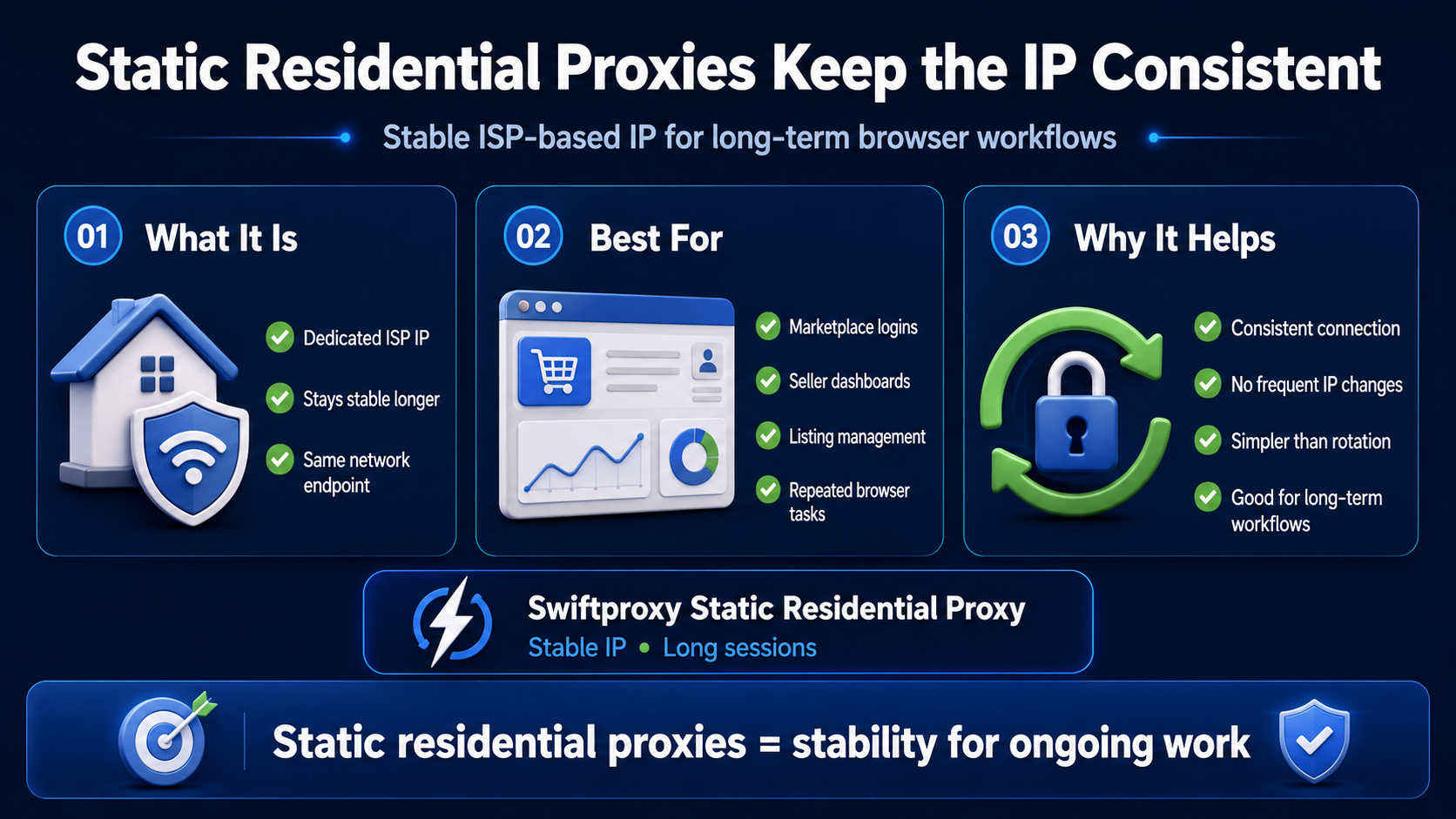
Static Residential Proxies Keep the IP Consistent
A Swiftproxy Static Residential Proxy provides a dedicated ISP-based IP that remains stable for an extended period.
This makes it suitable for repeated marketplace logins, seller dashboards, listing management, and other browser activities that benefit from a consistent connection. Instead of receiving a new IP during regular use, the account can continue operating through the same network endpoint.
For long-term workflows, static residential proxies offer a simpler alternative to frequent proxy rotation.
Use Sticky Sessions When You Need Flexibility
A static IP is not always necessary. Some users only need a stable residential IP for a few hours.
Swiftproxy Residential Proxies support both rotating and sticky modes, with Sticky Sessions lasting up to 180 minutes. This allows the same residential IP to remain active during a longer browsing or automation session before returning to normal rotation.
Swiftproxy also explains this setup in its 180-Minute Sticky Session Proxy Guide.
Choose the Proxy Based on the Workflow
For Etsy and Poshmark account activity, static residential proxies are better suited to long-term IP consistency, while sticky sessions provide temporary stability for shorter workflows.
For web scraping, market research, competitor monitoring, and ad verification, rotating residential proxies are usually the more practical choice because these tasks benefit from IP diversity.
The key is not to rotate IPs as often as possible. It is to match the proxy type and session behavior to the task you actually need to complete.
About the author
 Top-tier residential proxy solutions
 {{item.title}}
Related articles

 435
435


- Please provide your account number, or email address.
- Provide videos or screenshots, and simply describe the problems you are facing.
- Our staff will reply to your message within 24 hours.