
 FRENCH
 EN
 FRENCH
 繁体中文






Ad Verification Best Practices with Residential Proxies
Learn how residential proxies support ad verification across regions, compare localized ads and landing pages, and improve campaign monitoring with rotating and static IP sessions.

Digital ads do not always appear the same in every market. Location, IP address, browser language, device settings, and campaign rules can influence the creative, promotion, currency, or landing page a visitor sees. Ad verification helps advertisers confirm that campaigns are delivered as intended across different regions.
Residential proxies make these checks easier by providing network locations from different markets. Teams can compare localized ads and landing pages without relying on a single IP address or testing location. This makes residential proxies useful for geo-targeted ad verification, campaign monitoring, and regional market research.
What Is Ad Verification
Ad verification is the process of checking whether an advertisement appears in the correct location, placement, format, and context. It may include validating geo-targeting, checking redirects, reviewing landing pages, monitoring brand safety, and confirming that the intended offer is displayed. The goal is to identify differences between campaign settings and the experience users actually receive.
Location is especially important for international campaigns. Websites and advertising platforms may adjust content according to IP-based signals, resulting in different languages, prices, promotions, or destination pages. Testing from relevant geographic locations provides a clearer view of regional campaign delivery.
Why Residential Proxies Help with Ad Verification
Residential proxies route requests through IP addresses associated with residential networks. This allows advertisers to view public-facing content from different network locations and compare how campaigns appear across target markets. Swiftproxy Residential Proxies offer rotating and sticky session options for different verification workflows.
Rotating sessions are useful when teams need many independent checks across markets or IP addresses. Sticky sessions are better when several steps need to remain under the same network identity. Choosing the appropriate session type makes ad verification more consistent and easier to reproduce.
Use Proxy Rotation for Multi-Market Monitoring
Proxy rotation is useful when an advertiser needs broad regional coverage. Rotating residential proxies can support checks of localized creatives, promotions, prices, search results, and landing pages across multiple markets. They are also useful for permitted web scraping and market research involving publicly accessible regional information.
Rotation alone does not guarantee reliable results. Browser language, cookies, device type, target country, and testing time should remain as consistent as possible when comparing campaigns. Controlling these variables makes it easier to distinguish genuine campaign differences from changes caused by the testing environment.
Use Static Residential Proxies for Consistent Checks
Some verification tasks require the same IP address for a longer period. Examples include following a redirect chain, reviewing a multi-step landing page, reproducing a localization issue, or repeatedly monitoring the same campaign. Frequent IP changes can make these tests less consistent.
Swiftproxy Static Residential Proxies provide stable ISP-associated IP addresses for workflows where session continuity matters. They are better suited to repeatable testing, while rotating residential proxies are generally more practical for large numbers of independent checks. The right option depends on whether the priority is consistency or broader IP coverage.
Ad Verification Best Practices
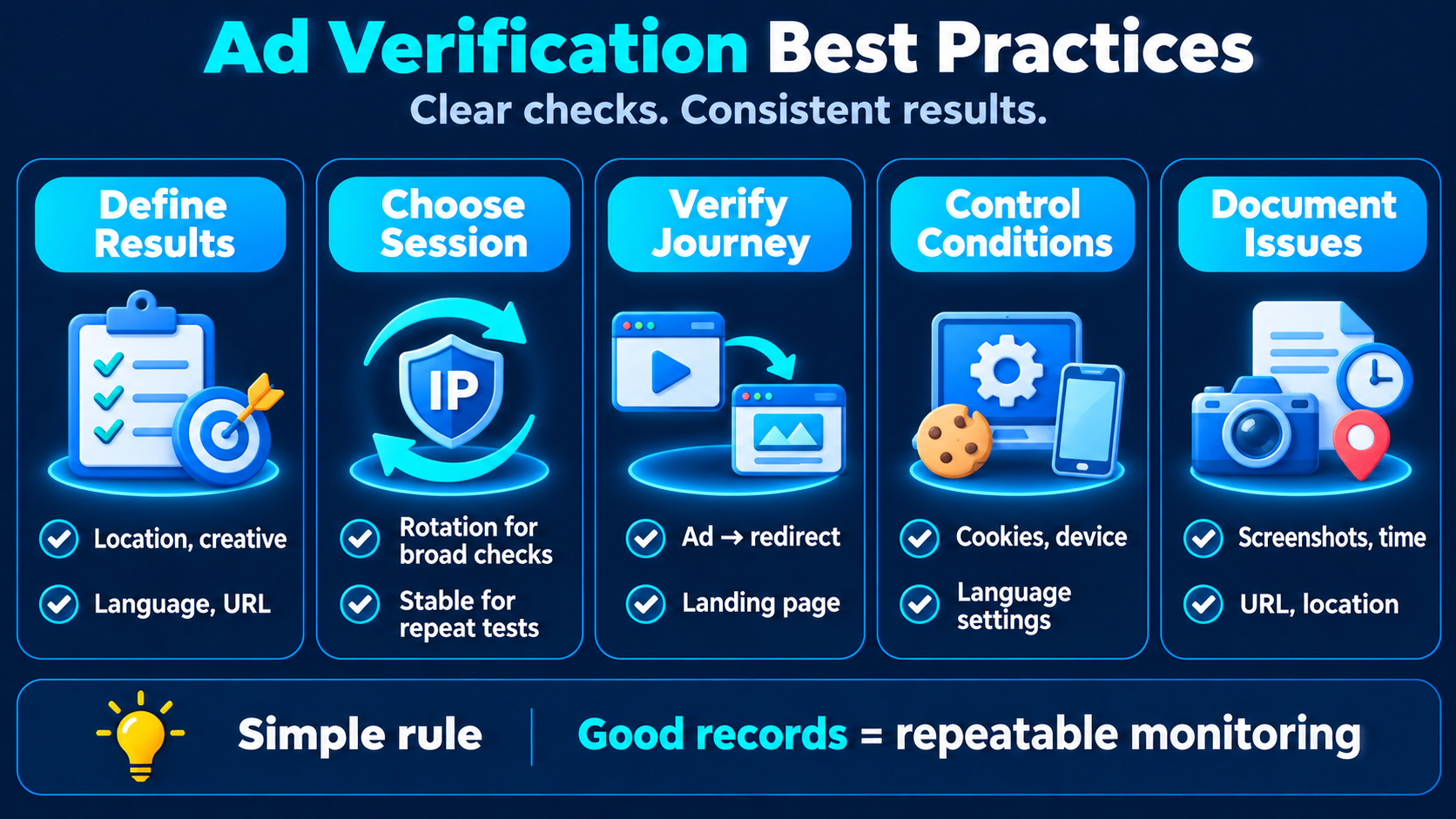
A reliable ad verification process starts with clearly defined expectations. Before testing a campaign, record the intended location, creative, promotion, language, currency, device type, and final landing page. This provides a baseline for comparing what should happen with what actually appears.
A practical workflow should include the following steps.
- Define expected results. Document the correct creative, location, language, currency, offer, and destination URL.
- Choose the right proxy session. Use rotation for broad regional checks and stable sessions for repeatable investigations.
- Verify the full journey. Check the advertisement, redirects, tracking parameters, and final landing page.
- Control testing conditions. Keep browser settings, cookies, device profiles, and language consistent.
- Document unexpected results. Save screenshots, timestamps, URLs, locations, and relevant campaign details.
Good documentation makes problems easier to reproduce. It also gives marketers, media buyers, and technical teams a shared set of evidence when investigating campaign issues. Over time, the same process can become a repeatable monitoring workflow.
Where Web Scraping and Market Research Fit In
Ad verification can overlap with broader market research when businesses need to understand how public content differs between regions. For example, teams may compare promotions, product availability, prices, advertising messages, or localized landing pages. Residential proxies can support these permitted web scraping workflows by providing additional geographic perspectives.
The proxy setup should still match the task. Rotating residential proxies work well when research requires many independent observations, while sticky or static residential proxies are more suitable when the same regional conditions need to be reproduced. Matching session behavior to the workflow improves consistency without adding unnecessary complexity.
Build a Reliable Ad Verification Workflow
Ad verification should not end when a campaign launches. Creatives, promotions, targeting rules, redirects, and landing pages can change throughout the campaign lifecycle. Regular monitoring helps advertisers identify regional inconsistencies before they affect a larger audience.
A practical approach is to use rotating residential proxies for broad cross-market checks and stable sessions when a specific issue requires deeper investigation. This combines geographic coverage with repeatable testing. Businesses managing international campaigns can also explore Swiftproxy's Ad Verification solution for location-based campaign monitoring.
FAQ
Are residential proxies useful for ad verification?
Yes. Residential proxies provide additional geographic network perspectives for checking public-facing advertisements, offers, currencies, and landing pages. They are particularly useful when campaign content changes according to location.
Should I use rotating or static residential proxies?
Use rotating residential proxies when you need broad IP diversity or many independent regional checks. Use static residential proxies or sticky sessions when several connected requests need to maintain the same IP. The right choice depends on whether coverage or session continuity is more important.
Can residential proxies support market research?
Yes. Residential proxies can support permitted research involving publicly available regional content such as prices, promotions, product availability, search results, and localized website content. Proxy rotation is particularly useful when research covers many markets or independent requests.
Note sur l'auteur
 Solutions proxy résidentielles de haut niveau
 {{item.title}}
Articles liés

 448



- Veuillez fournir votre numéro de compte ou votre adresse courriel.
- Fournissez des vidéos ou des captures d'écran et décrivez simplement les problèmes auxquels vous êtes confronté.
- Notre personnel répondra à votre message dans les 24 heures.



