
 FRENCH
 EN
 FRENCH
 繁体中文






How to Scrape Google Without Getting Blocked
Learn how to collect Google search data responsibly for SEO monitoring, competitor research, and market analysis, with practical tips for comparing search results across regions.


Google search data can support SEO monitoring, competitor research, market analysis, and ad verification. However, collecting large volumes of search data can become difficult when repeated automated requests trigger CAPTCHAs, rate limits, or failed connections.
A more reliable scraping workflow combines residential proxies, sensible proxy rotation, controlled request rates, and consistent regional settings. The objective is not simply to send more requests, but to collect accurate data at scale without creating unnecessary instability.
Why Google Scraping Gets Blocked
Automated scraping can generate traffic patterns that look very different from normal browsing. Sending many requests from one IP address, running too many concurrent requests, or repeatedly accessing the same pages can increase the likelihood of restrictions.
Google results can also vary by country, language, device, and time. This means a reliable scraping setup needs to consider both access stability and the consistency of the environment used to collect the data.
Use Residential Proxies for Google Scraping
Residential proxies route requests through residential IP addresses instead of concentrating an entire scraping workload on one server IP. They are especially useful for large-scale SERP monitoring and research that needs data from different geographic markets.
For example, a business comparing search visibility in the United States, Germany, and Japan may need search observations associated with each market. Residential proxies make it possible to use geographically relevant IP locations while distributing requests across a broader network.
For scalable public web data collection, businesses can use Swiftproxy Residential Proxies. Swiftproxy Residential Proxies The service supports rotating and sticky sessions, allowing teams to choose between frequent IP changes and longer session continuity.
Build a Practical Proxy Rotation Strategy
Proxy rotation changes the IP address used for different requests or sessions. It is particularly useful for high-volume SERP scraping because independent searches can be distributed across different residential IPs rather than relying on a single connection.
However, rotating an IP after every action is not always necessary. Multi-step workflows often work better when the same IP remains active for several related requests.
A simple approach is to use rotating residential proxies for large numbers of independent searches and sticky sessions when several requests need to remain connected. Matching the rotation method to the workload usually produces better results than maximizing rotation frequency.
Control Request Speed
Scraping faster does not automatically mean collecting better data. Large bursts of simultaneous requests can increase failed responses and create highly repetitive traffic patterns.
Control concurrency and distribute requests over time instead of sending everything at once. When error rates increase, slowing the request rate may be more effective than immediately retrying every failed request.
Retries should also be limited. Using gradual backoff and a maximum retry count can prevent temporary failures from consuming unnecessary bandwidth and resources.
Use Static Residential Proxies When Consistency Matters
Not every scraping task benefits from frequent IP changes. Static residential proxies keep the same IP address for longer periods, which can be useful for repeated regional tests, browser-based research, localization checks, and other workflows that depend on session continuity.
They can also make troubleshooting easier. When a page displays unexpected content, researchers can repeat the test using the same network identity rather than introducing a different IP on every attempt.
Swiftproxy Static Residential Proxies are designed for these persistent-session workflows. Swiftproxy Static Residential Proxies Rotating proxies are generally better for IP diversity, while static proxies are more suitable when stability is the priority.
Keep Regional Signals Consistent
IP location is only one factor in localized data collection. Browser language, device settings, cookies, and other session parameters can also influence the content returned to a user.
If a market research project targets the United Kingdom, for example, it is useful to maintain consistent UK-related settings throughout the test. Researchers should also record the query, location, device, language, and timestamp associated with each observation.
This makes it easier to compare datasets and identify genuine market differences instead of differences caused by inconsistent collection settings.
Google Scraping for Market Research
Search results provide useful signals about competitors and consumer markets. Businesses can monitor which brands dominate important queries, compare visibility between countries, and identify competitors that are gaining search exposure.
Residential proxy rotation is useful when researchers need to collect many independent observations across several markets. Static or sticky sessions are better when the same regional conditions need to be reproduced several times.
Together, these approaches can support competitor research, product analysis, pricing studies, and international market intelligence.
Residential Proxies for Ad Verification
Advertisements, promotions, and landing pages can differ according to geographic location. Advertisers may therefore need to check whether campaigns display the correct content in different markets.
Residential proxies can provide regional network perspectives for these checks. Rotating proxies are useful for broader multi-market verification, while static residential proxies can support repeated tests from the same network identity.
Businesses performing regional campaign checks can also explore Swiftproxy's Ad Verification solution.
Rotating vs Static Residential Proxies
The right proxy type depends on the structure of the project.
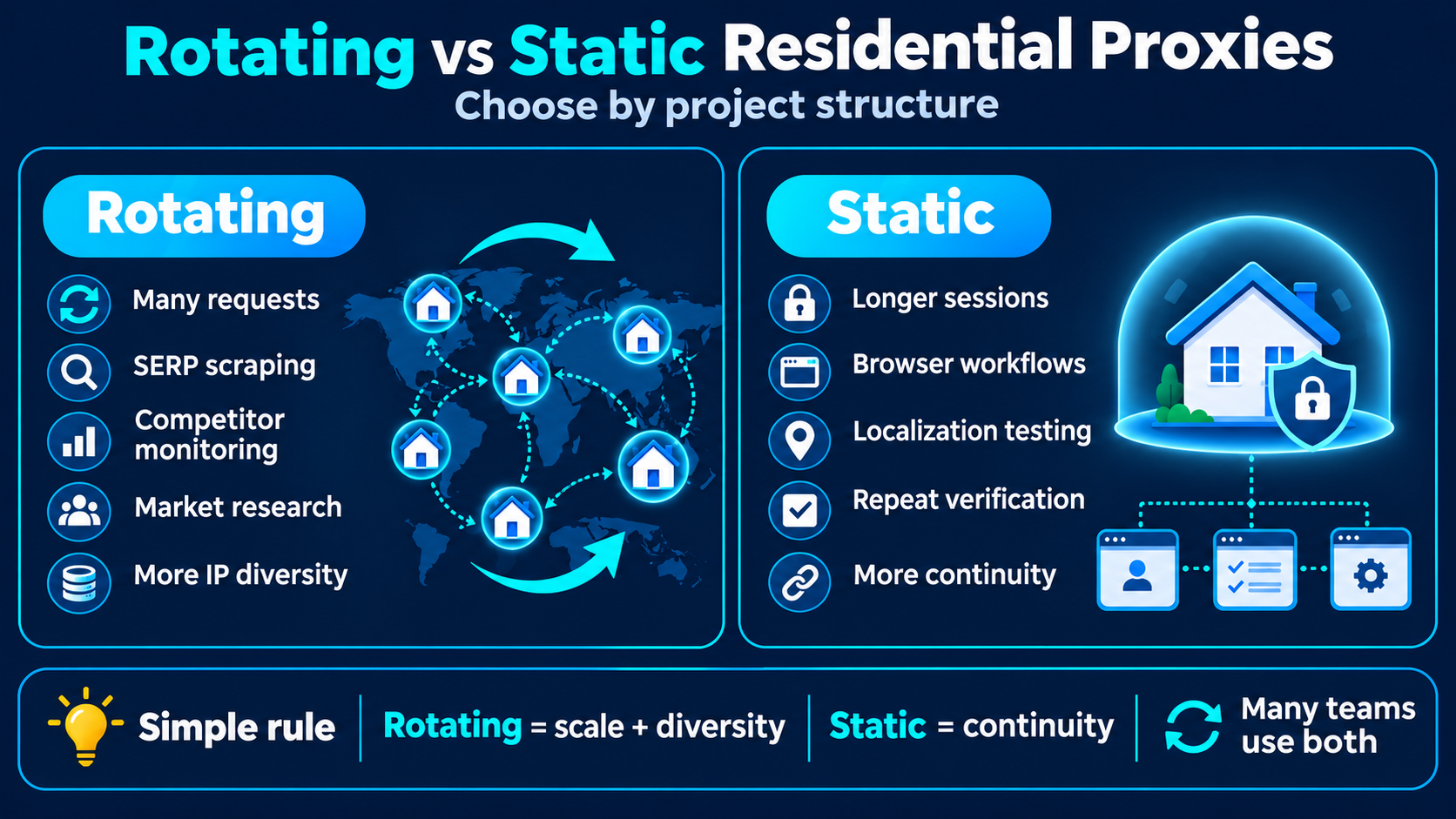
Rotating residential proxies are better suited to high-volume SERP scraping, competitor monitoring, and market research involving many independent requests. Static residential proxies are generally more suitable for longer browser sessions, localization testing, and repeated verification tasks.
Many professional workflows use both. Rotation provides scale and IP diversity, while static or sticky sessions provide continuity when a task requires it.
Frequently Asked Questions
Are residential proxies useful for Google scraping?
Residential proxies can support geographically distributed data collection and reduce dependence on a single server IP. They are particularly useful for SERP monitoring, market research, and other projects that need observations from multiple regions.
Should I use rotating or static residential proxies?
Use rotating residential proxies when your project involves many independent requests. Use of static residential proxies when maintaining the same IP throughout a longer session is more important.
Can proxies guarantee that scraping will never be blocked?
No. Proxy infrastructure is only one part of scraping reliability. Request volume, session behavior, website changes, and collection patterns can all affect access and data quality.
Final Thoughts
Reliable Google scraping depends on more than changing IP addresses. Residential proxies, a suitable proxy rotation strategy, controlled request rates, and consistent regional settings should work together as part of the same data collection workflow.
Rotating residential proxies are effective for scalable SERP monitoring and market research, while static residential proxies provide the continuity needed for repeated regional testing and ad verification. Choosing the right proxy type for each workload can improve both scraping efficiency and data consistency.
Before collecting data, businesses should also review applicable laws, website terms, and platform policies to ensure their scraping activities are appropriate for the intended use.
Note sur l'auteur
 Solutions proxy résidentielles de haut niveau
 {{item.title}}
Articles liés

 469



- Veuillez fournir votre numéro de compte ou votre adresse courriel.
- Fournissez des vidéos ou des captures d'écran et décrivez simplement les problèmes auxquels vous êtes confronté.
- Notre personnel répondra à votre message dans les 24 heures.



