







University Guide to International Academic Database Access and Public Data Collection
Discover how residential proxies and Swiftproxy’s non-expiring traffic support connection continuity for authorized academic research and compliant public data collection.

Universities and research teams may face network routing differences, limited service availability, and interrupted sessions when accessing international academic resources. These issues can slow long-term research and authorized public data collection.
Proxy services should not be used to bypass paywalls, licensing rules, authentication systems, geographic restrictions, or other access controls.
Residential proxies, static residential proxies, and proxy rotation may support connection continuity for authorized academic research. Swiftproxy’s non-expiring traffic model allows eligible unused traffic to remain available for future project stages, subject to applicable plans and service terms.
Residential Proxies for Academic Data Access
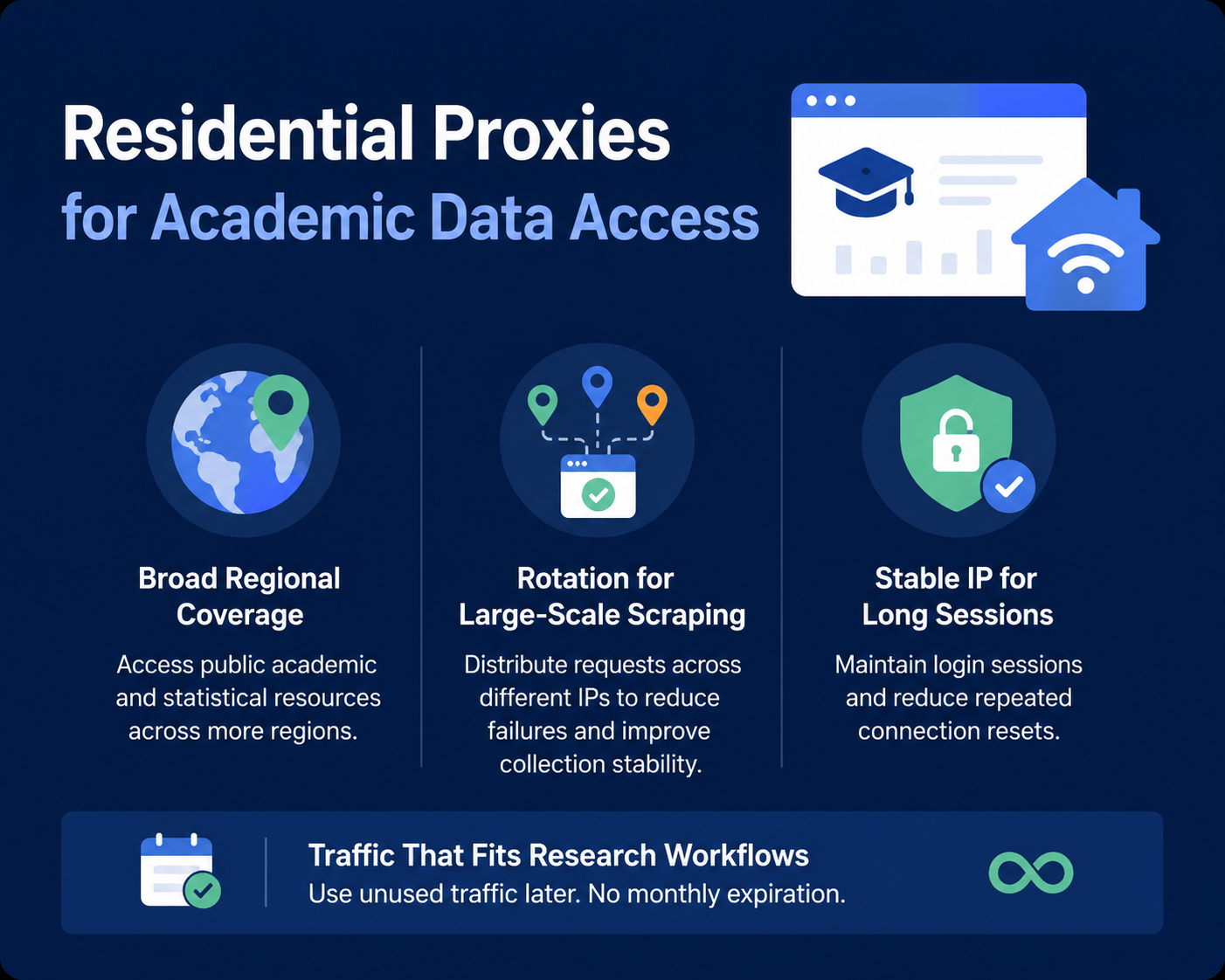
Residential proxies use IP addresses assigned by internet service providers to real household connections. They can provide broader regional coverage for accessing public academic and statistical resources.
For authorized and rate-limited public data collection, proxy rotation may reduce dependence on a single network endpoint and support geographically distributed research workflows. Rotation should not be used to bypass access controls, request limits, CAPTCHAs, blocking measures, or website restrictions.
Static residential proxies may support research sessions that require a consistent network endpoint. Their use should remain within database policies and institutional access rules.
Researchers should use only approved accounts and credentials. They should not share credentials or bypass concurrent-user limits.
Supporting Public Data Collection
Researchers may collect publicly available or properly licensed information from journals, university repositories, and government databases. Collection should follow applicable privacy, copyright, licensing, database, and platform requirements.
When datasets contain personal information, teams should collect only necessary data. They should also apply appropriate legal, security, and retention controls.
Research teams should follow website policies, request limits, institutional rules, and applicable regulations. Official APIs, licensed datasets, and approved download tools should be prioritized when available.
A suitable proxy setup may reduce reliance on a single network endpoint. It may also support authorized regional market research involving publicly accessible information.
Flexible Traffic for Long-Term Research
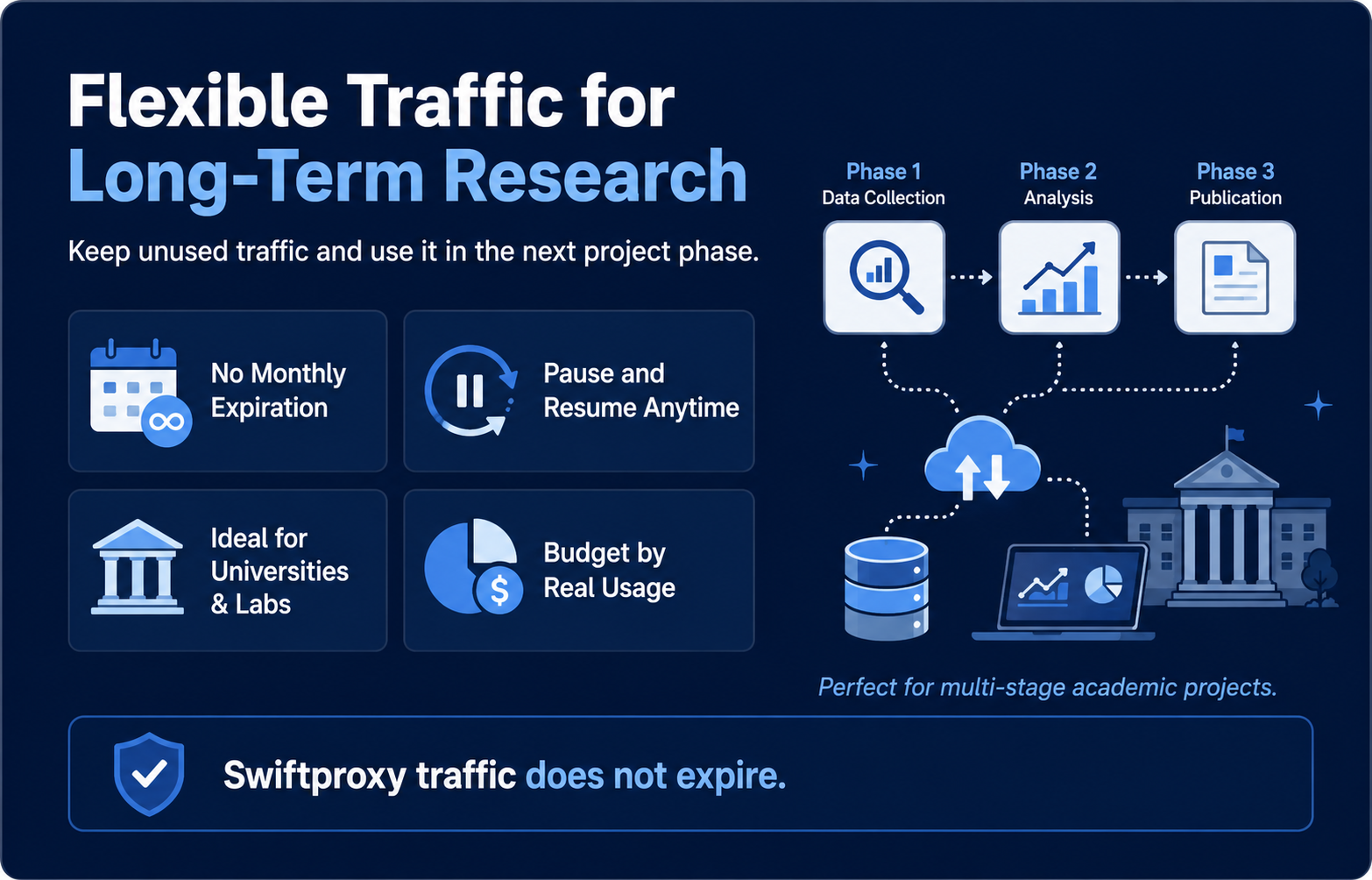
Academic projects often progress in stages. Data collection may pause while teams review results, revise methods, or wait for approval.
Monthly traffic expiration may not suit intermittent research workflows. Unused bandwidth may be lost before the next project stage begins.
Under applicable plans and service terms, eligible Swiftproxy traffic does not expire. Research teams can retain unused traffic for later use.
This model may suit universities, laboratories, and long-term research projects. It can help align traffic purchases with project schedules and actual usage.
Supporting Research Network Continuity
Rotating residential proxies may support authorized public data collection across multiple regions. Static residential proxies may be more suitable for workflows that require consistent sessions.
The appropriate option depends on geographic coverage, session continuity, request volume, and access policies. Careful proxy selection may support more flexible research workflows.
Swiftproxy provides residential proxy solutions for long-term data projects. Its non-expiring traffic model is designed for research schedules that change over time.
Applications Beyond Academic Research
Proxy infrastructure may also support authorized market research and ad verification. Researchers can review public market information or compare permitted digital content across regions.
Residential proxies may provide broader geographic coverage. Static residential proxies may support more consistent sessions. Both should be used in accordance with applicable laws, platform policies, and access requirements.
Conclusion
International academic research may be affected by network routing differences, service availability, and interrupted sessions. Residential proxies, static residential proxies, and proxy rotation may support connection continuity for authorized research and responsible public data collection.
Swiftproxy’s non-expiring traffic model may suit long-term and intermittent projects. Eligible unused traffic can remain available when research teams pause and later resume their work
關於作者
 頂級住宅代理解決方案
 {{item.title}}

 501
501