







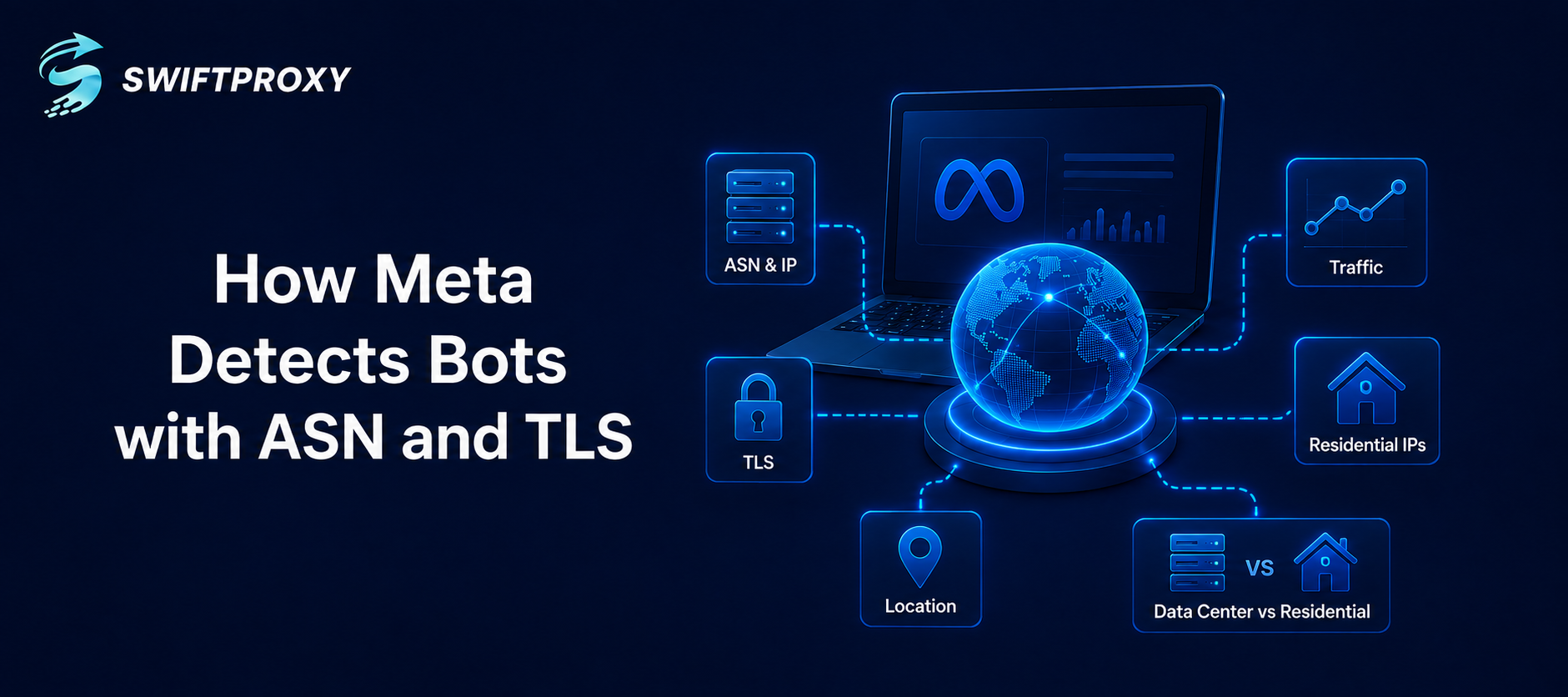
How Meta Detects Bots with ASN and TLS
Learn how Meta and modern anti-bot systems evaluate ASN classifications, TLS fingerprints (JA3/JA4), and network signals to detect automated traffic beyond browser fingerprints.

Bot Detection Goes Beyond Browser Fingerprints
Cookies, user agents, and browser fingerprints are only part of modern bot detection. Large platforms can also evaluate the network behind each request, including its IP reputation, ASN, TLS characteristics, location, and traffic patterns.
Meta does not publicly disclose its complete detection model. However, modern anti-bot systems commonly combine network and browser signals instead of relying on a single fingerprint.
For web scraping, market research, and ad verification, this means IP quality and network origin can be just as important as browser configuration.
Why Datacenter IPs Stand Out
Every public IP is associated with an Autonomous System Number, or ASN. ASN information can indicate whether traffic originates from a cloud provider, hosting company, mobile carrier, or consumer ISP.
Datacenter IP ranges are often linked to hosting infrastructure, making them relatively easy to classify even when the individual IP is new.
Residential IPs, by contrast, are associated with consumer ISP networks. This gives them network characteristics closer to ordinary household internet connections.
TLS Fingerprints Add Another Layer
HTTPS encrypts page content, but the TLS handshake still exposes technical characteristics such as protocol versions, cipher suites, and extensions.
Fingerprinting methods such as JA3 and JA4 can use these characteristics to classify different TLS clients. Changing an IP address therefore does not automatically change the connection profile created by the browser or networking stack.
Modern risk systems can evaluate ASN, IP reputation, TLS behavior, browser environment, geography, and request patterns together. Consistency across these signals is often more important than any single fingerprint.
Why Residential Proxies Matter
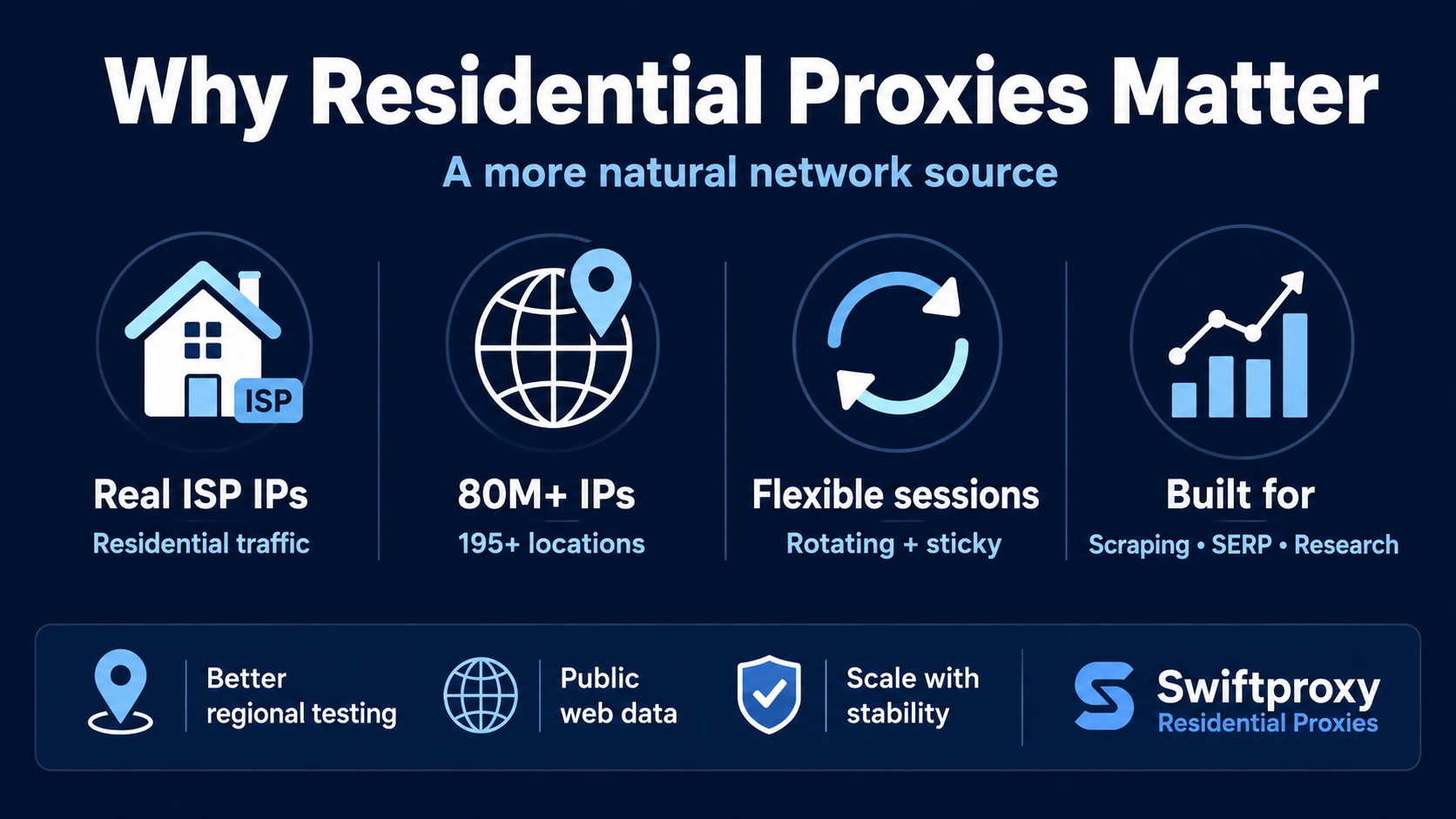
Residential proxies route requests through IP addresses associated with consumer ISP networks. Compared with datacenter proxies, they provide a network environment that more closely reflects normal residential internet traffic.
Swiftproxy offers 80M+ residential IPs across 195+ locations, together with rotating and sticky session options.
Businesses involved in web scraping, price tracking, SERP monitoring, and market research can use Swiftproxy Residential Proxies to collect public web data across different regions and ISP networks.
Their value is not in making automation invisible, but in providing a more appropriate network source for legitimate data collection and regional testing.
Rotating vs Static Residential Proxies
Choosing between rotating and static residential proxies depends on the workload.
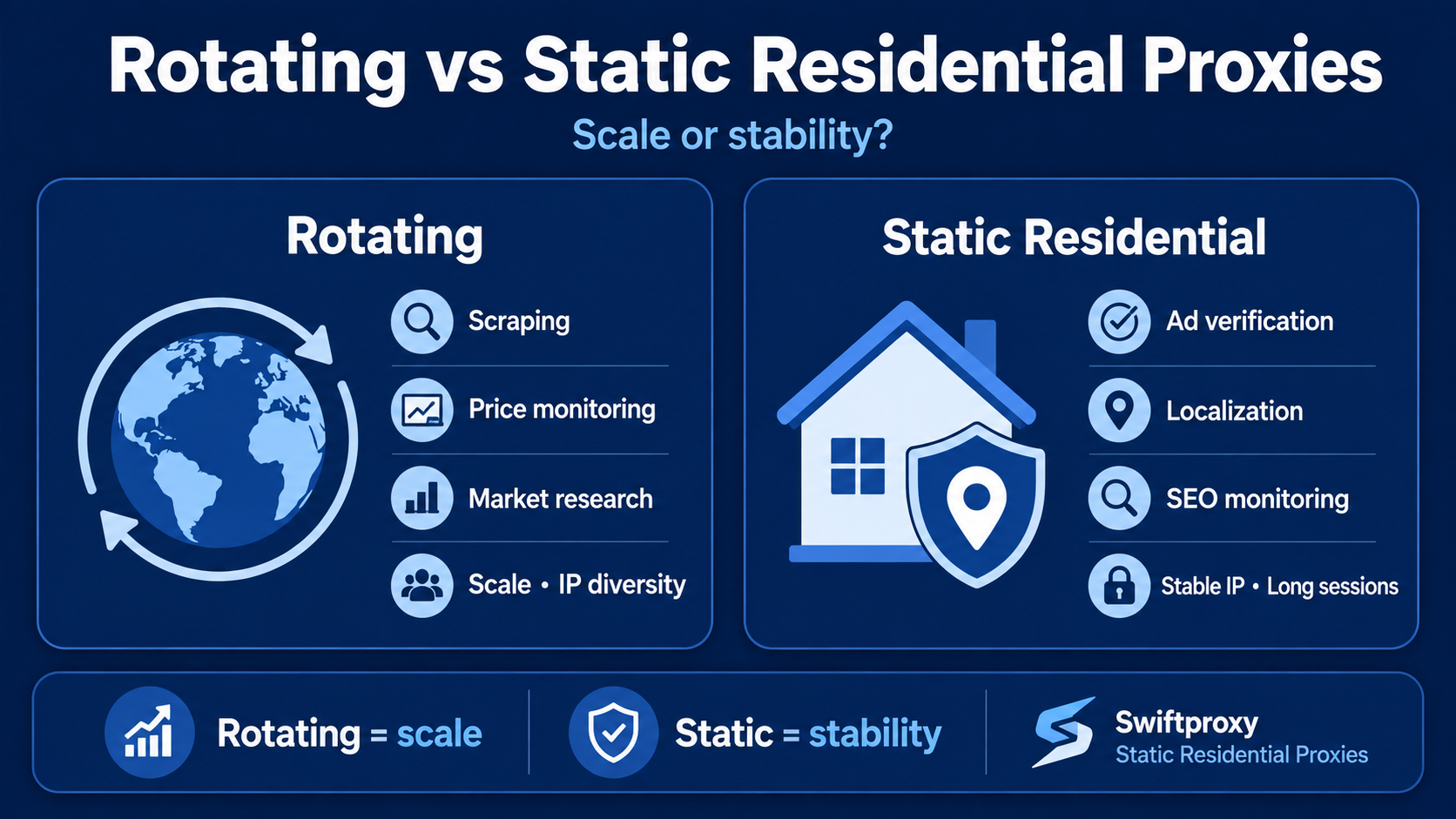
Rotating residential proxies are well suited to web scraping, price monitoring, and market research involving many independent requests. Proxy rotation provides broader IP diversity and geographic coverage.
Static residential proxies are better for workflows that require the same IP over longer periods, such as ad verification, localization testing, SEO monitoring, and persistent regional sessions.
For these use cases, Swiftproxy Static Residential Proxies provide stable residential IP connections with greater session consistency.
In short, rotating proxies prioritize scale, while static residential proxies prioritize stability.
Web Scraping, Market Research, and Ad Verification
Online content often changes by location. Search results, ecommerce prices, advertisements, promotions, and product availability may all vary between markets.
Rotating residential proxies help collect public data across multiple regions, while static or sticky sessions are better suited to repeated regional testing and ad verification.
The best results come from matching proxy type, location, and session duration to the actual workload rather than rotating IPs unnecessarily.
The Bottom Line
Modern bot detection extends beyond cookies and browser fingerprints. ASN classification, IP reputation, TLS fingerprints, geography, and traffic behavior can all influence how a connection is evaluated.
For web scraping, market research, and ad verification, residential proxies provide network characteristics closer to ordinary consumer connections than traditional datacenter IPs.
With 80M+ residential IPs, rotating sessions, sticky connections, and static residential options, Swiftproxy provides flexible proxy infrastructure for both large-scale data collection and stable regional workflows.
關於作者
 頂級住宅代理解決方案
 {{item.title}}

 24
24