








Static Residential Proxies: How They Work, Benefits & Use Cases
Learn what static residential proxies are, how they work, and their benefits for web scraping, market research, SEO monitoring, ad verification, and stable sessions.

Static residential proxies provide a fixed residential IP for tasks that require a consistent network identity. Unlike rotating residential proxies, which can switch IP addresses between requests or sessions, static proxies keep the same IP for longer periods.
This makes them useful for persistent web sessions, web scraping, market research, ad verification, SEO monitoring, and regional website testing. Understanding when to use static proxies instead of rotating ones can help businesses build more reliable and efficient proxy workflows.
What Are Static Residential Proxies
Static residential proxies are proxy servers that use IP addresses associated with Internet Service Providers while maintaining the same address over an extended period. For this reason, they are also commonly called ISP proxies.
Their main advantage is consistency. Instead of receiving a different IP whenever a session changes, users can continue working through the same network identity.
This makes Swiftproxy Static Residential Proxies particularly relevant for workflows that depend on persistent connections and repeated access from the same location.
How Do Static Residential Proxies Work
A static residential proxy acts as an intermediary between your application and the destination website. Your request first travels through the proxy server, which forwards it using the assigned residential IP.
The website therefore sees the proxy IP rather than your original address. Because the assigned IP remains stable, related requests can continue through the same connection.
This is useful for tasks involving multiple steps, such as navigating several pages, testing localized content, maintaining an authorized session, or collecting data over time.
Static vs Rotating Residential Proxies
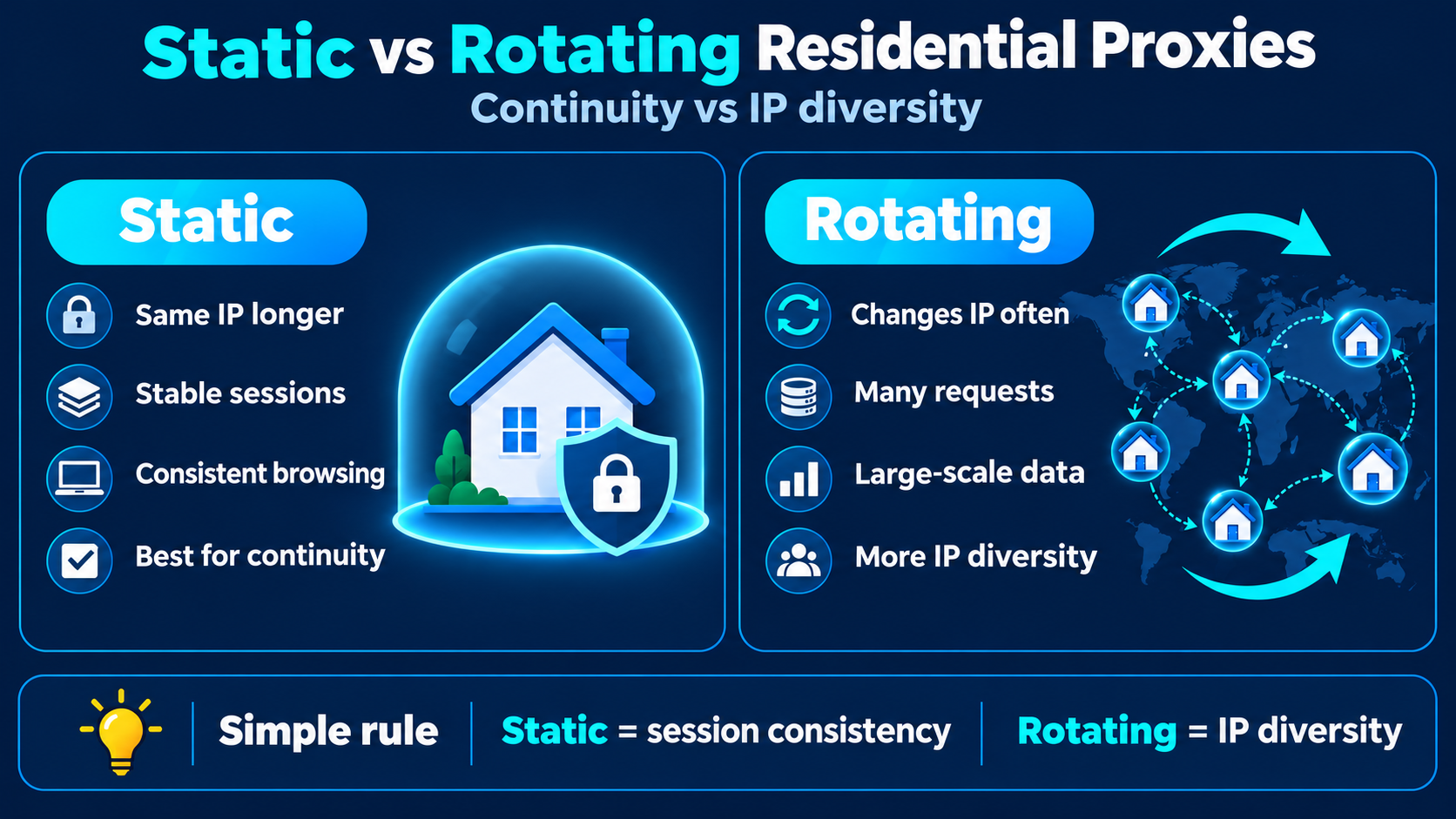
The main difference between static and rotating residential proxies is how IP addresses are managed.
Static residential proxies prioritize continuity. They are generally better for workflows where changing IP addresses could interrupt a session or create inconsistent browsing conditions.
Rotating residential proxies prioritize IP diversity. They change IP addresses automatically according to the session or rotation settings, making them better suited to large-scale data collection involving many independent requests.
A simple rule is:
- Static proxies for session consistency
- Rotating proxies for greater IP diversity
For projects that require flexible proxy rotation, Swiftproxy Residential Proxies provide an alternative to fixed-IP connections.
Key Benefits of Static Residential Proxies
Static residential proxies are especially valuable when the quality of a workflow depends on maintaining a predictable connection.
Their main benefits include:
- A consistent IP across longer sessions
- More predictable regional access
- Better continuity for multi-step tasks
- Easier monitoring from the same network location
- Reduced disruption caused by unnecessary IP changes
However, static residential proxies are not automatically the best solution for every project. When the workload consists of thousands of unrelated requests, rotating proxies may provide better scalability.
The proxy type should match how the application interacts with its target websites.
Static Residential Proxies for Web Scraping
Web scraping workflows can have very different requirements. Some involve thousands of independent URLs, while others require a sequence of connected requests.
Static residential proxies are particularly useful in the second scenario. A scraper may need to visit a category page, follow product links, maintain cookies, and continue collecting data within the same session.
Using a fixed IP helps preserve consistent network conditions throughout that process.
For large-scale scraping where each request can operate independently, rotating residential proxies are often more practical because traffic can be distributed across a broader range of IP addresses.
Market Research
Businesses increasingly rely on public web data to understand prices, product availability, promotions, and competitor activity across different markets.
Static residential proxies can help researchers monitor the same market repeatedly from a consistent geographic IP. This is useful when comparing information over time because unnecessary changes in network location can affect what a website displays.
Common market research applications include competitor monitoring, regional price analysis, product tracking, and promotional research.
For research covering many countries at scale, rotating residential proxies can complement static IPs by providing broader location and IP coverage.
Ad Verification
Digital advertisements can vary depending on location, targeting settings, browser conditions, and other factors. This makes regional ad verification an important task for advertisers, agencies, and brands.
Static residential proxies allow teams to inspect campaigns repeatedly from the same geographic network perspective. They can help verify whether regional ads, landing pages, and promotional content appear as expected.
A stable connection is especially useful when teams need to repeat the same checks under similar conditions.
However, IP location is only one element of ad delivery. Cookies, browser settings, devices, audience targeting, and campaign configuration can also influence the ads a user sees.
SEO and SERP Monitoring
Search engine results can differ between countries and regions. Businesses targeting international audiences therefore need a reliable way to monitor localized rankings and website experiences.
Static residential proxies can support repeated regional SERP checks, localized landing page testing, and competitor monitoring. By keeping the same IP location, teams can create more consistent conditions for recurring SEO checks.
Rotating residential proxies are usually more suitable when keyword tracking involves a large number of independent queries across multiple locations.
The right choice depends on whether the priority is consistency or scale.
When Should You Use Static Residential Proxies?
Static residential proxies make the most sense when your task benefits from keeping the same IP address throughout a session.
Typical use cases include persistent web scraping sessions, market monitoring, ad verification, SEO checks, website localization testing, and repeated access to regional content.
Rotating residential proxies are usually a better fit when many requests need to be distributed across different IP addresses. This is common in large-scale scraping, broad price monitoring, and high-volume public data collection.
For especially large workloads where traffic requirements are the main concern, businesses can also evaluate Swiftproxy Unlimited Residential Proxies alongside standard residential proxy options.
How to Choose a Static Residential Proxy Provider
A good proxy provider should match both the technical and geographic requirements of your project.
Start with IP stability. If maintaining the same address is important, the service should provide a connection model designed for persistent IP usage.
Next, consider geographic availability. Market research, SEO monitoring, and ad verification often depend on accessing content from specific countries or regions.
Protocol support and integration also matter. The proxies should work with the browsers, scraping tools, automation platforms, or custom applications used in your workflow.
Pricing should be evaluated against actual usage rather than network size alone. A small project requiring several stable IPs has very different needs from a large-scale data collection operation.
Finally, use proxies responsibly and follow applicable laws, access requirements, and website policies when collecting or analyzing online data.
Final Thoughts
Static residential proxies provide a practical solution for workflows where IP consistency matters more than frequent proxy rotation. Their stable network identity makes them useful for web scraping with persistent sessions, market research, ad verification, SEO monitoring, and regional website testing.
Rotating residential proxies solve a different problem by providing greater IP diversity for large-scale data collection. Choosing between the two should depend on session requirements, request volume, target locations, and the structure of the workflow.
For projects that require a stable residential IP over longer sessions, Swiftproxy Static Residential Proxies offer a straightforward starting point. Businesses that need broader IP rotation or higher-volume proxy infrastructure can choose a different Swiftproxy residential proxy solution based on their workload.
Frequently Asked Questions
What is a static residential proxy?
A static residential proxy provides an ISP-associated IP address that remains unchanged for a longer period. It is designed for tasks where maintaining the same network identity is useful.
Are static residential proxies the same as ISP proxies?
The terms are often used interchangeably. In commercial proxy services, ISP proxies generally refer to stable IP addresses associated with Internet Service Providers, although exact infrastructure can vary between providers.
Are static residential proxies good for web scraping?
Yes, particularly for scraping workflows that require persistent sessions or multiple connected requests. Rotating residential proxies may be more suitable for large-scale scraping involving many independent pages.
What is proxy rotation?
Proxy rotation is the process of changing the IP address used to send requests. An IP may rotate after every request, after a specific period, or when a new session begins.
Static or rotating residential proxies — which is better?
Neither option is better for every use case. Static residential proxies are more suitable when session continuity matters, while rotating residential proxies are generally better when IP diversity and request distribution are the priority.
關於作者
 頂級住宅代理解決方案
 {{item.title}}

 466






