








How to Monitor Brand Reputation with Residential Proxies
Learn how residential proxies support brand reputation monitoring, review tracking, competitor analysis, and regional SEO research to help businesses protect their online reputation.

A brand's reputation is influenced by what customers see across search engines, review sites, news pages, and competitor content. For global businesses, those results can vary significantly between markets, making manual monitoring difficult to scale.
Combining web scraping with residential proxies provides a more efficient way to track public information across locations. Businesses can monitor search visibility, analyze competitor activity, identify reputation risks, and collect market insights from a broader geographic perspective.
Why Brand Reputation Monitoring Matters
Customers rarely rely on a company's website alone when making a purchase decision. They may search for reviews, complaints, comparisons, alternatives, or recent news before deciding whether they trust a brand.
Regular monitoring helps businesses discover negative coverage early, follow changes in branded search results, and understand how competitors are positioning themselves.
This becomes more important for companies operating internationally. The content visible to a user in one country may differ from what appears in another, so relying on data collected from a single location can create an incomplete picture.
How Residential Proxies Support Reputation Monitoring
Residential proxies route requests through IP addresses associated with residential networks. For reputation monitoring, this makes it possible to collect public web data from different geographic perspectives.
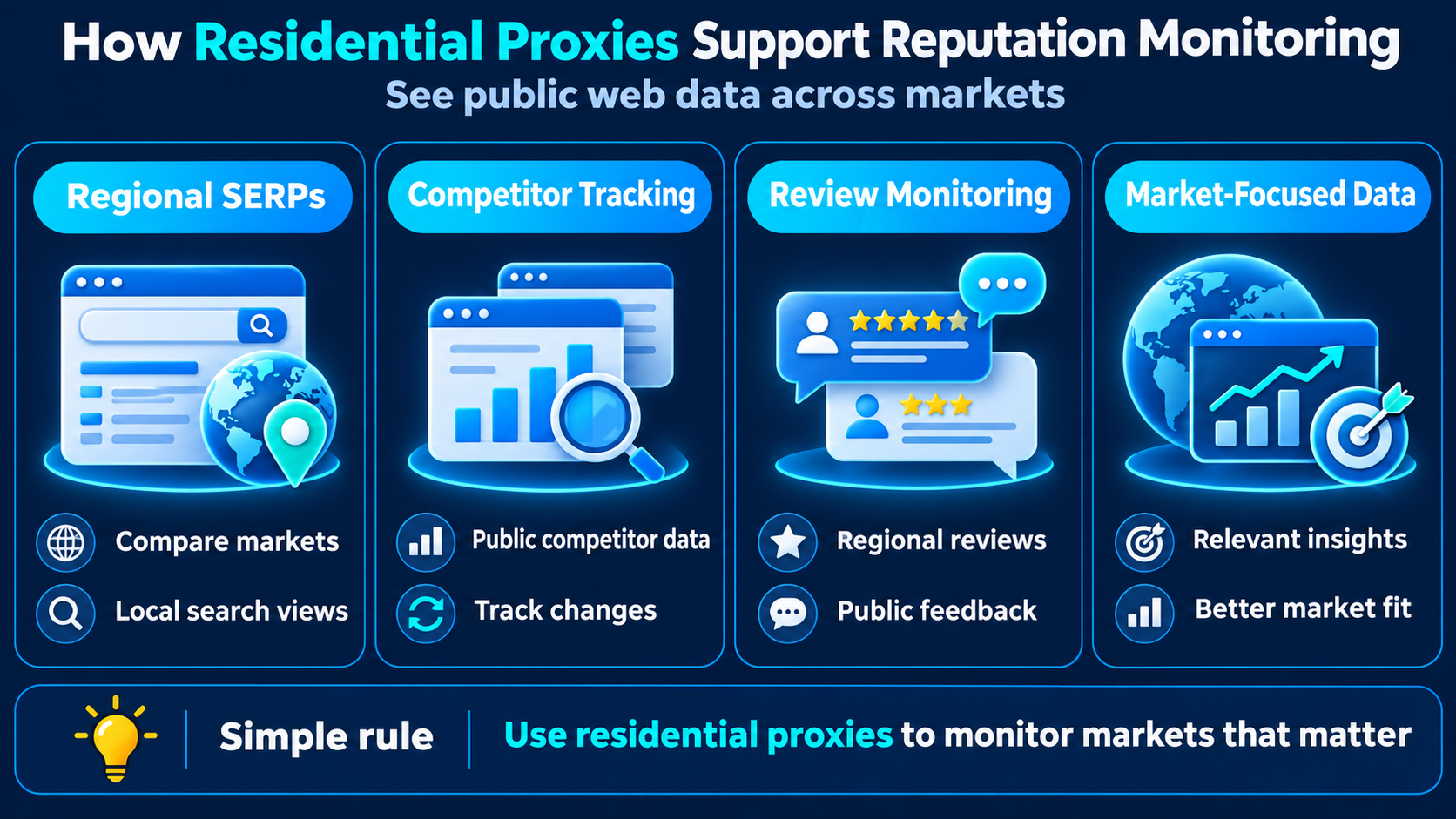
A company could, for example, compare branded SERPs in several target markets or monitor how regional review and competitor content changes over time.
Using Swiftproxy Residential Proxies with a scraping workflow can support regional SERP tracking, competitor analysis, review monitoring, and other large-scale data collection projects.
The goal is not simply to collect more data. It is to collect information that better reflects the markets a business actually serves.
Proxy Rotation for Scalable Web Scraping
Large monitoring projects can involve hundreds or thousands of requests across keywords, websites, and regions. Sending every request through one IP can make data collection less reliable and may trigger rate limits or temporary restrictions.
Proxy rotation distributes requests across different IP addresses. This makes rotating residential proxies especially useful when monitoring many independent pages or search queries.
For example, a business could use proxy rotation to track branded SERPs, compare competitor rankings, monitor public reviews, or collect regional pricing data.
Proxy rotation should still be combined with responsible request rates, retry logic, and data validation. A reliable scraping strategy depends on both proxy infrastructure and good collection practices.
When Static Residential Proxies Are Useful
Some workflows need consistency rather than frequent IP changes.
Static residential proxies maintain the same IP for a longer period, making them suitable for tasks that require stable sessions or repeated checks from a consistent network identity.
Swiftproxy Static Residential Proxies can be considered for monitoring tasks where session stability is more important than continuous rotation.
In practice, rotating residential proxies are better suited to distributed data collection, while static residential proxies are more appropriate for workflows that depend on IP consistency.
Using Proxy Data for Market Research
Brand reputation monitoring can also provide useful competitive intelligence.
Businesses can collect public information about competitor pricing, product positioning, customer feedback, search visibility, and promotional strategies. Comparing this data across markets can reveal regional trends that might not be visible from a single location.
For example, a retailer may discover that a competitor is promoting different products in different countries. An SEO team may find that competing brands dominate certain regional search results. A marketing team may identify new customer concerns appearing repeatedly in reviews.
These insights can support broader market research and help teams make more informed decisions.
Residential Proxies for Ad Verification
Location also matters in digital advertising.
Campaigns, landing pages, offers, and promotional messages may vary depending on the user's region. This makes regional verification useful for businesses running international campaigns.
Residential proxies can help teams view publicly available advertising experiences from different locations. They can be used to check whether localized landing pages display correctly, whether regional offers are consistent, and whether campaign destinations match expectations.
Ad verification data should be used alongside advertising platform analytics to provide a more complete view of campaign performance.
Build a Better Monitoring Workflow
A good reputation monitoring workflow starts with clearly defined search terms. These may include brand names, products, competitors, review queries, and keywords associated with complaints or alternatives.
Next, identify the markets and public sources that matter most. Use an appropriate proxy configuration to collect the data, then organize results by keyword, location, source, and date.
For projects that require larger-scale collection, Swiftproxy Web Scraping Proxies can be integrated into scraping workflows designed to gather public web data across multiple markets.
The final step is analysis. Rather than reacting to individual results, look for meaningful patterns such as declining branded visibility, repeated customer complaints, changing competitor positions, or sudden differences between regions.
Responsible Web Scraping
Residential proxies improve the flexibility of web data collection, but they should be used as part of a responsible scraping strategy.
Businesses should focus on publicly accessible information they are permitted to collect and follow applicable website policies, privacy requirements, and data protection rules. Request rates should remain reasonable, and scraping systems should include error handling and data validation.
When a website provides an official API that meets the project's needs, using that API may also be a suitable option.
Final Thoughts
Brand reputation monitoring is most useful when businesses can see how their online presence changes across markets, not just from a single location.
Residential proxies can support this process by enabling regional SERP scraping, web scraping, market research, competitor monitoring, and ad verification. Proxy rotation helps scale larger data collection projects, while static residential proxies provide stability when consistent sessions are required.
With the right proxy setup and a focused monitoring strategy, businesses can turn public web data into actionable insights and respond to reputation changes more effectively.
關於作者
 頂級住宅代理解決方案
 {{item.title}}

 445






