







Amazon Web Scraping with Residential Proxies: A Practical Guide
Learn how Amazon web scraping with residential proxies supports price monitoring, competitor research, and product tracking. Explore proxy rotation strategies and best practices for reliable data collection.

Amazon offers valuable public data for e-commerce research, including product prices, ratings, availability, seller information, and promotions. For businesses monitoring hundreds or thousands of products, collecting this information manually quickly becomes impractical. Web scraping makes large-scale monitoring possible, while residential proxies provide the network flexibility needed for more reliable data collection.
Why Businesses Scrape Amazon Data
Amazon data can support price intelligence, competitor analysis, product research, and regional market monitoring. Instead of relying on occasional manual checks, businesses can collect selected information over time and build datasets that reveal changes in pricing, availability, and product positioning.
For example, a retailer may track competitor prices to identify promotions or pricing trends. A market research team may monitor ratings, review counts, sellers, and availability to understand how products perform within a category. Consistent data collection turns individual Amazon pages into useful market intelligence.
Why Residential Proxies Matter for Amazon Scraping
Large-scale web scraping usually involves many requests. Sending all of them through a single IP address can lead to rate limits, temporary errors, or additional verification.
Residential proxies route requests through IP addresses associated with residential networks. This allows scraping systems to distribute requests across different IPs and, when needed, access public content from different geographic locations.
For projects requiring rotating IPs, geographic targeting, or sticky sessions, Swiftproxy Residential Proxies can provide the proxy layer for web scraping and market research workflows.
Proxies are only part of a reliable scraping setup. Request frequency, retry logic, session management, parsing, and data validation remain equally important.
How Proxy Rotation Works
Proxy rotation determines how often the IP address used by a scraper changes. Rotating residential proxies are particularly useful when a project needs to process large numbers of independent Amazon product pages.
Consider a price monitoring system collecting information from thousands of product URLs. Instead of routing every request through one IP, the scraping workload can be distributed through a residential proxy pool. This reduces dependence on a single network identity and makes larger research projects easier to scale.
Frequent rotation is not always necessary. If several requests belong to the same browsing session, keeping one IP for a period of time can produce more consistent results. Sticky sessions are better suited to these workflows.
Rotating vs Static Residential Proxies
The right proxy type depends on what the scraper needs to accomplish.
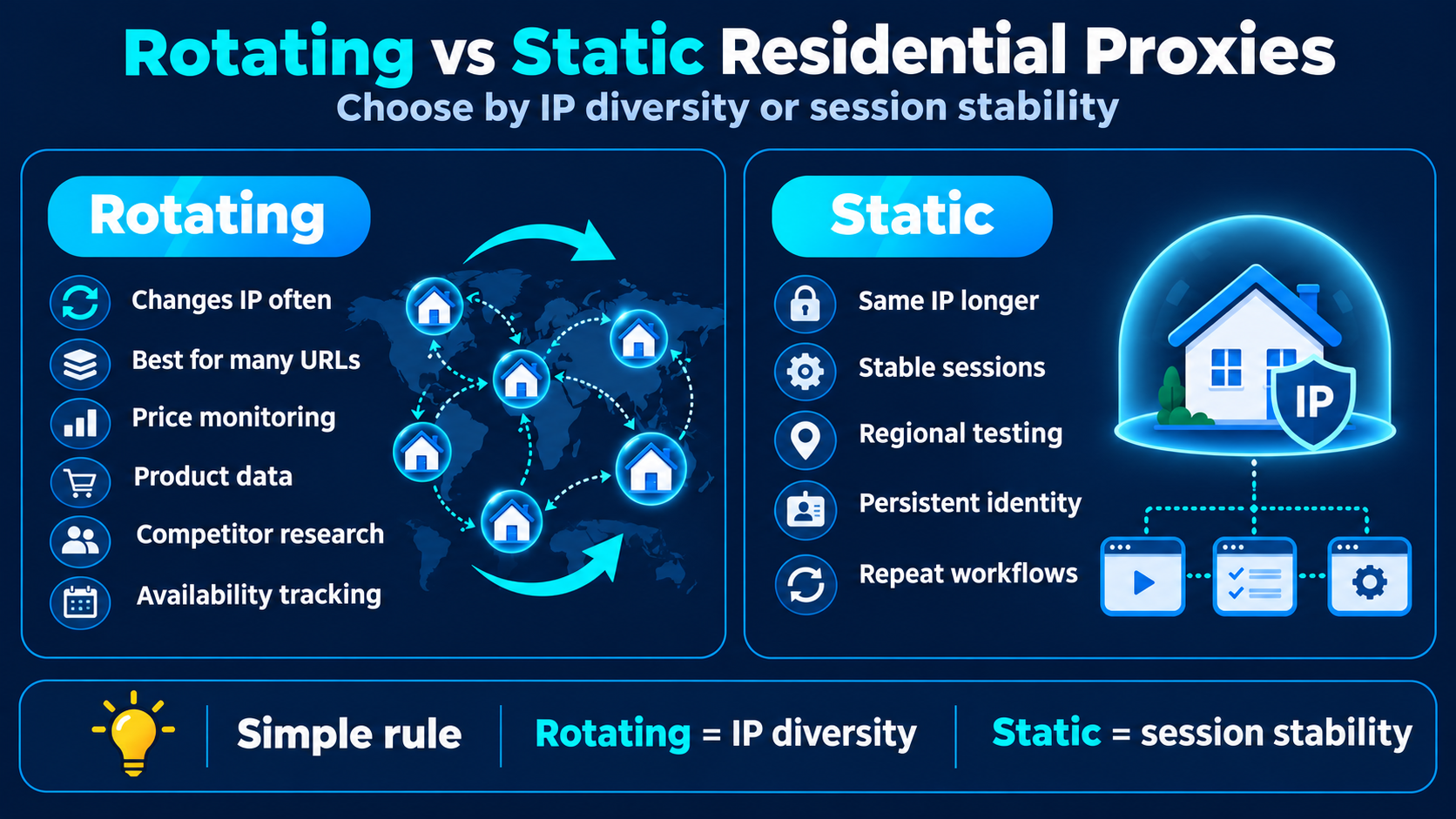
Rotating residential proxies are usually better for Amazon price monitoring, product data collection, competitor research, availability tracking, and other workloads involving many independent URLs.
Static residential proxies maintain the same IP address for longer periods. They are more suitable for stable sessions, repeated regional testing, or workflows that require a persistent network identity.
For projects where consistency matters more than frequent rotation, Swiftproxy Static Residential Proxies provide another option.
A simple rule is to use rotating proxies when IP diversity matters and static residential proxies when session stability matters.
Building a Reliable Amazon Scraping Workflow
A successful scraping project should begin with a clearly defined dataset. For price monitoring, this might include product ID, title, price, currency, seller, availability, and collection time. Market research projects may also track ratings, review counts, and product attributes.
Once the required data is clear, focus on four areas:
- Choose the right proxy strategy. Use rotating residential proxies for independent requests and sticky or static connections when session continuity matters.
- Control request frequency. Start with reasonable concurrency and increase it only after monitoring response quality.
- Add retry and backoff logic. Temporary failures should trigger controlled retries instead of repeated immediate requests.
- Validate the data. A successful page response does not always mean the expected product information was returned.
These practices improve data quality while reducing unnecessary requests and processing costs.
Using Amazon Data for Market Research
Amazon scraping becomes more valuable when information is collected consistently over time. A single price provides a snapshot, while historical data can reveal price changes, promotions, inventory patterns, and competitor reactions.
The same approach can be applied to ratings, reviews, seller changes, and product availability. Businesses can use these signals to evaluate competitors, identify category trends, and support pricing or product decisions.
Regional research is another important use case. Amazon content can vary between markets, so residential proxies can help researchers compare publicly accessible product information from different geographic perspectives.
Residential Proxies for Ad Verification
Residential proxies can also support regional ad verification. Brands and agencies may need to check whether promotions, advertisements, or landing pages appear correctly in different locations.
Connecting through residential IPs from relevant regions provides one geographic perspective for these tests. However, ad delivery can also depend on cookies, device type, language, account state, and campaign targeting, so proxy location should not be treated as the only variable.
Common Amazon Scraping Mistakes
A common mistake is assuming that proxy rotation alone will make a scraper reliable. Changing IP addresses cannot solve excessive request rates, incorrect parsing, poor retry logic, or incomplete data validation.
Another mistake is changing IPs during workflows that require session continuity. Proxy behavior should match the structure of the scraping task rather than applying maximum rotation to every request.
It is also better to collect only the data required for the project. Clearly defined datasets reduce bandwidth, storage requirements, and unnecessary processing.
Responsible Web Scraping
Residential proxies should be used as infrastructure for legitimate data collection. Businesses should review applicable website terms, access requirements, available APIs, and relevant laws before starting an Amazon scraping project.
Where an official API or licensed data source meets the project's requirements, it should also be considered. Responsible request rates and careful data handling help create more sustainable research workflows.
Final Thoughts
Amazon web scraping can provide useful insights for price monitoring, competitor research, product intelligence, and regional market analysis. Residential proxies make these workflows more flexible by supporting distributed requests, geographic targeting, and different session strategies.
Rotating residential proxies are well suited to large-scale data collection, while static residential proxies provide greater consistency for session-based workflows. Combining the right proxy strategy with controlled requests, reliable parsing, retry logic, and data validation creates a stronger foundation for scalable market research.
Frequently Asked Questions
Are Residential Proxies Good for Amazon Scraping?
Residential proxies can support Amazon web scraping by distributing requests and providing connections from different geographic locations. They are particularly useful for larger price monitoring and market research projects.
Should I Use Rotating or Static Residential Proxies?
Rotating residential proxies are usually better for large numbers of independent product requests. Static or sticky residential connections are more suitable when a stable session or consistent IP is required.
Can Residential Proxies Help with Amazon Price Monitoring?
Yes. They can provide the network infrastructure needed for distributed and regional price monitoring. The scraping application remains responsible for extracting, validating, storing, and analyzing the collected information.
Can Residential Proxies Be Used for Ad Verification?
Yes. Residential proxies can support legitimate regional ad verification by allowing businesses to view publicly accessible content from different geographic network locations.
關於作者
 頂級住宅代理解決方案
 {{item.title}}

 429