







What You Need to Know About Reverse Proxies
Learn how reverse proxies sit between users and backend servers to optimize traffic routing, enable load balancing, and enhance application security.

A reverse proxy sits between users and one or more backend servers. It receives incoming requests, forwards them to the appropriate server, and returns the response to the client. This gives organizations greater control over application traffic, performance, and security.
How Reverse Proxies Work
Users connect to the reverse proxy instead of communicating directly with the origin server. The proxy routes each request according to factors such as server availability, application rules, and traffic conditions.
The client normally receives the response without needing to know which backend server processed the request.
Performance and Reliability
Reverse proxies can distribute requests across several backend servers when load balancing is configured. This may reduce pressure on individual systems and redirect traffic when a server becomes unavailable.
Caching can also reduce repeated requests to the origin. Frequently requested content may be stored and delivered more efficiently. Actual performance depends on infrastructure, cache settings, traffic patterns, and application design.
Security Benefits
A reverse proxy can reduce direct exposure of backend server addresses. Some solutions also support TLS termination, connection limits, traffic filtering, logging, and integration with web application firewalls.
These features can reduce certain risks, but they do not guarantee protection from DDoS attacks, unauthorized access, malware, or software vulnerabilities. Reverse proxies should be combined with authentication, firewalls, access controls, monitoring, updates, and redundant infrastructure.
Reverse Proxies and Forward Proxies
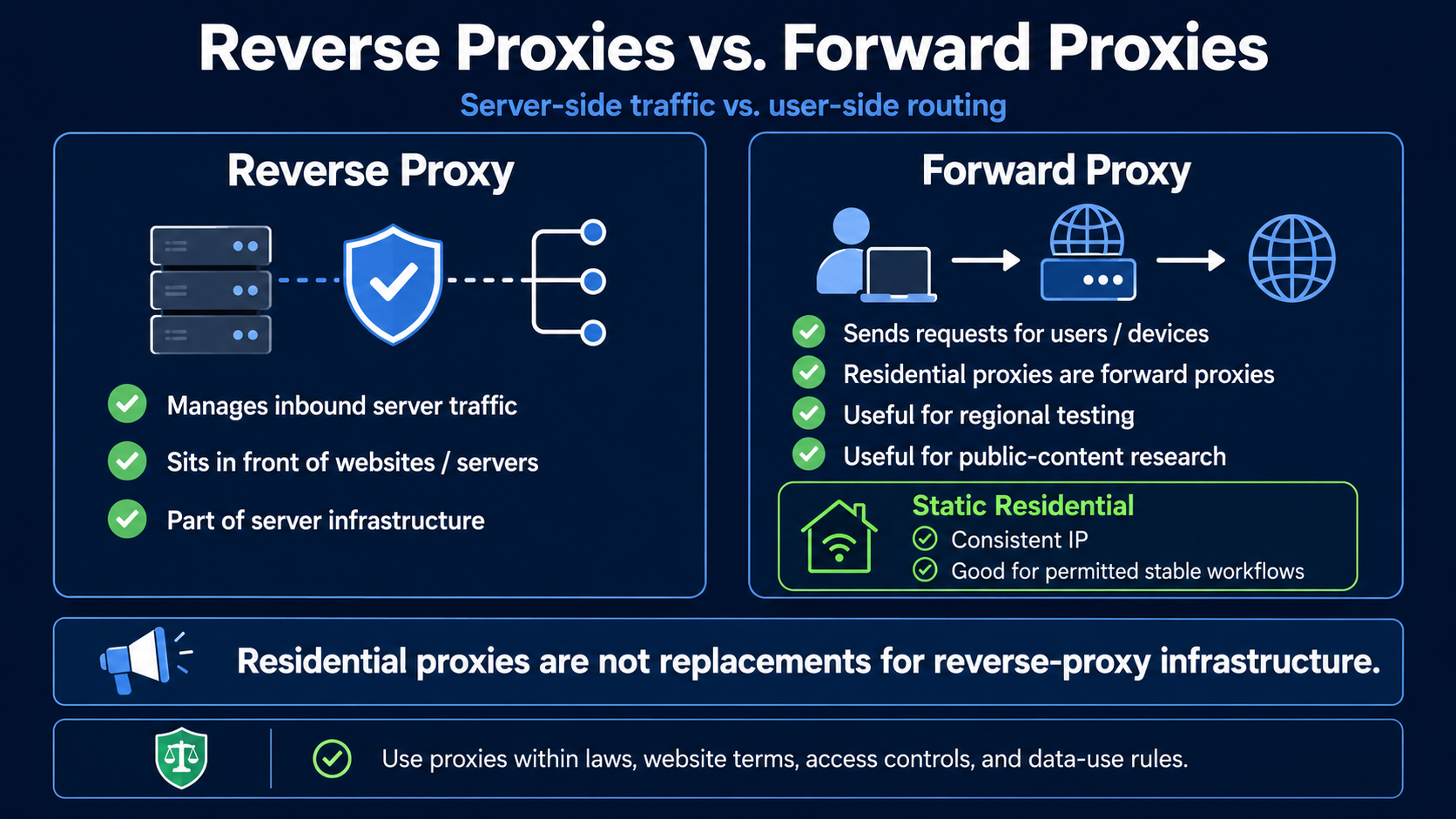
A reverse proxy manages traffic entering a server environment, while a forward proxy sends requests on behalf of a user or device.
Residential proxies are forward proxies and should not be presented as replacements for reverse-proxy infrastructure. Swiftproxy offers residential proxies that may support authorized regional testing and public-content research. Its static residential proxies may suit permitted workflows that require a consistent IP address.
All proxy use should comply with applicable laws, website terms, access controls, and data-use requirements.
Choosing a Reverse Proxy Solution
Organizations should evaluate traffic volume, routing requirements, TLS support, caching, health checks, logging, monitoring, and redundancy. The selected solution should provide secure configuration options and clear technical documentation.
Regular testing and configuration reviews are necessary because an unavailable or incorrectly configured reverse proxy can interrupt access to backend services.
Conclusion
Reverse proxies can support application delivery through traffic routing, caching, load distribution, and reduced origin exposure. Their effectiveness depends on correct configuration and integration with broader security and availability controls.
They should be treated as one part of a complete infrastructure strategy rather than a guarantee of security or uninterrupted service.
關於作者
 頂級住宅代理解決方案
 {{item.title}}

 497
497