







Applications and Limitations of Proxy Servers
Learn the practical applications and technical limitations of proxy servers for traffic management, regional testing, privacy, and compliant network usage.


A proxy server routes internet requests between a device and an online service. Depending on its configuration, it may manage traffic, cache content, apply access rules, or reduce direct exposure of the user’s original IP address.
However, a proxy does not automatically guarantee anonymity, encryption, security, or access to online services.
Common Applications
Businesses may use proxies for authorized website testing, application monitoring, localization checks, and public-content research. Network administrators may also use them to manage bandwidth, filter traffic, or separate approved testing environments.
Residential proxies can support permitted research across different locations. Static residential proxies may be more suitable when a legitimate workflow requires a consistent IP address and stable session.
Privacy and Security
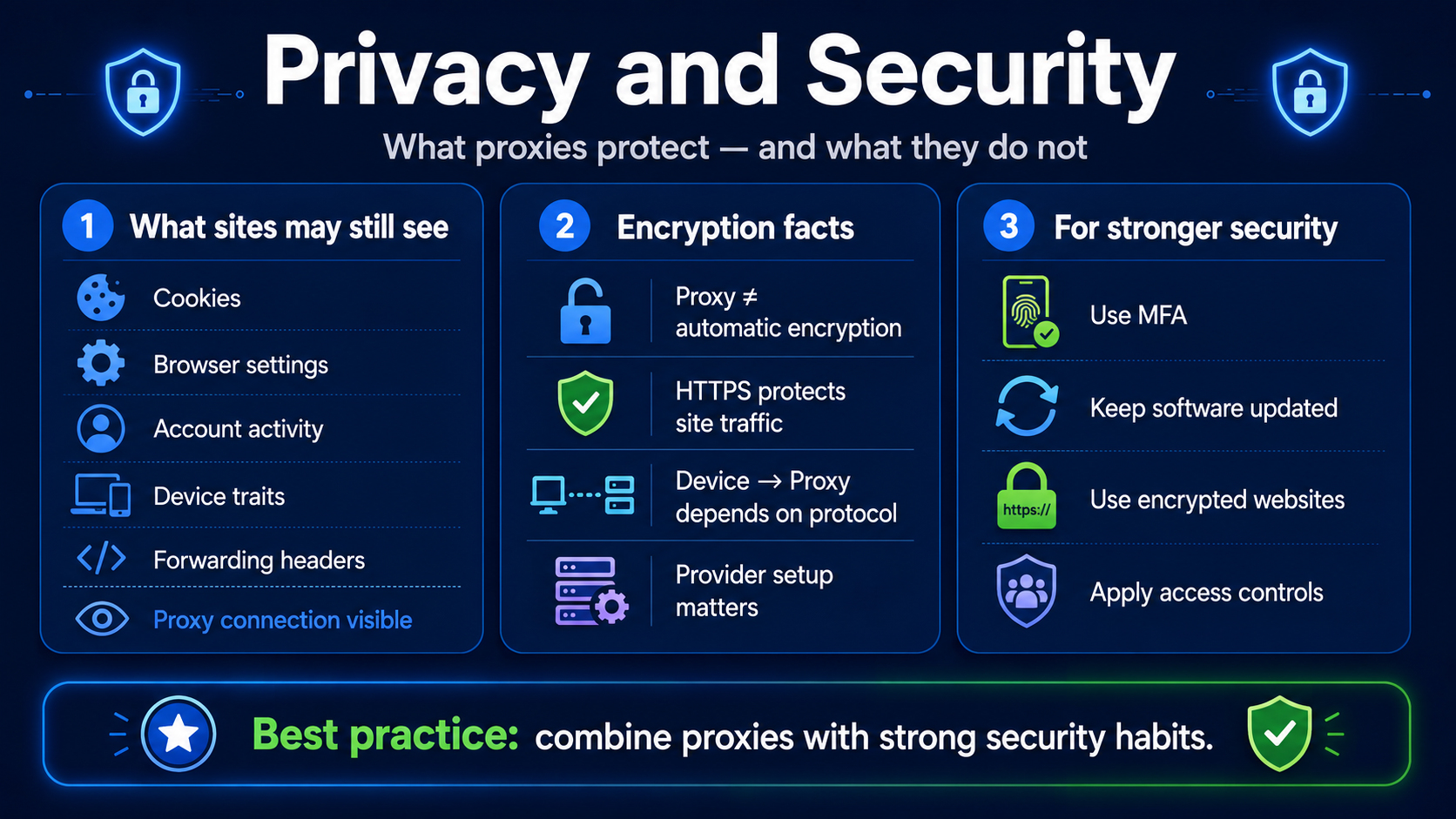
A destination service generally sees the proxy connection, but it may still receive information through cookies, browser settings, account activity, device characteristics, or forwarding headers.
Proxies also do not automatically encrypt all network traffic. HTTPS protects communication with the destination website, while protection between the device and proxy depends on the selected protocol and provider configuration.
For stronger security, users should combine proxies with multi-factor authentication, updated software, encrypted websites, and appropriate access controls.
Key Limitations
Proxy performance may vary because of server location, infrastructure, traffic levels, and network conditions. Routing through an additional server can increase latency or affect connection stability.
The provider may also process or retain connection information. Users should therefore review its privacy policy, authentication options, logging practices, traffic limits, and service terms.
Unknown or free proxies may present additional security and reliability risks. Sensitive information should only be transmitted through trusted applications and encrypted connections.
Choosing a Proxy Service
Swiftproxy offers residential proxies for authorized regional testing and permitted public-content research. Its static residential proxies may support approved workflows requiring a consistent IP address.
Swiftproxy currently supports HTTP/HTTPS and SOCKS5 protocols. Users should select a product based on location coverage, session requirements, authentication, traffic needs, and applicable service rules.
Responsible Use
Proxies should not be used to bypass access controls, evade platform enforcement, conceal harmful automation, or collect restricted information. Technical access does not automatically provide permission to use or redistribute online content.
All activity should comply with applicable laws, website terms, privacy requirements, intellectual-property rules, and organizational policies.
Conclusion
Proxy servers can support traffic management, regional testing, application monitoring, and other authorized activities. They may reduce direct IP exposure, but they do not provide complete privacy or security.
The appropriate proxy depends on the intended purpose, technical requirements, provider practices, and compliance obligations.
關於作者
 頂級住宅代理解決方案
 {{item.title}}

 494
494