







Why Proxy Speed Matters: Optimizing Residential Proxy Performance
This article explains how proxy speed impacts business performance and explores how residential proxies improve data access, automation efficiency, and global scalability.

For businesses relying on global data access, proxies are no longer just tools for changing IP addresses. As automation, web data collection, and digital operations expand, proxy performance has become essential to business efficiency.
Whether for web scraping, market research, competitor monitoring, ad verification, or SEO tracking, proxy speed directly affects productivity. Reliable proxy networks enable smoother workflows, higher request success rates, and better scalability.
Today, enterprises care not only about the size of a proxy IP pool but also how efficiently those IPs support large-scale operations.
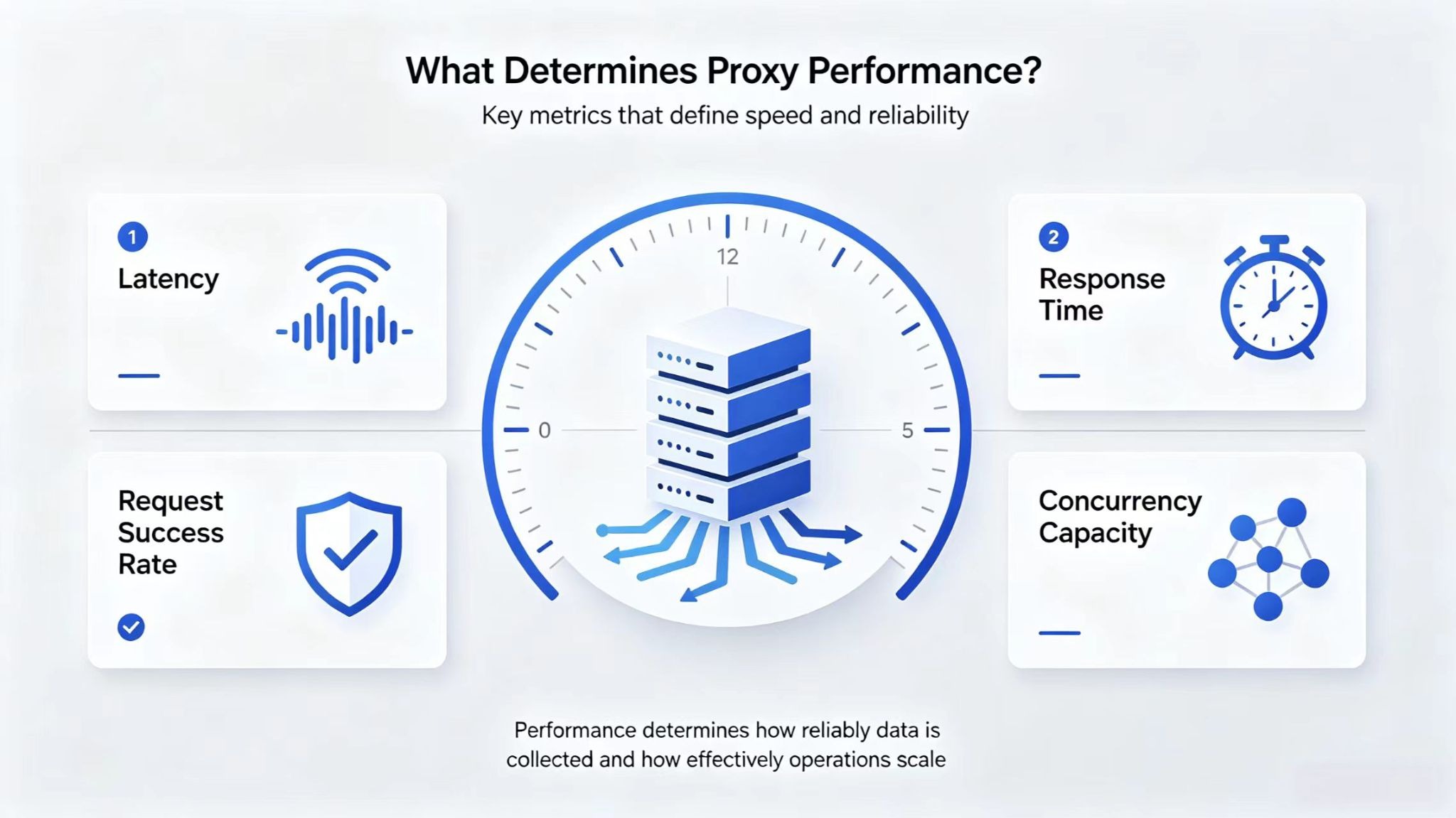
What Determines Proxy Performance?
Proxy performance depends on several technical factors, including latency, response time, request success rate, and concurrency capacity.
These metrics determine how quickly requests are processed, how reliably data can be collected, and how effectively businesses can scale their online operations.
Latency: The Foundation of Proxy Speed
Latency refers to the time required for a request to travel through a proxy server to the target website and return with a response. Lower latency means faster communication and better overall performance.
In large-scale scraping environments, even a 100ms latency difference can significantly impact total processing time when millions of requests are executed.
For businesses operating real-time data workflows, latency plays an important role. SEO monitoring platforms need quick access to search results from different regions, market research systems require timely data collection, and ad verification platforms depend on fast connections to confirm campaign visibility.
High-performance residential proxy networks optimize latency by combining geographically distributed IP pools, ISP-based connections, and intelligent routing technologies.
Response Time: Improving Data Collection Efficiency
While latency focuses on network delay, response time measures the total time needed to complete a request, including server processing and data delivery.
For large-scale web scraping, response time directly affects how quickly businesses can collect and analyze information. Slow proxies may lead to longer scraping cycles, outdated data, and reduced monitoring efficiency.
Reliable residential proxies with optimized infrastructure allow businesses to collect public web data more efficiently. Combined with features such as global IP coverage and proxy rotation, they help maintain stable access across different websites without depending on a single IP address.
Request Success Rate: Reliable Access Matters
Proxy speed alone does not guarantee successful operations. A fast connection is ineffective if requests frequently fail due to IP blocks, unstable networks, or poor-quality IP resources.
A high request success rate is essential for businesses collecting large amounts of online data. Failed requests can result in incomplete datasets and inaccurate business decisions.
Proxy rotation improves reliability by distributing requests across multiple IP addresses. Dynamic residential proxies automatically rotate IPs based on usage requirements, making them suitable for web scraping, price monitoring, SERP tracking, and market intelligence.
For tasks that require a consistent identity, such as long sessions or account management, businesses can use static residential proxies to maintain reliable connectivity with dedicated residential IP addresses.
Concurrency: Supporting Large-Scale Operations
Concurrency refers to the number of requests a proxy system can handle at the same time. As business operations grow, the ability to process multiple connections simultaneously becomes increasingly important.
Large-scale web scraping, global market research, and ad verification often require thousands of parallel requests. Without sufficient concurrency capacity, businesses may experience slow data collection, request delays, and reduced automation efficiency.
A scalable proxy network enables companies to handle higher workloads while maintaining stable performance.
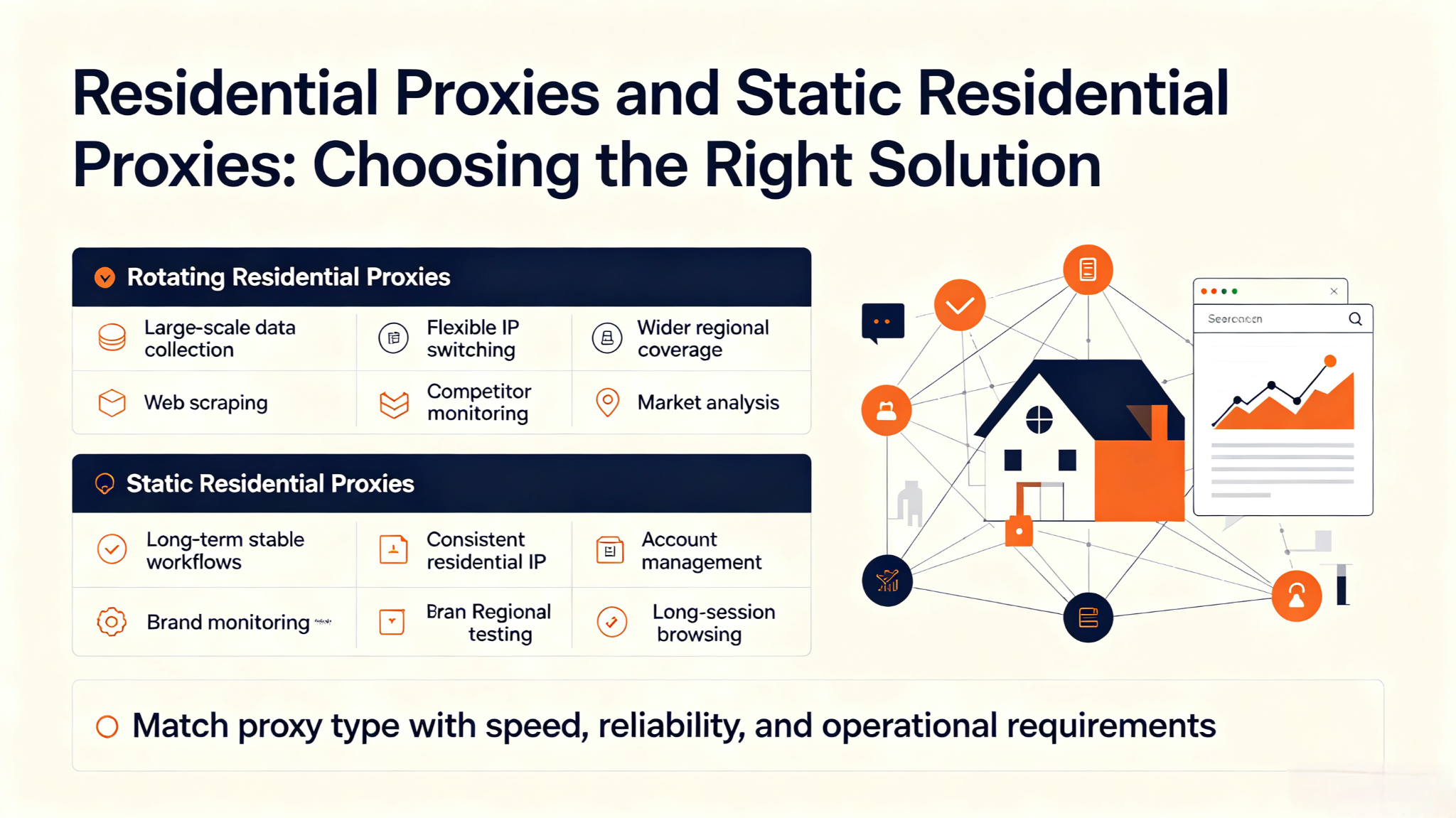
Residential Proxies and Static Residential Proxies: Choosing the Right Solution
Different business scenarios require different proxy solutions.
For large-scale data collection, rotating residential proxies are often preferred because they provide flexible IP switching and better coverage across different regions. They are commonly used for web scraping, competitor monitoring, and market analysis.
For workflows that require long-term stability, static residential proxies are a better choice. They provide consistent residential IP addresses for applications such as account management, brand monitoring, regional testing, and long-session browsing.
Selecting the right proxy type helps businesses balance speed, reliability, and operational requirements.
How Businesses Improve Proxy Performance
To optimize proxy performance, companies should consider several factors. Choosing the right proxy type, selecting appropriate geographic locations, and monitoring key metrics such as response time and request success rate can significantly improve efficiency.
The fastest proxy is not always the best option. A reliable proxy solution should provide consistent connectivity, high-quality IP resources, and stable performance over time.
Businesses should also monitor proxy performance continuously by analyzing response time, failure rates, and connection stability.
How Proxy Speed Creates Business Advantages
Proxy speed directly impacts business outcomes, including faster market intelligence, more accurate competitor monitoring, efficient web scraping, and higher automation efficiency.
High-performance proxy networks help businesses gather market insights, monitor competitors accurately, verify advertisements globally, and improve automation efficiency.
Proxy technology has evolved from a simple IP access solution into an important part of modern digital infrastructure. For businesses using web scraping, market research, SEO monitoring, and ad verification, proxy speed is no longer just a technical feature—it directly affects operational success.
A global e-commerce company may monitor thousands of product listings across multiple marketplaces every day. Without reliable proxy performance, delayed or failed requests can affect pricing decisions and market insights.
Advertising platforms also rely on proxy performance to verify campaigns across different regions, devices, and search environments.
Conclusion
Proxy performance depends on more than IP pool size. Factors such as latency, response time, success rate, and concurrency determine data access efficiency.
By using residential proxies, proxy rotation, and static residential proxies when needed, businesses can improve data accuracy, optimize automation workflows, and scale global operations.
關於作者
 頂級住宅代理解決方案
 {{item.title}}

 458
458