











Rotating Residential Proxies for Web Scraping and Market Research
Learn how rotating residential proxies support web scraping, market research, price monitoring, and ad verification with flexible IP rotation, sticky sessions, and regional targeting.

Rotating residential proxies help businesses collect public web data across multiple pages and regions without relying on a single IP address. By automatically distributing requests across different residential IPs, proxy rotation is well suited to web scraping, market research, price monitoring, and ad verification.
But frequent rotation is not always necessary. Some workflows need the same IP for several connected requests, while others require a stable IP for much longer. The right choice depends on whether the task needs IP diversity, short-term session consistency, or long-term stability.
What Are Rotating Residential Proxies
A residential proxy routes traffic through an IP associated with an internet service provider and residential network. A rotating residential proxy changes the outgoing IP automatically according to a defined rule, such as after each request or when a new session starts.
This allows data collection systems to access a broader pool of residential IPs without manually switching addresses. It is especially useful for large-scale projects where requests are independent or where geographic targeting is important.
Swiftproxy Residential Proxies support rotating and sticky connection modes, making them suitable for different scraping and research workflows.
How Proxy Rotation Works
Proxy rotation determines how long an IP remains active before another IP is assigned. With per-request rotation, each new connection can use a different IP, which works well when requests do not depend on each other.
Sticky sessions keep the same residential IP for several related requests. This is useful when cookies, redirects, login states, or location settings need to remain consistent during a short workflow.
A simple rule can help.
- Use rotating residential proxies for independent requests at scale.
- Use sticky sessions for short multi-step workflows.
- Use static residential proxies when the same IP must remain stable over time.
Why Rotating Residential Proxies Work Well for Web Scraping
Web scraping often requires collecting data from hundreds or thousands of public pages. Sending every request through one IP concentrates the workload on a single network identity. Proxy rotation spreads those requests across a larger residential IP pool instead.
For example, an eCommerce project may need to monitor prices, stock levels, reviews, and promotions across multiple regions. If each product page can be collected independently, rotating residential proxies provide a practical way to distribute requests while maintaining geographic flexibility.
Proxy rotation should still be combined with sensible request rates, controlled retries, accurate parsing, and data validation. Reliable scraping depends on both proxy infrastructure and well-designed request logic.
Residential Proxies for Market Research
Market research often depends on understanding how websites appear in different locations. Prices, currencies, search results, product availability, promotions, and delivery options may change from one region to another.
Residential proxies allow researchers to compare these regional differences without operating infrastructure in every target country. For example, a company can compare how the same product is priced and promoted in the United States, the United Kingdom, and Germany.
Rotating residential proxies are especially useful when the research involves many independent pages. They allow requests to be distributed across different residential IPs while targeting the locations needed for each market.
Residential Proxies for Ad Verification
Ad campaigns are often targeted by location, language, or audience. Businesses therefore need to verify whether ads and landing pages appear correctly in the intended markets.
Rotating residential proxies work well for repeated independent checks across different locations. Sticky sessions are more suitable when the test includes several connected steps, such as opening an ad, following redirects, and checking the final landing page.
For more reliable verification, teams can record the test location, displayed creative, language, destination URL, and timestamp. This makes regional campaign issues easier to identify and investigate.
Rotating vs Static Residential Proxies
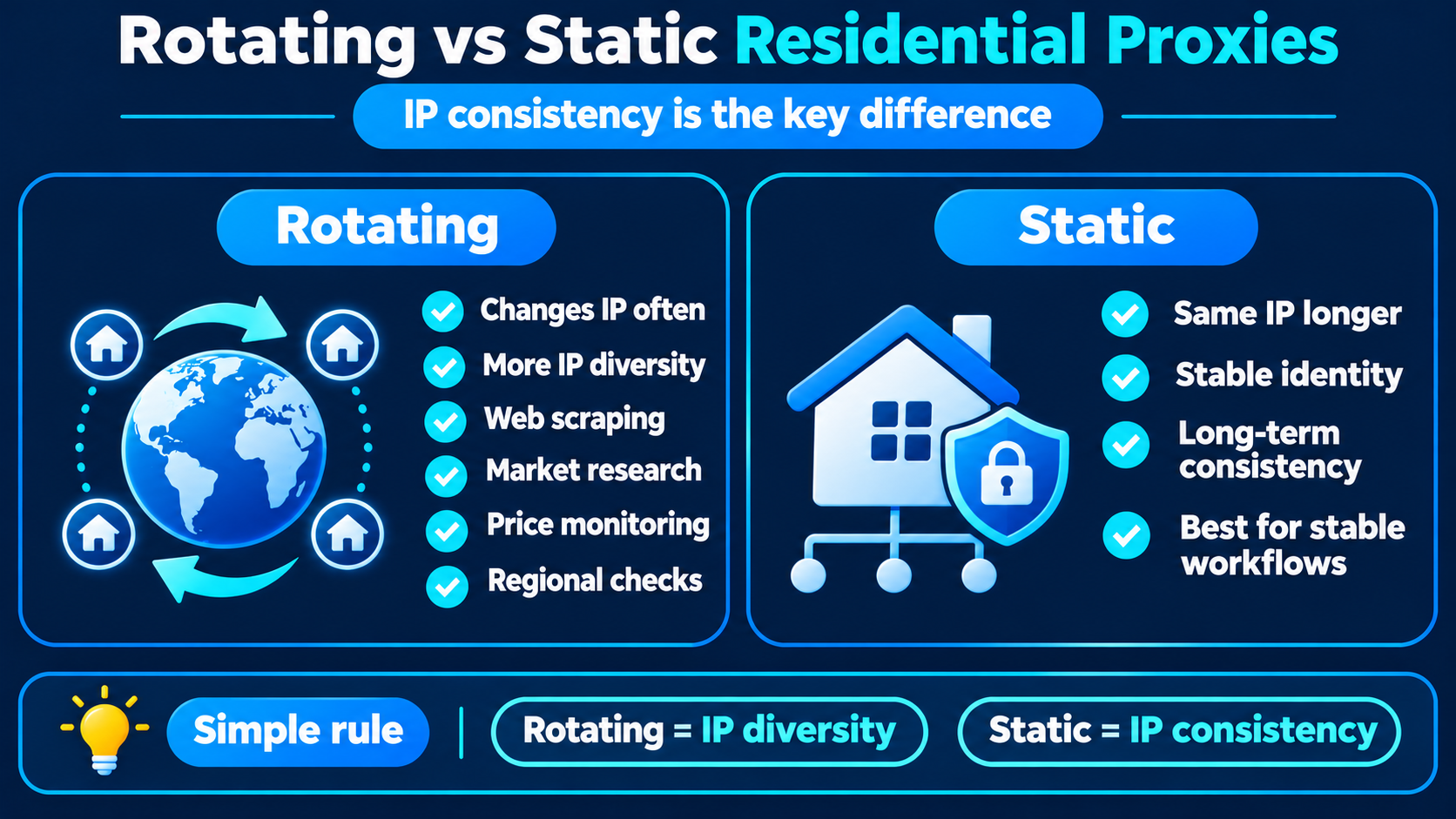
The main difference between rotating and static residential proxies is IP consistency.
Rotating residential proxies prioritize IP diversity and are generally better for large-scale web scraping, market research, price monitoring, and repeated regional checks. Static residential proxies keep the same IP available for longer periods and are more suitable when a stable network identity is required.
For workflows where long-term IP consistency matters more than rotation, Swiftproxy Static Residential Proxies provide a more appropriate option.
How to Choose the Right Proxy Type
Choosing the right proxy type starts with understanding how requests are connected.
If each request can be completed independently, rotating residential proxies are usually the best fit. If several requests belong to the same temporary session, sticky residential proxies provide better continuity. If the same IP must remain available over a longer period, static residential proxies are usually more suitable.
The goal is not to rotate IP addresses as often as possible. It is to match the proxy behavior to the structure of the task.
Frequently Asked Questions
What is proxy rotation?
Proxy rotation is the process of automatically changing the IP address used for outgoing requests. Rotation can happen after each request, when a session ends, or according to another configured rule.
Are rotating residential proxies good for web scraping?
Yes. They are especially useful when web scraping involves many independent public pages because requests can be distributed across different residential IPs instead of relying on one address.
What is the difference between rotating and sticky proxies?
Rotating proxies change IP addresses frequently. Sticky proxies keep the same IP for several related requests. Rotating sessions are better for independent requests, while sticky sessions are better for short workflows that require continuity.
When should I use static residential proxies?
Static residential proxies are useful when IP stability is more important than frequent rotation. They are a better fit for long-running sessions, repeated testing, or systems that rely on a consistent IP.
Final Thoughts
Rotating residential proxies are a strong choice for web scraping, market research, price monitoring, and ad verification when a workflow benefits from IP diversity. Sticky sessions provide continuity for connected requests, while static residential proxies are better suited to tasks that require long-term IP stability.
The best proxy strategy is not the one that rotates IPs most frequently. It is the one that matches how the application collects and uses data.
By choosing the right balance between rotation and consistency, businesses can build proxy workflows that are simpler, more reliable, and easier to scale.
關於作者
 頂級住宅代理解決方案
 {{item.title}}

 484






