







How to Choose a Stable Residential Proxy
Learn how to choose a stable residential proxy by evaluating connection success rates, sticky session durations, and IP reputation for reliable data collection.

A large residential proxy pool can provide broad geographic coverage, but pool size alone does not guarantee reliable performance. Slow responses, failed connections, and unexpected IP changes can interrupt web scraping, market research, ad verification, and other automated workflows. These problems often increase retry costs while reducing the accuracy and completeness of collected data.
A better way to evaluate a residential proxy service is to focus on connection success rate, sticky session duration, and IP reputation. Together, these metrics show whether a proxy network can maintain stable access across real target websites. They also help businesses select the right proxy configuration for each task.
Look for a High Connection Success Rate
Connection success rate measures how often proxy requests successfully reach the target website. A low rate can result in timeouts, missing pages, repeated requests, and incomplete datasets. Even a small failure rate can become costly when a scraping project involves thousands of product pages or search results.
A reliable proxy network should automatically detect unavailable nodes and route traffic through active residential IPs. It should also maintain consistent response times when request volume increases. These capabilities reduce manual retries and help large data collection tasks run more efficiently.
General speed tests are useful, but they do not show how proxies will perform on every target. Test the network directly on the marketplaces, search engines, and advertising platforms relevant to your project. Swiftproxy Residential Proxies support location-based data collection with flexible targeting and proxy rotation.
Choose the Right Sticky Session Length
Proxy rotation changes the IP address after each request or after a selected period. Frequent rotation is useful for large-scale web scraping because requests can be distributed across multiple residential IPs. It can also reduce the pressure placed on individual proxy nodes.
However, some workflows require one IP address to remain active across several connected steps. Login sessions, shopping carts, localized searches, checkout tests, and multi-page ad verification may fail when the IP changes unexpectedly. These interruptions can trigger repeated authentication, CAPTCHAs, or session resets.
A sticky session proxy keeps the same residential IP for a defined period. Shorter sessions are suitable for basic public data collection, while longer sessions work better for account-based activities and multi-step verification. When one IP must remain available for an extended period, Swiftproxy Static Residential Proxies can provide greater consistency.
Check Residential IP Reputation
Residential IP quality depends on the address's reputation and previous usage. An IP can belong to a real internet service provider and still be restricted if it has been associated with spam, excessive requests, or aggressive automation. Low-quality IPs often trigger CAPTCHAs, access-denied pages, and additional security checks. Taking a moment to check IP before deployment can help avoid these problems before they affect live traffic."
IP reputation is especially important for market research. A flagged address may receive different prices, promotions, search results, or regional content from a typical local visitor. This can reduce the accuracy of competitor analysis, pricing research, and location-based data collection.
Clean IPs are also essential for ad verification. Advertising platforms may limit the campaigns or landing pages shown to suspicious traffic, making geographic targeting more difficult to verify. A reliable provider should continuously monitor its network and remove inactive, overused, or poorly performing IPs.
Match the Proxy Type to the Task
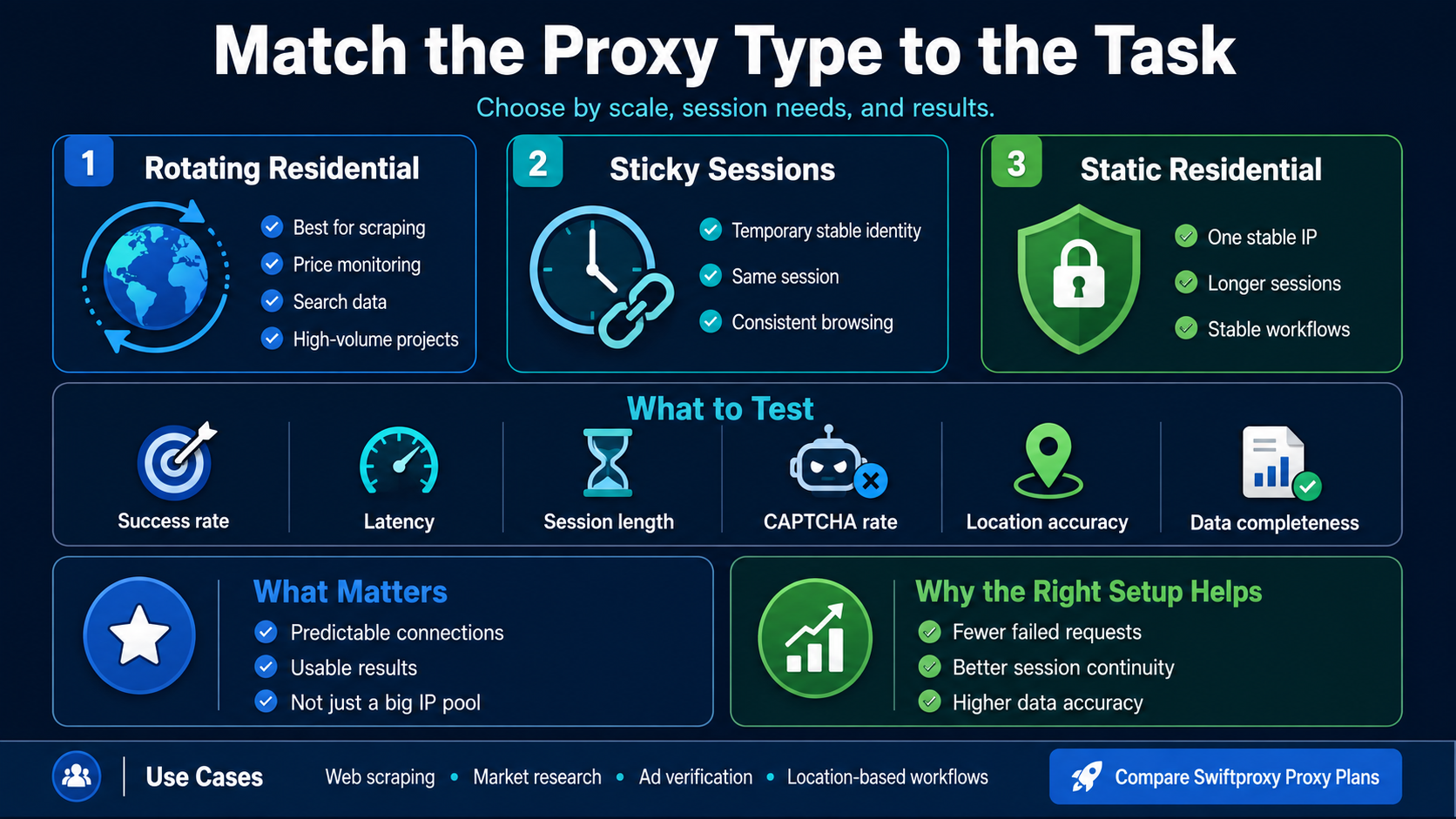
Rotating residential proxies are suitable for web scraping, price monitoring, search data collection, and other high-volume projects. Sticky sessions are better for workflows that require a temporary but consistent browsing identity. Static residential proxies are designed for tasks that depend on one stable IP over a longer period.
Before choosing a provider, test connection success, response latency, session duration, CAPTCHA frequency, location accuracy, and data completeness. The best residential proxy is not simply the service with the largest IP pool. It is the one that delivers predictable connections and usable results on your target websites.
Choosing the right proxy setup can reduce failed requests, protect session continuity, and improve data accuracy. Compare Swiftproxy Proxy Plans to find a suitable solution for web scraping, market research, ad verification, and other location-based business workflows.
關於作者
 頂級住宅代理解決方案
 {{item.title}}

 411
411