







3 Proxy Mistakes to Avoid with Multiple Accounts
Learn the 3 critical proxy mistakes in multi-account management and how to align IP consistency, session stability, and environment separation for seamless operations.

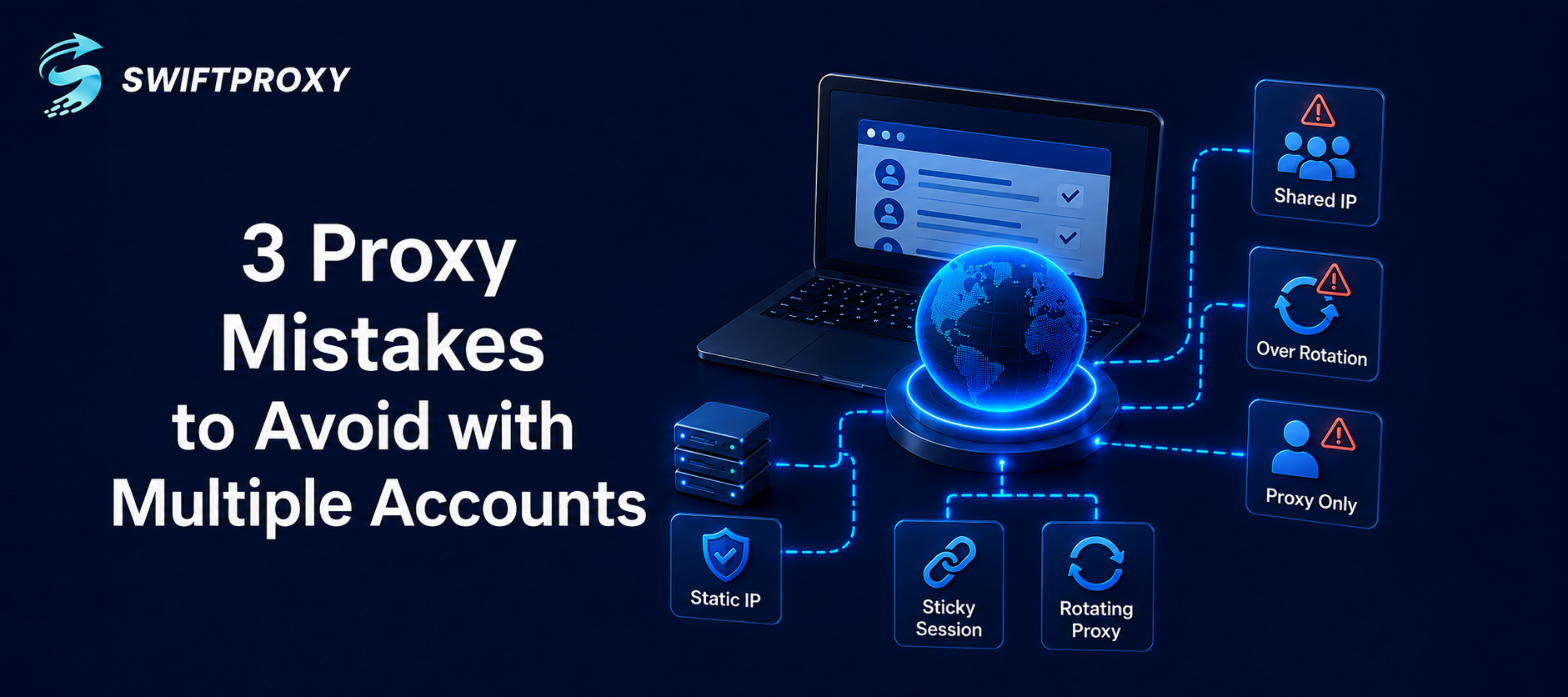
Managing multiple accounts with proxies is not just about changing IP addresses. A poor proxy setup can create inconsistent connections, unnecessary IP overlap, and avoidable account-management problems.
For beginners, three mistakes appear most often: sharing one IP across too many accounts, rotating IPs too frequently, and relying on a proxy as the only form of environment separation.
Mistake 1: Sharing One IP Across Multiple Accounts
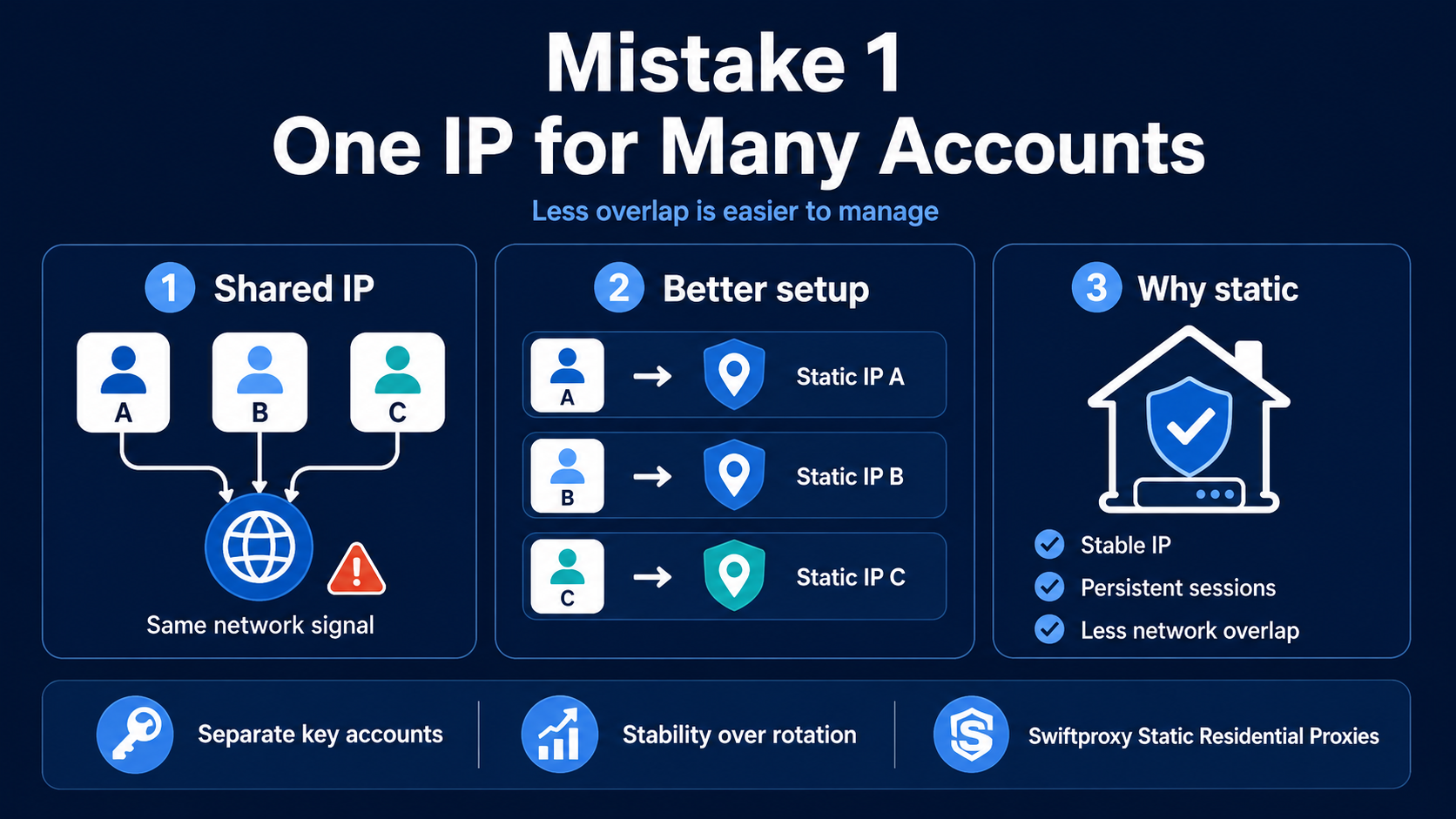
Multiple users can naturally share one public IP on home, office, or public networks. However, when several independently managed accounts consistently use the same proxy IP, they also share the same network signal.
For workflows that need stronger separation, assigning a stable IP to each important account environment is often easier to manage.
For example:
- Account A → Static IP A
- Account B → Static IP B
- Account C → Static IP C
Swiftproxy Static Residential Proxies are suitable for tasks that require long-term IP consistency. Because the IP stays stable, they are a better fit for persistent sessions than frequently changing proxy addresses.
A separate IP does not guarantee that an account will never be reviewed or restricted, but it can reduce unnecessary network overlap.
Mistake 2: Rotating IPs Too Often
More proxy rotation is not always better.
If an account frequently switches between different IPs, ISPs, cities, or countries, the connection pattern may become inconsistent. Long-running sessions usually benefit more from stability than constant IP changes.
The three common proxy modes serve different needs:
- Static residential proxies provide long-term IP consistency.
- Sticky sessions keep the same IP for a defined session.
- Rotating residential proxies change IPs across requests or sessions.
The best approach is to rotate only when the task actually benefits from IP diversity.
Mistake 3: Depending Only on the Proxy
A proxy changes the visible IP address, but websites can evaluate many other signals. These may include cookies, browser sessions, device information, login history, location patterns, and user behavior.
For legitimate multi-account workflows, keep browser environments organized and consistent. Separate browser profiles can help prevent cookies and session data from mixing between accounts.
Proxies should also be used in accordance with the target platform's account and automation policies.
Static or Rotating Residential Proxies
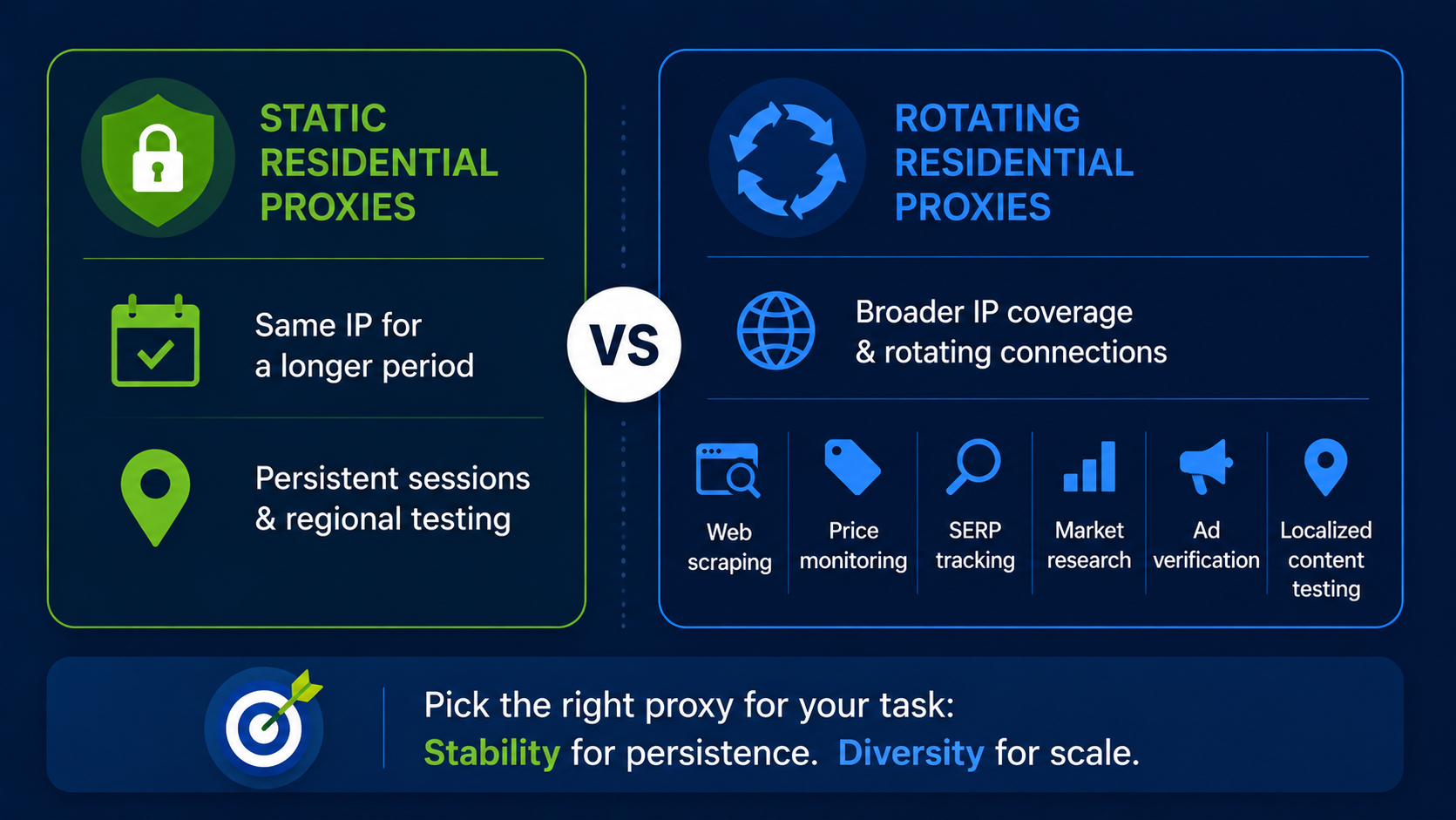
The choice depends on one simple question:
Do you need IP stability or IP diversity?
Choose static residential proxies when a task needs the same IP for a longer period, such as persistent sessions or repeated regional testing.
Choose Swiftproxy Residential Proxies when you need broader IP coverage, rotating connections, or temporary sticky sessions.
Rotating residential proxies are especially useful for:
- Web scraping
- Price monitoring
- SERP tracking
- Market research
- Ad verification
- Localized content testing
When Proxy Rotation Is Useful
Proxy rotation works best when handling large numbers of independent requests.
For web scraping and market research, rotating residential proxies can distribute requests across different IP addresses and locations. This is useful for comparing product prices, search results, ecommerce listings, travel fares, competitor content, or regional website variations.
In these cases, IP diversity is often more important than maintaining one permanent connection.
Residential Proxies for Ad Verification
Residential proxies can also support ad verification by helping marketers check how ads and landing pages appear in different regions.
Rotating proxies are useful for testing multiple markets, while static or sticky sessions are better when the same location needs to be checked repeatedly.
The goal should be to verify regional ad delivery and content rather than create artificial clicks, impressions, or conversions.
Final Takeaway
The three biggest multi-account proxy mistakes are sharing one IP across too many independent accounts, rotating IPs without a clear reason, and expecting a proxy to handle every aspect of account separation.
Use static residential proxies when consistency matters. Use sticky sessions when temporary continuity is needed. Use rotating residential proxies when web scraping, market research, ad verification, or other data tasks require greater IP diversity.
The right proxy strategy is not about changing IPs as often as possible. It is about matching the connection type to the task.
關於作者
 頂級住宅代理解決方案
 {{item.title}}

 24
24