








Why SEO Monitoring Requires Proxy IPs: How Residential Proxies Improve Global Rank Tracking
Global SEO monitoring requires accurate regional data to track rankings, analyze competitors, and understand search trends. This article explores how residential proxies, static residential proxies, and proxy rotation help businesses collect reliable SEO data and improve international search performance.

As businesses expand globally, SEO monitoring has become essential for tracking rankings, analyzing competitors, and optimizing marketing strategies.
However, international SEO is more complex than local SEO. Search results vary based on location, IP address, language, and user behavior. A keyword ranking highly in one country may have completely different results in another market.
Using a single IP address for large-scale SEO data collection can lead to inaccurate results, access restrictions, and IP blocks. Therefore, many SEO teams use residential proxies and static residential proxies to collect reliable global search data.
What Is SEO Monitoring?
International SEO monitoring refers to tracking website performance across different countries and regions. It includes keyword ranking tracking, SERP analysis, competitor research, content monitoring, and advertisement verification.
For global businesses, accurate SEO data helps answer key questions: How does a website rank in different markets? Which competitors are gaining visibility? Are local ads displayed correctly?
Proxy IPs allow companies to access search engines from different locations and collect more accurate regional data.
Why Does SEO Monitoring Need Proxy IPs?
Access Local Search Results
Search engines provide different results based on user location. The same keyword may show different rankings, competitors, and advertisements in different countries.
Residential proxies allow SEO teams to access search engines through local IP addresses and collect results that match real user experiences.
This helps businesses monitor regional rankings, analyze SERP changes, and improve international SEO strategies.
Make Web Scraping More Reliable
SEO monitoring often requires collecting large amounts of public data from search engines and websites. However, sending too many requests from one IP can trigger anti-bot systems and cause restrictions.
Using residential proxies with proxy rotation distributes requests across multiple IP addresses, reducing blocking risks and improving scraping stability.
Proxy-based web scraping is commonly used for SERP tracking, keyword research, competitor analysis, and market research.
Improve Keyword Rank Tracking Accuracy
Keyword rankings can vary significantly between countries and cities. Monitoring rankings from only one location may not reflect actual market performance.
Rotating residential proxies allow SEO tools to collect ranking data from different regions, helping businesses compare performance, identify opportunities, and optimize localized content.
Support Competitor and Market Research
Global SEO requires understanding competitor strategies in different markets.
Residential proxies help businesses collect public information about competitor rankings, content updates, product visibility, and market trends without being limited by their own location.
By combining proxies with web scraping tools, companies can gain deeper insights into customer behavior and competitive landscapes.
For example, an e-commerce company entering the European market can use local residential proxies to monitor Google rankings and competitor visibility before launching new campaigns.
Verify Ads Across Global Markets
Global advertising campaigns often display different content depending on user location.
Without proxy IPs, marketers may only see ads based on their own region. Residential proxies allow businesses to view advertisements as local users.
This helps brands verify ad placements, monitor competitors, detect unauthorized usage, and improve campaign accuracy.
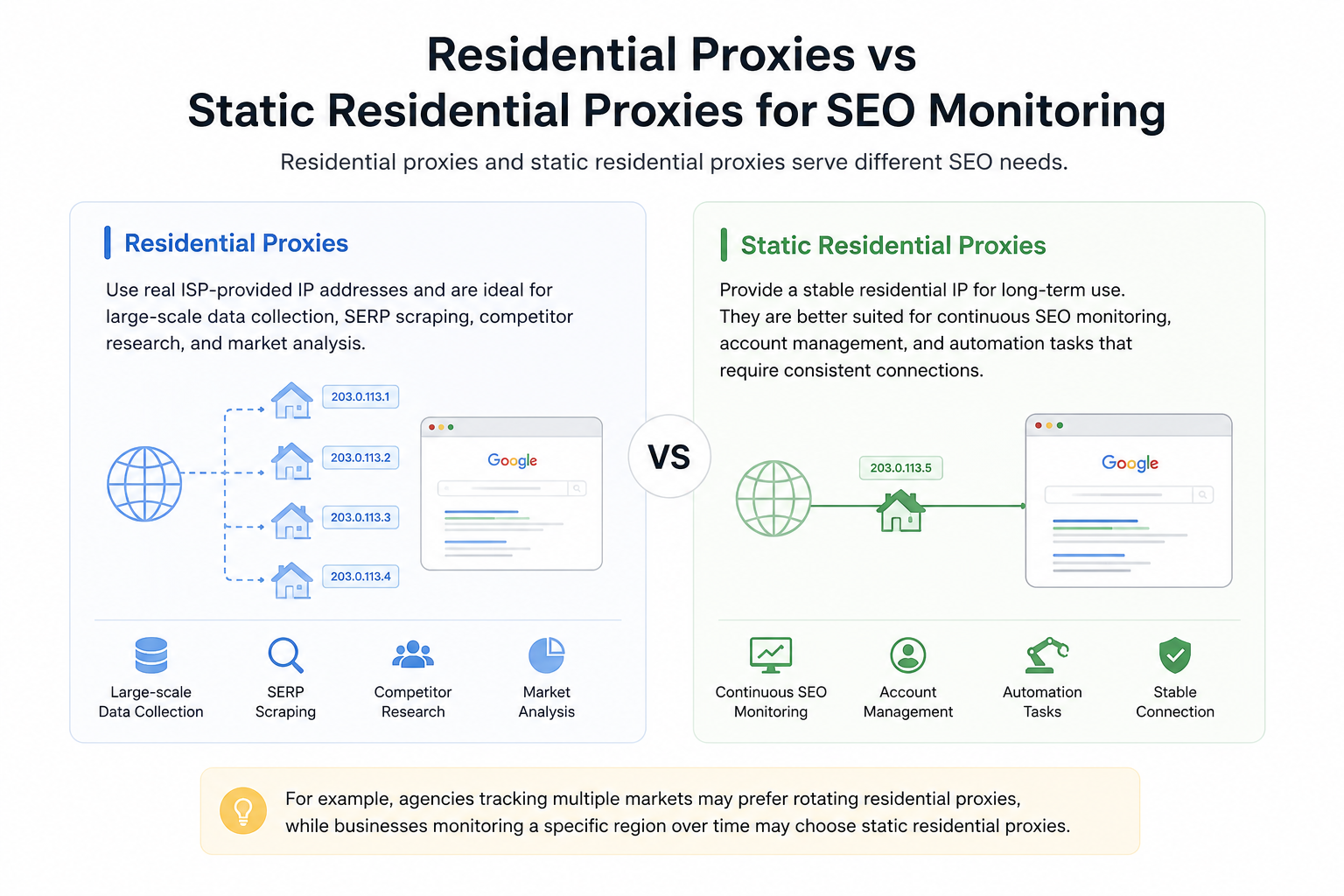
Residential Proxies vs Static Residential Proxies for SEO Monitoring
Residential proxies and static residential proxies serve different SEO needs.
Residential proxies use real ISP-provided IP addresses and are ideal for large-scale data collection, SERP scraping, competitor research, and market analysis.
Static residential proxies provide a stable residential IP for long-term use. They are better suited for continuous SEO monitoring, account management, and automation tasks that require consistent connections.
For example, agencies tracking multiple markets may prefer rotating residential proxies, while businesses monitoring a specific region over time may choose static residential proxies.
Why Choose Residential Proxies Instead of Datacenter Proxies?
Datacenter proxies usually provide fast connections but are easier for websites to identify because they come from hosting providers rather than real user networks.
Residential proxies offer more realistic IP identities, better location accuracy, and higher trust levels, making them more suitable for SEO monitoring and large-scale web scraping.
For businesses collecting global search data, residential proxies can provide more reliable results.
How Proxy Rotation Helps SEO Data Collection
Proxy rotation automatically switches between multiple IP addresses during data collection.
This helps businesses reduce IP restrictions, improve regional data coverage, and support larger-scale SEO workflows.
For SEO agencies and enterprises managing multiple markets, rotating residential proxies provide a flexible solution for collecting international search data.
Best Practices for Using Proxy IPs in SEO Monitoring
Choosing the right proxy type is important for effective SEO monitoring.
Residential proxies are suitable for large-scale data collection, while static residential proxies are better for stable long-term monitoring.
Businesses should also select proxy locations based on target markets and combine proxies with SEO tools, crawlers, and analytics platforms to improve data accuracy.
Conclusion
International SEO monitoring requires accurate regional data to understand rankings, competitors, and market trends.
Residential proxies, static residential proxies, and proxy rotation help businesses collect reliable SEO data, improve web scraping efficiency, and monitor global search performance.
By using SEO proxies for SERP tracking, market research, and ad verification, companies can make better decisions and build stronger international SEO strategies.
Looking for reliable SEO proxies for global data collection? Swiftproxy residential proxies provide stable connections, flexible location targeting, and scalable solutions for international SEO monitoring.
關於作者
 頂級住宅代理解決方案
 {{item.title}}

 401
401





