







Pay2.House — virtual cards for affiliate marketing, subscriptions, and online services
Pay2.House provides virtual cards for advertising payments, subscriptions, SaaS platforms, and other online services. This article explains how the service helps businesses and marketers manage online payments, separate expenses, and scale their payment operations.

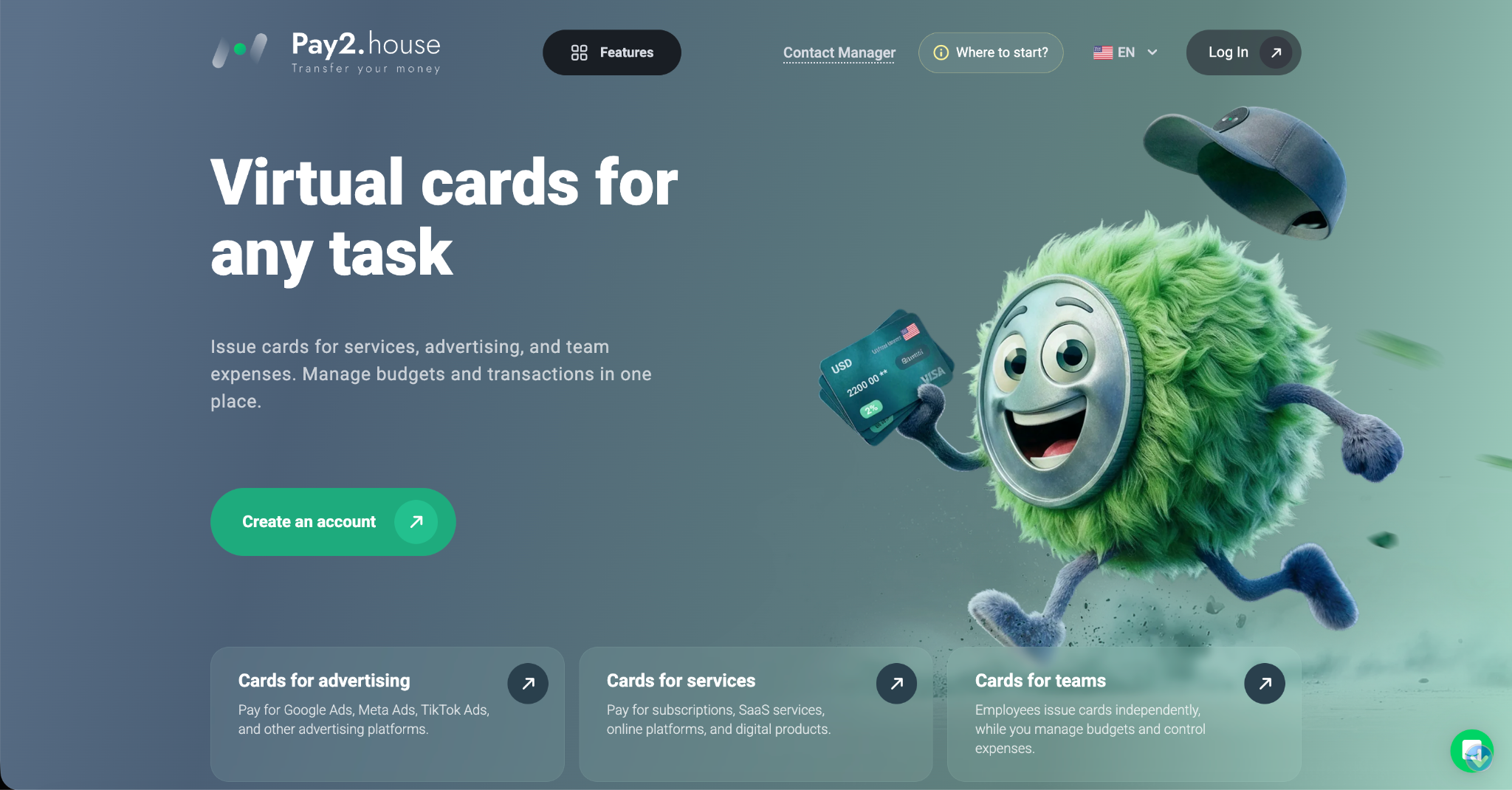
Today, a virtual card is a practical tool for those who regularly pay for advertising, SaaS, subscriptions, and digital services. Pay2.House offers this type of card: cards can be issued quickly, used for online payments, and organized into a convenient expense management system.
Why people need virtual cards in the first place
A regular bank card works well for everyday payments, but quickly becomes inconvenient when you need to pay for several services at once, separate budgets, or issue separate cards for different tasks. For business, marketing, advertising, and teamwork, this is no longer just a matter of convenience but of organization: when each expense goes through a separate card, it is easier to control spending, track subscriptions, and keep different areas from being mixed into one payment flow.
What real tasks Pay2.House helps solve
|
Need |
What is usually inconvenient |
How Pay2.House helps |
|
Advertising payments |
All charges go through one card, making expenses difficult to control |
Separate virtual cards can be issued for different ad accounts and tasks |
|
Subscription and SaaS payments |
Recurring charges are difficult to track |
It is easier to separate services by card and see where the money is going |
|
Teamwork |
Expense access is needed without giving one card to everyone |
The service supports team-based workflows and card management |
|
Scaling payments |
Manually managing each payment takes time |
Bulk card issuance and API integration are available |
|
Quick start |
A lengthy issuance process slows down the start of work |
The service emphasizes fast card issuance on its website |
Pay2.House virtual cards are suitable for paying for advertising platforms, subscriptions, and online services. Payments on Facebook Ads, Google Ads, TikTok Ads, and other digital products are also mentioned, where users value fast card issuance, clear terms, and the ability to use the card immediately. Pay2.House
What is Pay2.House’s strong point
The main advantage of the service is not the phrase “virtual cards” itself, but how it addresses users’ practical needs. If someone only needs to pay for a subscription once, many solutions will work. But when there are many payments, they are recurring, distributed across different tasks, and require control, factors such as issuance speed, clear funding logic, the ability to issue multiple cards, and manage them in one interface become important. This is where the value lies.
Key solutions and advantages of Pay2.House
– High card linking rate with Meta, Google Ads, and TikTok.
– Stable payment processing and fewer declined transactions.
– Balance top-ups via USDT TRC20.
– BINs from different geographies: the USA, Canada, Estonia, Hong Kong, and Singapore.
– Ability to pay for Apple Developer, OnlyFans, Amazon, servers, hosting, domains, and AI services.
– Bulk issuance of virtual cards for working with multiple accounts.
– API for process automation and integration with internal systems.
– Low entry threshold: minimum top-up of $50.
Where Pay2.House is especially useful
1. Advertising platform payments
If a company, media buyer, or marketer regularly pays for advertising accounts, it is more convenient to keep expenses separate. One card — one project, one account, or one direction. This makes it easier to control spend, plan budgets, and quickly identify where expenses have increased. The service blog contains separate materials on paying for Google Ads and other platforms, showing the product’s practical focus on these tasks.
2. Subscription and digital service payments
Virtual cards are convenient when a company pays for dozens of online tools: servers, hosting, domains, AI services, and SaaS subscriptions. If everything is kept on one card, expenses get mixed together and it becomes difficult to see which charges are active. In Pay2.House, services can be distributed across different cards, categories can be tracked separately, and recurring payments can be managed more efficiently.
Terms you should know in advance
Below are the key parameters from the official Pay2.House pricing section. These are exactly the details people usually look for before registration. Pay2.House
|
Parameter |
Terms |
|
Virtual card issuance |
5 USD / EUR |
|
Monthly maintenance |
5 USD / EUR |
|
Minimum card top-up |
50 USD / EUR |
|
Fee for topping up a card from the account |
4% |
|
Account top-up via USDT TRC20 |
no fee |
The service guide also states that the cards are intended for outgoing online payments and are not used to receive incoming payments from third parties. This is an important point: Pay2.House should be viewed specifically as a payment tool, rather than a universal card for every scenario.
Why Pay2.House may be more convenient than “one card for everything”
|
Approach |
What happens in practice |
|
One bank card for all services |
Charges get mixed together, budgets are difficult to track, and managing multiple areas is inconvenient |
|
Multiple virtual cards in Pay2.House |
Expenses are separated, payments are structured, and teams and projects are easier to control |
For many users, the value of virtual cards becomes clear over time. At first, they are simply a convenient payment method, and later they become a clear expense management system. In this regard, Pay2.House looks like a service not for occasional payments, but for regular online payment operations where speed, organization, and scalability matter. Pay2.House
Conclusion
Pay2.House is a virtual card service for those who need to pay for advertising, online services, subscriptions, and digital products without confusing their expenses. Its strength lies in practicality: fast card issuance, clear pricing, convenient top-ups, support for team workflows, and the ability to build a transparent payment system around real needs. If a user needs not just to “have a card” but to properly manage online payments, Pay2.House looks like a logical and practical solution.
關於作者
 頂級住宅代理解決方案
 {{item.title}}

 52
52