







How to Choose a High-Performance Proxy Service
Speed without trust is a liability. Cheap proxies may offer low prices and large IP pools, but once blocks and CAPTCHAs start piling up, sessions fail and the time and money you hoped to save quickly disappear. In 2026, reliability is everything. Websites deploy layered anti-bot systems, fingerprinting engines, and behavioral analysis that goes far beyond simple IP detection. If your proxy service isn't built for that reality, it won't hold up. Let's break down what actually makes a proxy service reliable—and how to evaluate one properly before committing budget and infrastructure.

1. IP Quality
A reliable proxy service starts with clean, high-trust IPs. Not recycled addresses that have already been abused across dozens of scraping farms. Not datacenter ranges that security systems flag on sight.
Look for providers that:
Continuously refresh their IP pools
Monitor blacklist databases actively
Maintain low IP reuse across customers
Clearly explain how IPs are sourced
Testing is conducted first by sending requests to high-security sites and monitoring block rates within the first 100 to 500 requests. If failure rates spike early, it indicates that the IP has a weak reputation and should be discarded.
Swiftproxy, for example, emphasizes fresh IP sourcing and ongoing reputation monitoring. That focus directly reduces block rates and improves session stability over time.
2. IP Rotation and Session Control
Rotation is not just “change IP every request.” That's amateur hour. Real reliability comes from intelligent rotation control. You need flexibility. Sometimes you want a new IP every call. Other times, you need sticky sessions that preserve login state.
A strong provider offers:
Automatic rotation
Sticky session options
Customizable rotation intervals
API-level control
Poor rotation logic breaks sessions, disrupts scraping accuracy, and increases detection risk. The solution is simple. Use persistent sessions for logins and apply controlled, task-based rotation for large-scale data collection instead of rotating randomly.
3. Speed, Latency, and Network Optimization
Speed alone doesn't equal reliability. But slow proxies absolutely destroy it. High latency increases timeout errors. Timeouts lead to retries. Retries amplify detection signals. It snowballs quickly.
Evaluate performance by:
Measuring average response time over at least 1,000 requests
Monitoring timeout frequency
Testing during peak traffic hours
Reliable providers optimize routing and minimize packet loss. Swiftproxy, for instance, is engineered for high-speed delivery under load, which makes it suitable for large automation workflows where milliseconds add up.
4. Success Rate and Block Resistance
This is the metric that really matters. If 30 percent of your requests fail, your infrastructure cost quietly doubles. You just don't see it immediately.
Reliable proxy networks actively adapt. They monitor target site behavior, adjust routing patterns, and respond to anti-bot changes instead of ignoring them.
Key indicators to track:
HTTP 200 response rate
CAPTCHA frequency
Connection drop percentage
Retry rate per 1,000 requests
If a provider avoids discussing measurable success rates, that's a red flag. Serious operators track these numbers obsessively.
5. System Stability and Uptime
Behind every reliable proxy service is serious infrastructure. Load balancing. Redundancy. Failover systems.
Without that backbone, you'll see random disconnects, half-finished jobs, and scraping tasks that fail overnight.
Ask directly:
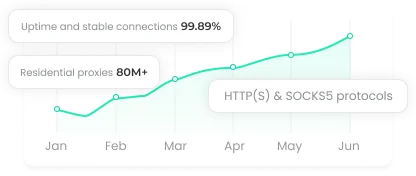
Is uptime guaranteed at 99.9 percent or higher
Is traffic distributed across multiple nodes
Are failover systems automated
Enterprise-grade providers invest heavily here. Swiftproxy positions itself around infrastructure reliability, which is critical if your business depends on uninterrupted automation.
6. Transparency and Documentation
This is often overlooked—but it tells you everything about a provider's maturity.
Reliable services provide clear documentation, setup guides, limitations, and realistic expectations. They don't promise “undetectable proxies.” They explain best practices.
Be cautious if a provider:
Hides technical details
Makes exaggerated claims
Avoids real-world examples
Good documentation reduces onboarding time. Clear usage guidance reduces misuse—and protects IP reputation long term.
7. Support That Actually Responds
When something breaks, minutes matter. Especially during product launches, ad audits, or competitive monitoring windows.
Reliable proxy services provide:
Fast response times
Technical—not just sales—support
Direct communication channels
Responsiveness isn't a bonus feature. It's operational insurance.
8. Scalability Without Performance Loss
Here's the real test.
Can the proxy network handle 10 million requests the same way it handles 10,000?
A reliable provider supports:
Small and large workloads
Multiple simultaneous target sites
Different tools and industries
Scaling should not introduce sudden block spikes or performance degradation. If it does, the infrastructure isn't designed for growth.
Before committing, gradually increase request volume during testing and monitor stability. If performance drops sharply, that's your warning sign.
Final Thoughts
Reliable proxies are not about promises. They are about proof. Measure performance under load, validate IP reputation, and monitor success rates before scaling. When infrastructure, rotation logic, and support align, automation becomes predictable, efficient, and resilient instead of fragile and reactive.
關於作者
 頂級住宅代理解決方案
 {{item.title}}

 411
411