







From Fixed Networks to Flexible Access: How Residential Proxies Support Modern Enterprise Connectivity
Discover how modern enterprises are moving beyond traditional fixed connections to leverage residential proxies, static proxies, and proxy rotation for seamless, location-aware global data operations.

For years, enterprise networks relied on fixed connections, dedicated IP addresses, and centralized systems to support digital operations. However, as businesses expand globally, cloud services, international markets, and data-driven workflows have changed how companies access online resources.
Today, enterprises need flexible network access that can adapt to different regions and digital environments. From market research and web scraping to ad verification, accurate regional data has become increasingly important, driving demand for solutions such as residential proxies, static residential proxies, and proxy rotation.
Why Fixed Network Connections Are No Longer Enough
Traditional enterprise networks focus on stability and security through fixed IP addresses and controlled access points. While this model remains important for internal systems, it has limitations when businesses need to operate across global digital environments.
Online platforms often deliver different content depending on a user's location, IP address, language, and browsing environment. A company accessing a website from one fixed location may not see the same prices, search results, advertisements, or product information as users in other regions.
For example, an international e-commerce company may need to monitor product pricing across multiple markets, while marketing teams may need to verify how advertisements appear in different countries. Fixed connections cannot easily replicate these regional user experiences, making it harder for businesses to collect accurate market insights.
The Growing Need for Flexible Network Access
As companies expand globally, network access is no longer limited to connecting from a single location. Businesses increasingly need the ability to access online platforms through different geographic environments.
Flexible network access enables companies to better understand regional markets, collect public web data, monitor competitors, and test digital experiences from the perspective of local users.
Proxy technologies have become an important part of this process. By providing access through different IP environments, proxies help businesses overcome geographic limitations and gather more accurate information from global markets.
How Residential Proxies Support Enterprise Operations
Residential proxies use ISP-assigned IP addresses from real residential users or devices, providing a more authentic browsing environment and accurate regional access. They help businesses collect public data for web scraping, analyze local markets, and monitor competitor activities.
Residential proxies also support SEO monitoring, SERP tracking, and ad verification by allowing teams to view search results and advertisements from different locations, improving data accuracy and regional insights.
Residential Proxies vs Data Center Proxies: Choosing the Right Enterprise Solution
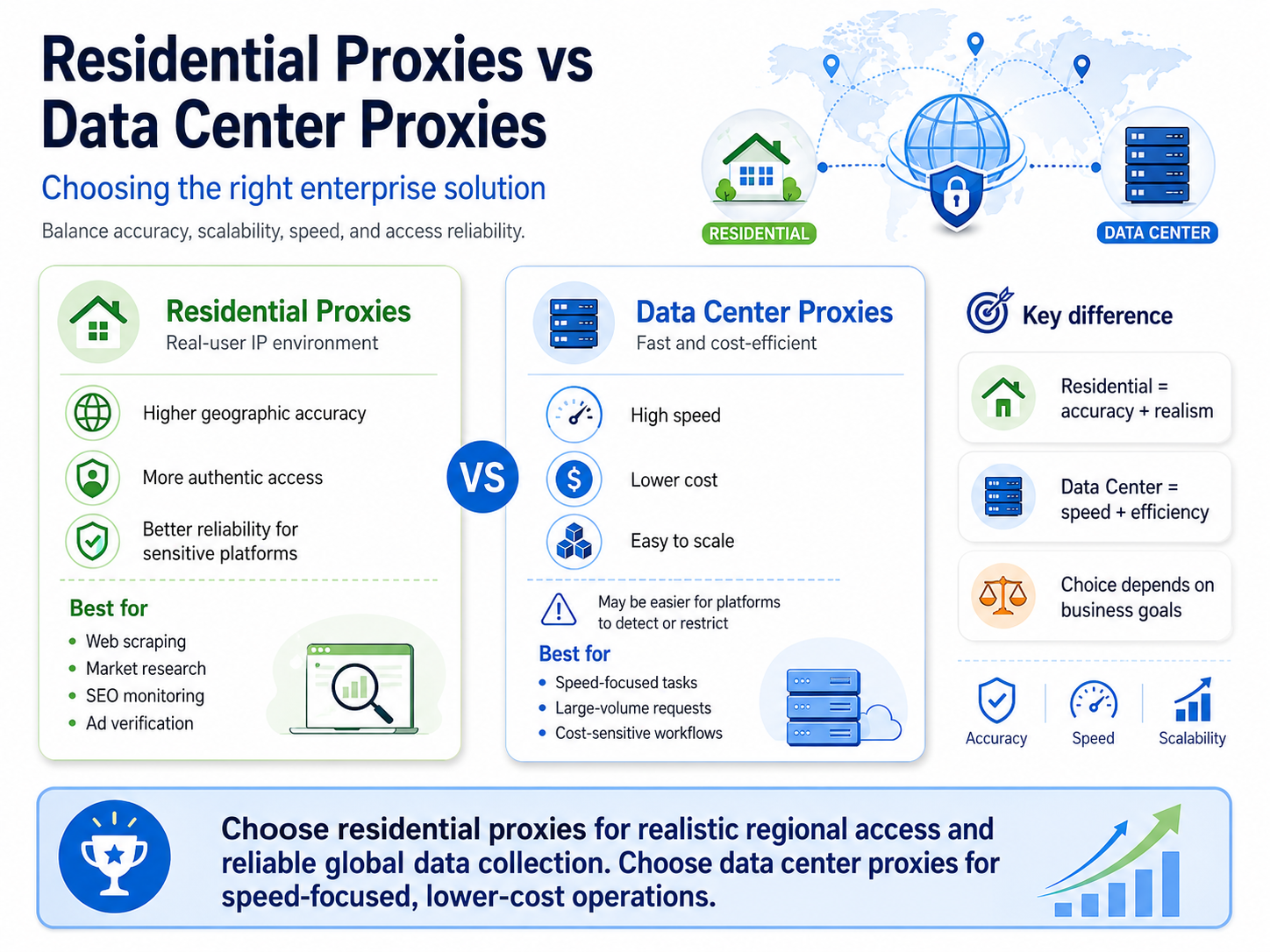
When choosing a proxy solution, businesses need to consider factors such as accuracy, scalability, and access reliability. Traditional data center proxies can provide fast connections and lower costs, but they are hosted on servers and may be easier for some platforms to identify and restrict.
Residential proxies use IP addresses assigned by ISPs to real residential devices, providing a more authentic user environment and better geographic accuracy. This makes them suitable for enterprise use cases such as web scraping, market research, SEO monitoring, and ad verification, where reliable regional access and accurate data collection are important.
While data center proxies remain useful for speed-focused tasks, residential proxies are often a better choice for businesses that need realistic access environments and more reliable global data operations.
Static Residential Proxies for Stable Long-Term Access
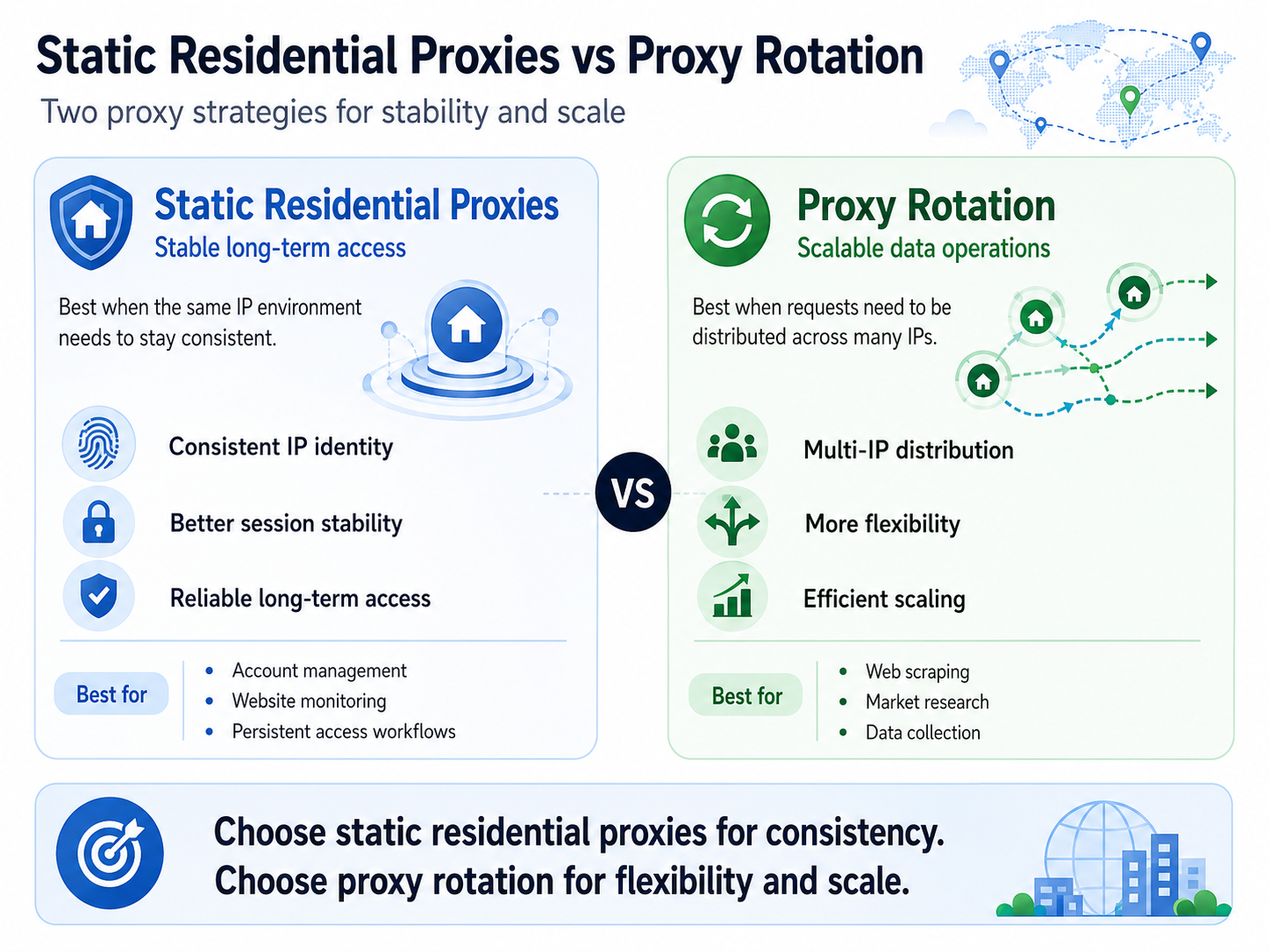
While flexible access is important, some business scenarios require a consistent IP identity. Static residential proxies combine residential IP characteristics with stable connections, making them suitable for long-term operations that require persistent access.
Businesses can use static residential proxies for account management, continuous website monitoring, and applications where maintaining the same IP environment is important. Compared with frequently changing connections, static residential proxies provide greater stability for ongoing digital operations.
Proxy Rotation for Scalable Data Operations
As enterprise data requirements grow, companies often need to manage large volumes of online requests. Proxy rotation helps distribute traffic across multiple IP addresses, improving flexibility and reducing dependence on a single connection.
For large-scale web scraping, market research, and data collection tasks, proxy rotation allows businesses to access information from different regions while maintaining efficient and scalable workflows.
The Future of Enterprise Network Access
In the past, network stability was measured by connection consistency. For global e-commerce brands, this means monitoring pricing differences, competitor listings, and customer experiences across multiple markets without relying on a single location. Today, enterprises increasingly measure network capability by accessibility, scalability, and regional accuracy. Modern enterprises need networks that can adapt to global markets, diverse user environments, and constantly changing digital platforms.
Residential proxies, static residential proxies, and proxy rotation provide businesses with the flexibility required for global data collection, market analysis, digital testing, and advertising verification.
As companies continue to expand internationally, flexible network access will become an increasingly important part of building efficient and data-driven digital strategies.
Conclusion
Enterprise network requirements are moving beyond traditional fixed connections toward more flexible and location-aware access solutions.
While fixed networks remain essential for internal infrastructure, businesses operating in global markets need the ability to access online resources from different regions and environments. Residential proxies, static residential proxies, and proxy rotation help companies improve data accuracy, optimize digital operations, and gain deeper insights into worldwide markets.
The future of enterprise connectivity is not only about staying connected, but about accessing the right information from the right place at the right time.
Businesses building global data workflows can benefit from residential proxy solutions that support web data collection, automation, and regional testing.
關於作者
 頂級住宅代理解決方案
 {{item.title}}

 494
494