








How Cloaking Works: Understanding Traffic Filtering in Affiliate Marketing
Learn how cloaking works in affiliate marketing, from traffic filtering and White Pages vs. Offer Pages to proxy-based GEO testing, click analysis, and landing page troubleshooting.

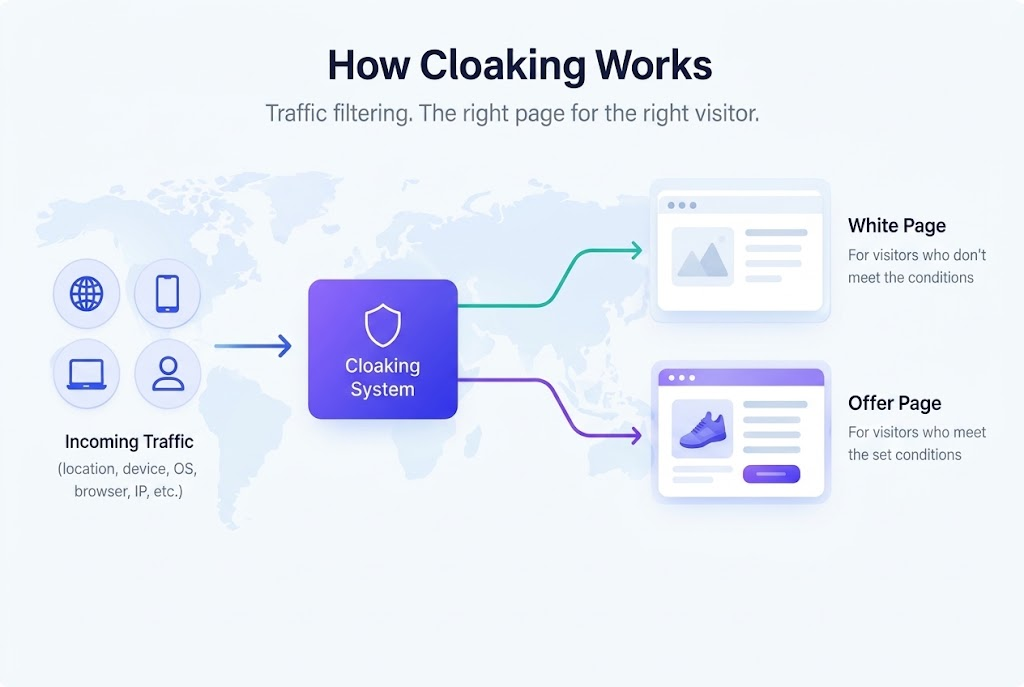
Cloaking is a technology that helps manage incoming traffic based on predefined conditions. It allows marketers to determine how visitors are routed by considering parameters such as geographic location, device, browser, and IP address.
In affiliate marketing, traffic filtering is used to separate visitors according to specific criteria. In this setup, a White Page is intended for bots, advertising system checks, and other non-target traffic, while an Offer Page contains the main promotional offer.
In this article, we will explain how cloaking works, explore its main components, and look at how proxies can help test websites and analyze differences between regions.
What Is Cloaking?
Cloaking is a traffic filtering method that uses information about an incoming request to determine how it should be processed. The system checks the request against predefined rules and selects the appropriate routing scenario.
Depending on the platform, the following parameters may be considered:
- Geographic location (GEO): The visitor's country or region.
- Device type: Desktop computer, tablet, or smartphone.
- Operating system and browser: The software used to access the website.
- IP address and network information: Available details about the visitor's connection.
- Referrer: Information about the source that brought the visitor to the website.
- Language: The language specified by the browser or included in the request.
The available parameters depend on the platform and its configuration.
For affiliate marketers, traffic filtering helps organize traffic flows, test routing scenarios, and investigate why visitors may experience different results when accessing a website.
White Pages and Offer Pages: The Main Components of Cloaking
Many traffic filtering setups use two types of pages: White Pages and Offer Pages. Each serves a different purpose.
What Is a White Page?
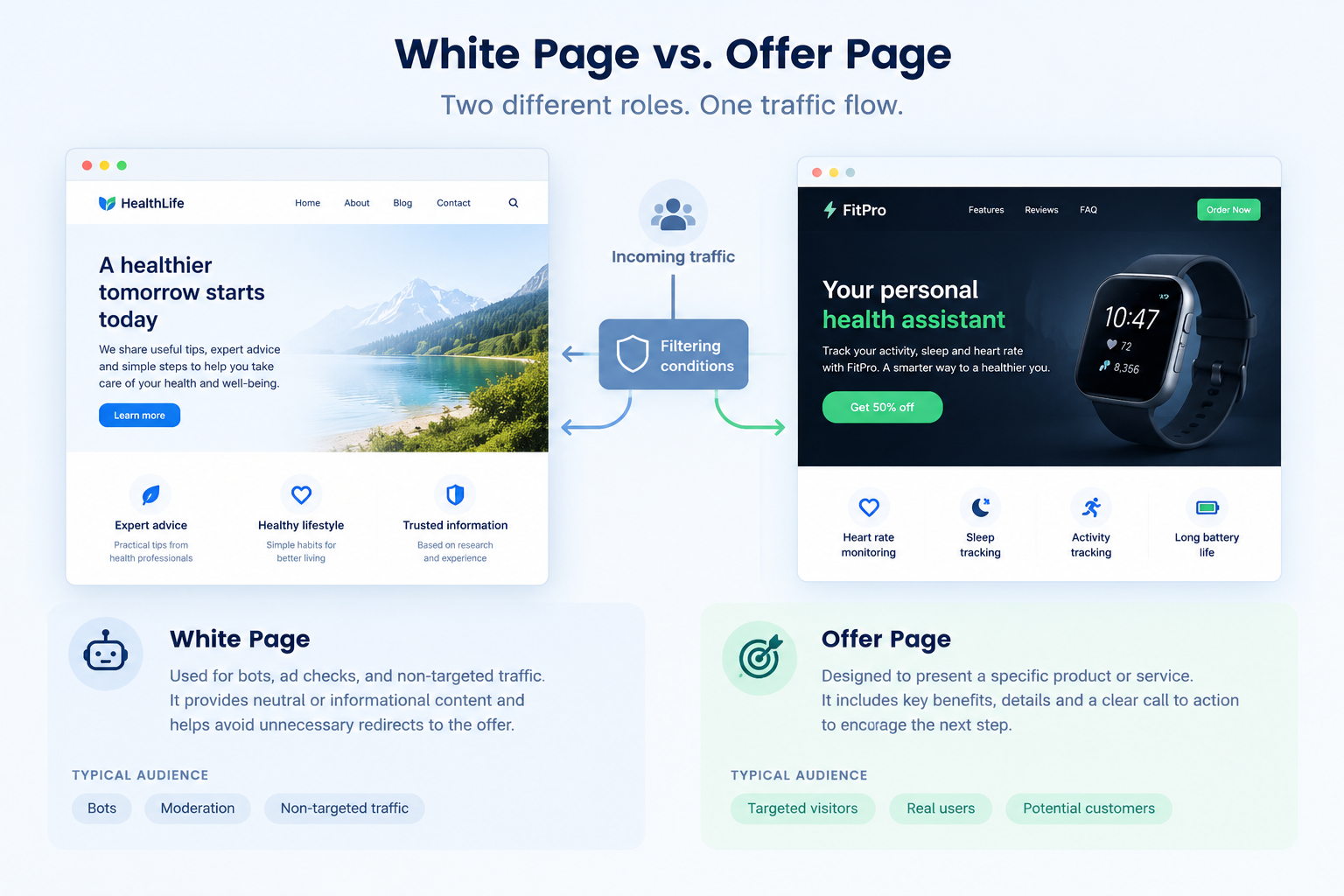
A White Page is an informational website intended to handle non-target traffic in cloaking setups. Depending on the filtering configuration, this traffic may include automated bots, advertising system review requests, and visitors who do not meet the specified criteria.
White Pages typically contain content related to a particular topic and may include descriptions, images, contact details, and other informational materials.
When preparing a White Page, it is important to focus on content quality, proper display across different devices, and working links. The page should be complete and understandable for its intended audience.
What Is an Offer Page?
An Offer Page is a landing page that presents the main promotional offer. It contains information about a product or service, its key benefits, and the action visitors are encouraged to take.
Depending on the campaign, it could be a product page, a registration page, or a landing page with a lead form.
The quality of an Offer Page affects more than conversion rates. Loading speed, mobile usability, clear information, and functional forms are also important for the user experience.
How Does Traffic Filtering Work?
The traffic filtering process typically consists of several stages.
1. An incoming request arrives. A user or automated system opens a link. The platform receives the available information about the request and the connection.
2. The system checks the configured conditions. Depending on the platform, it evaluates GEO, device, browser, IP address, and other parameters.
3. The routing result is determined. The system applies the configured rules and processes the request according to the selected scenario.
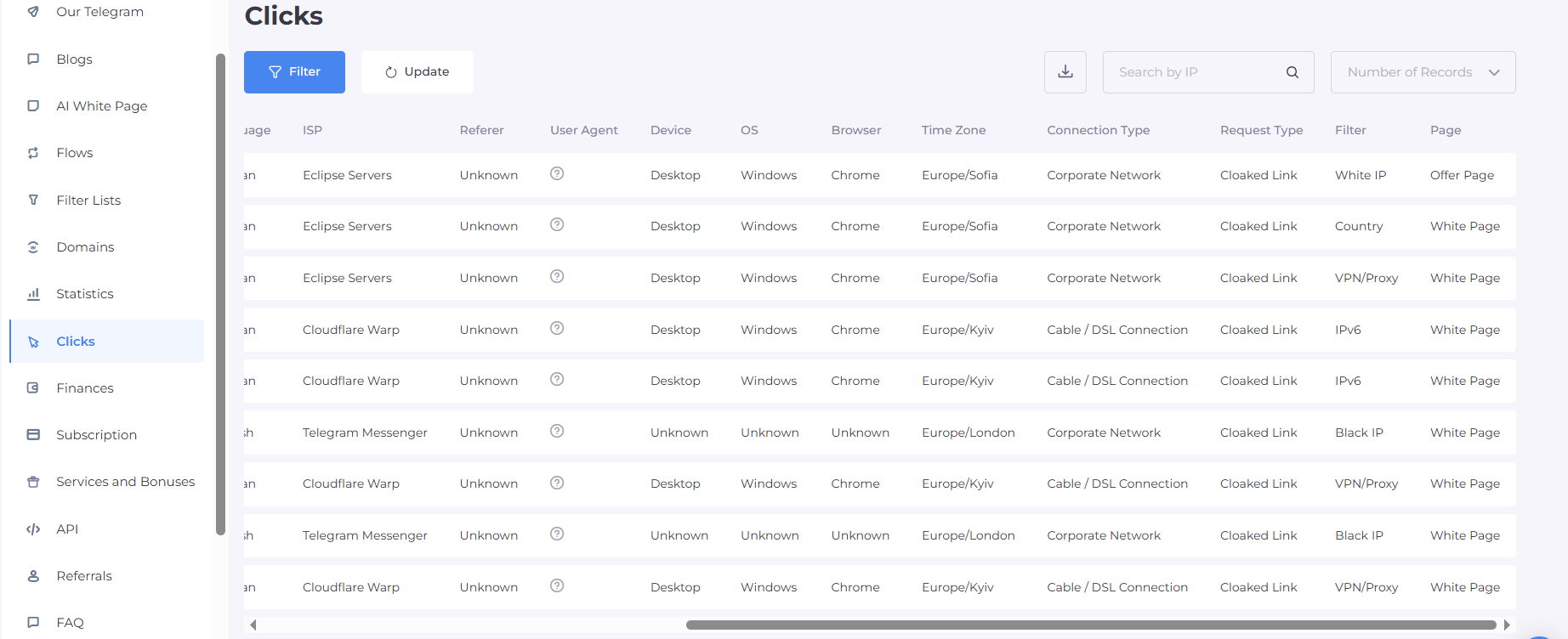
4. The result appears in the statistics. Click data helps marketers understand how incoming traffic was processed, which conditions were triggered, and which page the visitor reached.
The exact process depends on the platform and integration method.
For example, an affiliate marketer may need to check whether a website displays the correct language and currency for visitors from different countries. Filtering settings help investigate traffic routing, while website testing confirms that localized content works correctly.
It is also important to distinguish traffic filtering from a standard redirect. A redirect sends a visitor from one URL to another according to a particular rule. Cloaking platforms may support more complex combinations of conditions and destinations.
What Role Do Proxies Play in Cloaking?
Proxies and cloaking platforms solve different technical problems.
A proxy routes a network connection through an intermediary server. In a typical proxy configuration, the destination website sees the proxy's IP address instead of the user's original IP address. Depending on the proxy type and provider, connections may be available from different geographic locations.
Cloaking, on the other hand, evaluates incoming traffic against predefined conditions and manages its routing.
Proxies can therefore be useful for testing how a website behaves under different network conditions.
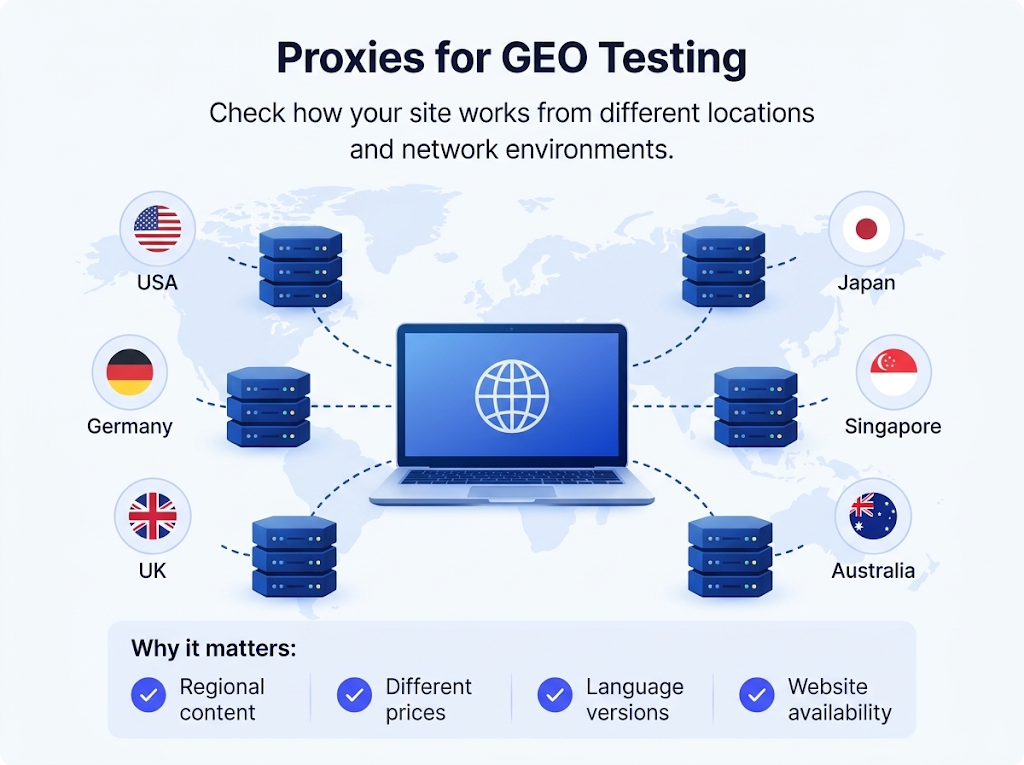
For example, a marketer may need to check whether a landing page displays the correct currency in Germany, whether a localized website loads properly in Japan, or whether a page is accessible from a particular region.
However, proxies do not guarantee that a test will fully reproduce the environment of a real local user. Browser settings, device characteristics, cookies, and other factors may also affect the results.
GEO Testing With Proxies
Proxy infrastructure can support several practical tasks:
- Regional content checks: Verify that the website displays the expected language, currency, prices, and localized information.
- Website availability tests: Check whether a page loads through different network connections.
- Troubleshooting: Compare results across different IP addresses and network environments.
- Market research: Explore publicly accessible websites and regional product pages while respecting the relevant websites' terms.
Services such as SwiftProxy can be considered for these tasks when their available locations and proxy types match the project's requirements. When choosing a solution, consider the target countries, testing frequency, and connection stability.
Test results should be interpreted carefully. An IP address alone does not guarantee that a website will identify a request as originating from a particular country or process it in the same way as a typical local user's request.
Why Are Statistics and Click Analysis Important?
Configuring traffic filtering is only one part of managing a website. Statistics help evaluate incoming traffic and identify configuration issues.
Depending on the platform, click data can help answer several questions:
- Which conditions affected the processing of a request?
- Which page did the visitor reach?
- Are there errors on particular devices or in specific browsers?
- Do results differ between geographic locations or network connections?
- Is the issue related to the platform's configuration or the website itself?
When troubleshooting, it is better to change one parameter at a time and repeat the test under comparable conditions. This makes it easier to identify which change affected the result.
Landing pages should also be tested separately. Even when a request is routed correctly, the destination page may load incorrectly, display incomplete content, or perform poorly on mobile devices.
For this reason, traffic filtering, proxy testing, and website statistics should be treated as complementary tools.
For example, Cloaking.House allows users to configure traffic flows, set filtering conditions, and analyze clicks through its dashboard. Combined with proxy-based testing, these tools can help marketers investigate website behavior systematically and identify technical issues more quickly.
Conclusion
Cloaking is a traffic filtering technology that processes incoming requests according to predefined conditions. White Pages and Offer Pages serve different purposes, while filtering rules determine how the system handles incoming traffic.
Proxies provide a different set of capabilities: they allow marketers to test websites through alternative network connections, check regional versions, and investigate technical issues.
Understanding the differences between these technologies makes it easier to choose the right tool for each task. A reliable workflow includes proper configuration, regular testing, traffic statistics, and landing page checks. It is also important to follow advertising platform requirements and ensure that the pages and traffic practices used comply with their policies.
Bonus for readers: Use code SWIFTPROXY to get 30% off all plans Cloaking.House
關於作者
 頂級住宅代理解決方案
 {{item.title}}

 60






